The alpha, twice a week
That was 8 min.
Get the best new moments in your inbox every Wednesday and Saturday. It's free.
Check your inbox
We sent a link to your address. Click it to finish signing up. Not there in a minute? Look in spam.
or
The Pragmatic Engineer · 8 min · Nov 18, 2026
Startups have less time to win and need more AI capital
 Harjot Gill
 says ambitious startups need to fund tokens, CI, and compute to move quickly as competitors copy ideas faster.
The episode’s best minutes
Full analysis- 20:18Software factories turn each release into a learning loop4 min
- 25:29Code review shifts from reading diffs to managing release risk6 min
- 55:17Startups have less time to win and need more AI capitalPro pick 8 min
- 5 more moments in the full episode
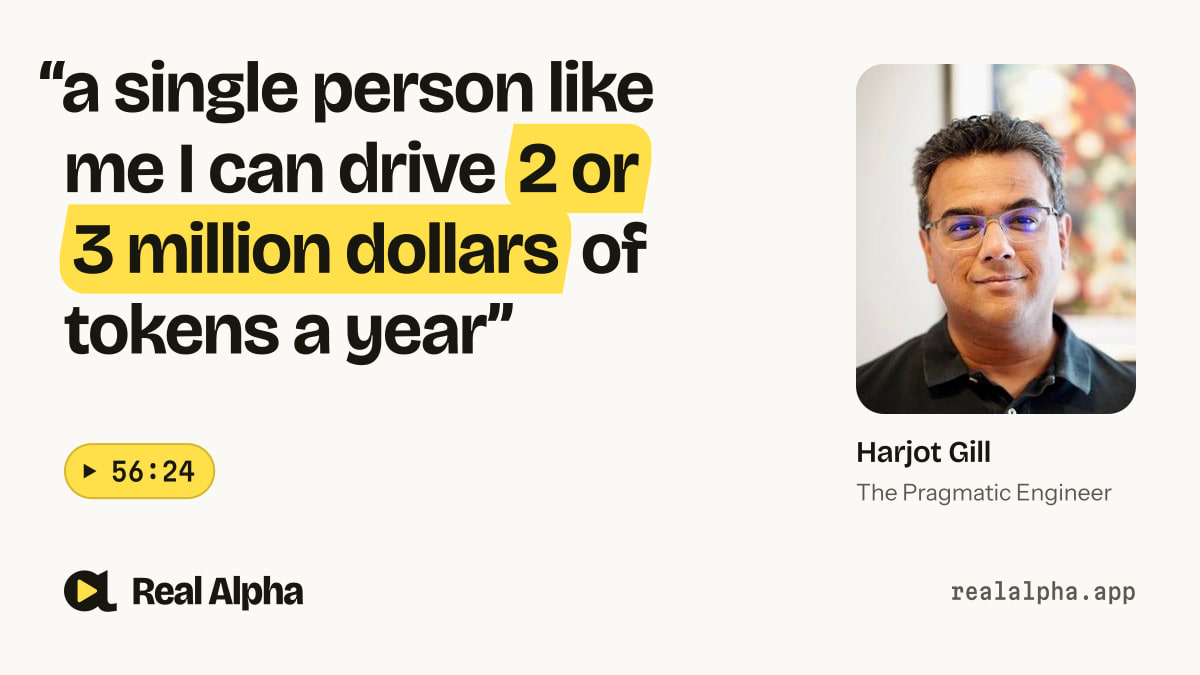
“a single person like me I can drive 2 or 3 million dollars of tokens a year”
 Harjot Gillat 56:24 · The Pragmatic Engineer
Takeaways Pro pick
- AI spending shifts startup costs from headcount to tokens and compute.
- A small team can direct millions of dollars in model usage.
- Gill says startups may have only weeks to establish mindshare.
One of Pro's picks, open to you here. Try Pro free for 7 days
One of Pro's picks. The rest of the summary and the 3 takeaways are in Real Alpha Pro; the video, the quote and the transcript stay free.
Read it with Pro, 7 days freeAbout this segment
Harjot Gill says ambitious startups need to fund tokens, CI, and compute to move quickly as competitors copy ideas faster. The shrinking window to win mindshare makes speed and investment strategic advantages.

Harjot Gill is founder and CEO of CodeRabbit.
Co-founded CodeRabbit, the AI code review company that became the most installed AI app on GitHub and GitLab.

Gergely Orosz, Host · Host, The Pragmatic Engineer
Spent four years at Uber heading mobile, web and backend teams; shipped part of its payments system.
From “Software factories and code reviews with Harjot Gill”, Nov 18, 2026. Watch the full episode
Answers “What will AI look like in the next few years?” See all 259 answers
Thanks. We'll look at and fix what's off.
Transcript
Transcribed by machine (Whisper) from the episode’s audio, so a word may be off here and there.
- 55:25
But let's talk about, I know X is not necessarily great for capturing the nuance, but you had an observation there. You said that you're seeing this trend. Is it startups spending a lot on software factories? I think that's going to be inevitable. There are multiple software businesses you can run. But if you're looking at hyper growth, VC funded startup in these competitive spaces, you would probably need more capital right now because now your bottlenecks have shifted.
- 55:50
Earlier, you needed to like pay mainly for the talent. So you'll get like ex-Netflix, ex-Google, ex-Facebook engineers. They themselves will be founders. They will hire from the same pool. Give them nice talk, some better, really good laptops. And that's it. Like it was all like the brain game. Like the IQ was the people. But you needed to pay for them, right? in Silicon Valley like the base salary would have been 300k plus and stock and all that we're talking a million plus in terms of running a business like in early stages I'm talking about Seed, Series A even before you hire sales like a lot of it is like the team like the dev team right now what we're seeing is like the IQs on the tap like the tokens like in fact even the smartest people need to be driving tokens and a single person like me
- 56:33
I can drive 2 or 3 million dollars of tokens a year like blended models not just always using the best model. And perhaps it should even be more once we have the factory concept taking off. So my point here was like the bottlenecks are now shifting in how much you can like drive these tokens, number of agents, the CI, and the other infrastructure. Humans can make a lot more decisions in a day to drive.
- 56:55
millions of dollars spent now you need like it's almost like marketing team if you remember like i mean 10 people can drive 100 million dollars of spend same thing we're going to see with engineers now a small team can drive 150 million dollars of spend of 30 million in that company right and that's how you stay competitive because now you're going to compete with everyone who's writing software in an inefficient way not in an economically viable way if you're going to mass produce you're going to see like companies composite startups now pinup, which will be a brand, but with like many products, they're going to mass produce, just like how you do in a factory. I feel you're still a huge exception in everyone I talk to, including inside of NVIDIA, there's a monthly budget of $10,000, and you can go above
- 57:38
that, but most devs I talk to don't go about that. So I'll just play a little bit of devil's advocate with you. So you're spending a lot on AI, like way more than most. You're also a founder, So you have a really good idea of where the business is and what value is adding. What value do you think you and people spending this much is adding in terms of like, does this mean that you're clear you're moving faster?
- 58:01
But what is this resulting in? Are you getting more customers? Are customers spending more? Are you just, I don't know, getting more free user? You see what I mean? Because you're in a great position. Usually for an engineer, it will be maybe harder to connect. But you can clearly connect like what either you're seeing right now or what you're expecting to see as a result of this investment and spend.
- 58:19
Yeah, all of the above. Like one of the things you're going to see is like this point SaaS solutions, the days are over. Like now you're going to see really like companies doing a lot more software, right? And this is adding value in all parts of our stack. First of all, like, I mean, as I mentioned, like earlier, I would like rely on vendors for some of the things. Now you can just build in-house much cheaper. There are many tools like CI, we moved in-house, we moved vector databases in-house, a bunch of this stuff. Those are very clear areas. You can like go and build those differentiators quickly, right? And the other thing is even for the market, Like the people have infinite cap appetite for software and these solutions, right?
- 58:52
So there are companies which are going to like, for example, we are in the SDLC space. So all of our customers want to go and ship faster. Code review is not the only bottleneck they're running. Now they're on the market looking for the next thing, which is how do I solve my CI bottleneck? How do I do this? Like, so we're in that business. So we have to, first of all, go and learn quickly where the bottlenecks are going to be.
- 59:09
I mean, we're getting arrows in the back, front, whatever, right? But what that also puts us uniquely in a position is that we can offer these products faster to the customers. but even everyone wants to shift faster like that's the thing with with the with the vc funded companies right so that the the kind of like the range of tech you want to go quickly build that's your usually or more like i mean you have like a few months now the problem with the with the software right now is like even like so a lot of these startups they used to have a moat of a few months before they got copied but now they're getting copied within days and weeks so you can't just go to the market in this competitive market with a idea which is shallow like you you you get like even um and tropics gonna copy you in like two weeks right now oh so i see where
- 59:51
you're coming from but i still want to push back on the fact that my sense is okay you're spending this crazy amount of money you know you personally are spending or you're on track to spend like two million per year or let's just talk about per month like you're you're you and the team maybe are spending 500k in this month maybe next month will be 600 maybe then 700 but in return what you're getting is you know you you are in the dev tool space with ai code review you're now realizing oh dang we also have this bottleneck with ci maybe we'll do something with ci or help our customers do something with ci and we do this because we're now so fast we're seeing where they're going to be in like six months or 12 months so now we're now going to start this product we'll spend more then we realize maybe it'll be a feature flag and we'll be able to roll
- 1:00:32
out and so on and by doing this you're almost like doing r&d for your business and you're also building your products and the bet is that you're you'll be expanding your market you'll sell more to customers but what i'm wondering is are you not a little bit unique that this might be true for anyone who's in a dev tools market but for some some company in any other market as well like so basically now you're moving in a compressed time frame Let's say it took you like a while to go to market and do a PMF, six, nine months if you're a YC company, right? Now you can like go there and try that idea quickly. And if it's a shallow idea, now the risk is you can get copied. So basically, we'll probably have to like do more, but you are now moving at a compressed timeframe. The earlier the bottlenecks were in scaling the team, right? So I needed to have the talent. You will like get all this VC money, scale the team. I don't need to scale the team at the same level, right?
- 1:01:21
I mean, maybe the sales still need to scale because they have to do the meetings, but product, marketing, engineering, you can now do few people burning a lot more tokens, right? And this token spend right now, if you, and it's quality tokens, like you can get cheap tokens, it will take you longer to get there. If you have the quality tokens, your price per task will be high, but you get there faster at a high quality, right?
- 1:01:42
Okay, so what I'm hearing is what you're actually saying with this tweet, which wasn't that as nuances. If you are in the VC game, meaning you're raising venture capital because you want to build a billion-dollar company, which means you actually want to win your market. Like inside of DevTools, you might have a niche. May that be like AI code review or AISRE or CICD, something like that. If you're starting today, you will probably need to raise a larger amount because you need to win this quickly.
- 1:02:12
The game will be over pretty quickly and you want to get meaningful traction before the big guys and Tropic OpenAI can maybe copy you. Oh, and as an added benefit, you can have a small team to start with and you don't need to worry too much about hiring. But by the time you would hire anyway, you will want to build some solution and get customers and so on. So like everything is just compressed and you can pay more.
- 1:02:33
Right. I mean, the attention is compressed. Like if you don't get the mind share after building your MVP in like maybe one or two months, that's the window you have now. before someone just gobbles up that idea and runs with it. Okay, so that's pretty brutal. Yeah, I mean, that's the situation right now we're dealing with. Like the window of opportunity to get the mindshed has become shorter.