The alpha, twice a week
That was 5 min.
Get the best new moments in your inbox every Wednesday and Saturday. It's free.
Check your inbox
We sent a link to your address. Click it to finish signing up. Not there in a minute? Look in spam.
or
How I Invest · 5 min · Nov 23, 2026
Stock-bond diversification is less reliable than it looks
David Stubbs links positive stock-bond correlations to geopolitical shocks and rate normalization, not just COVID.
The episode’s best minutes
Full analysis- 8:11Stock-bond diversification is less reliable than it looks5 min
- 20:50A portfolio may land at 20–35% alternatives after planning4 min
- 36:10Evergreen funds need assets with steady deal flow and liquidity4 min
- 4 more moments in the full episode
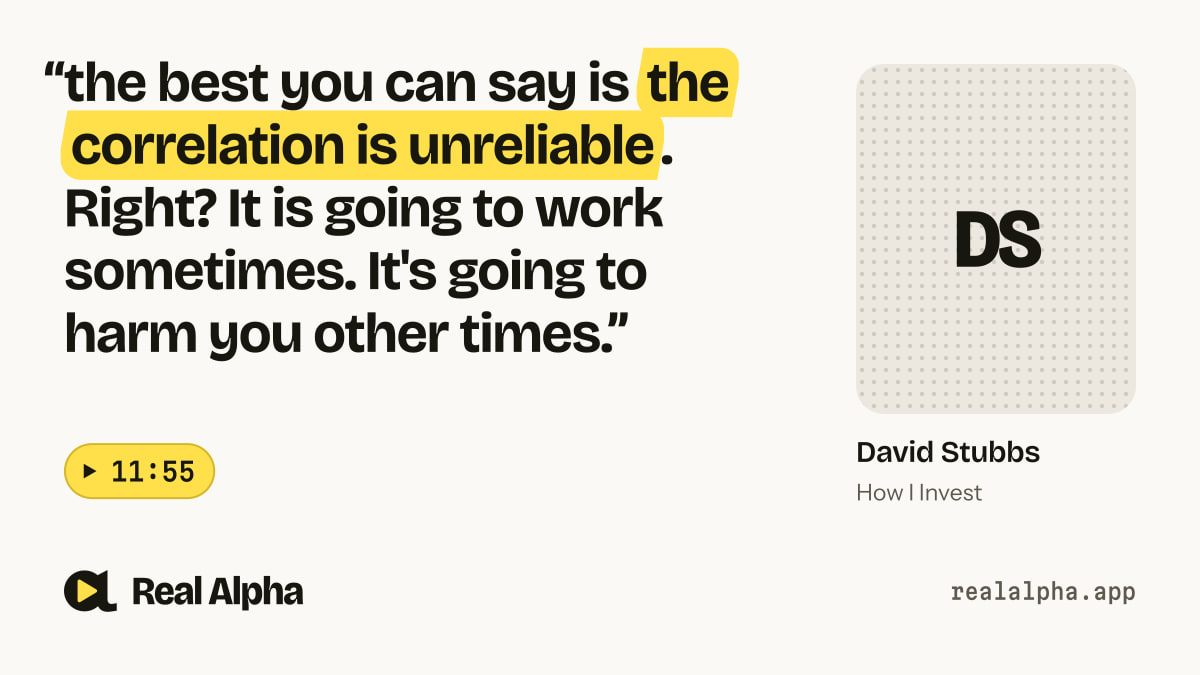
“the best you can say is the correlation is unreliable. Right? It is going to work sometimes. It's going to harm you other times.”
Takeaways
- Geopolitical volatility can push stocks and bonds down together.
- Rising rates have challenged bonds as a portfolio stabilizer.
- Stubbs calls the future correlation unreliable, not permanently broken.
About this segment
David Stubbs links positive stock-bond correlations to geopolitical shocks and rate normalization, not just COVID. Bonds may regain a stabilizing role, but investors cannot yet rely on them alone.
David Stubbs is Chief Investment Strategist at AlphaCore.

David Weisburd, Host
From “David Stubbs on AI's Portfolio Risk, the Rise of Private Markets, and the Psychology of Wealth”, Nov 23, 2026. Watch the full episode
Thanks. We'll look at and fix what's off.
Transcript
From the transcript How I Invest publishes with the episode.
- 8:24
Because of COVID. But you also are implying that that has persisted in a post COVID world. Yeah. Why do you think that is? Oh, well, 2022 was the clearest and and most, you know, durable, example. Right? You had a multi month decline in the equity market, the same time as a multi month increase in in bond yields. And the supply constraints that are unique at the time were a key part of that coming out of COVID Russia, Ukraine.
- 8:48
Absolutely, you know, key part of it. But those are just two examples of a persistent set of trends. One is a world of of greater shocks. We're in a in a world of tense geopolitics, of a geopolitical recession, of of great power conflict at the at the margins, and, you know, and a lot of discontent amongst, you know, the populations of advanced democracies and therefore causing very significant changes at the polls.
- 9:11
So the election of of Donald Trump in 2016, Brexit, for example, there. And then, of course, a lot of armed conflict from Russia, Ukraine, and obviously the Iran war as well. So... And, of course, that COVID itself, which I would argue, yes, was a health care issue, but was also a sign of a dysfunctional international order unable to deal with the pandemic. So we're in a world... We're not just being unlucky.
- 9:31
This is a structural increase in geopolitical volatility. Second, we were coming from a period of time of ultra low interest rates. And to a certain extent, we've just had to get back to normal. You could argue now that a a ten year yield, and we were speaking at a time when it's in the high fours having been a little bit over five, that's... That was pretty normal pre pre the financial crisis in two thousand seven and eight.
- 9:51
You could argue that the rise we've seen across US interest rates really starting, you know, from the depths of the lows in COVID when the Fed flat interest rates has been a a... Basically a half decade, call it, of normalization of of bond yields. In that time, bond yields up means price down. Yeah. That was a very challenging environment for fixed income. And often, when it happened too quickly and you've got a surge in bond yields, disturbed equities, and there was your your your positive correlation and 2022 being the best example.
- 10:18
What's interesting now is we we know this has been the case. You look back the last five years, that's that's just statistically what's happened, and portfolios that incorporated, you know, some other stabilizers, call it certain, you know, hedge funds or certain private markets, did display good... Greater resilience, especially in 2022. Anyone can look up that data. The question is, how high do the bond yields have to get before maybe the the character of fixed income changes again and it becomes more attractive already today.
- 10:45
Right? You get close to 5% of the tenure. It's much better than the 2% or whatever you're getting at the lows. And you see now short term fixed income with the Fed hiking. You know, that's what... It's what's gonna be well above, you know, where where most measures of inflation are. You know? At least that's the expectation next couple of years. So fixed income has become at the margin more attractive.
- 11:04
The question mark is, does it rally when the equities have a bad day? There's some evidence to when the ten year got up up above five, there were a couple of big down days to the market, the equity market, and bond yields did fall. So it started to play its traditional role again. I think it's too early to say that you can rely on duration, which is the technical term for it, for, obviously, bonds change to interest rates, to bail out your equity portfolio.
- 11:27
I don't think we we would ever advocate for a world where alternatives would have no role in a portfolio, but we might get to a place where fixed income can play a bigger role to gain in controlling risk. And I think it's a little too early to say that we're there yet. Said another way. When people talk about the correlation between assets, they're talking about historical. Sure. They could prognosticate, but they don't know about the future correlation.
- 11:48
They could only speak of it in this It would be very helpful to know the future correlation, David. Very, very helpful. That would help me a lot, if I if I knew the future co... Correlation. And there was a lot of hyperbole in the last five years about fixed income. People say, oh, the bond market's broken and sixtyforty is done forever. And I used to say when I was at JP Morgan, Blackstone, and now I say it at AlphaCore is the best you can say is the correlation is unreliable.
- 12:10
Right? It is going to work sometimes. It's going to harm you other times. And I think that if you have a fiduciary responsibility, that's not good enough. You have to figure out other ways to smooth volatility, to bring the expected outcome of a portfolio closer to your clients' acceptable level of risk, While doing everything else that they want, give them liquidity, generate income, growth, whatever is their priority.
- 12:35
And I say to people who don't invest in private markets or broader alternatives, you're trying to do a series of very difficult things with one hand tied behind your back. I mean, why would you? We'd like to put all asset classes on a level playing field and construct a portfolio that, you know, helps meet meets clients' goals.