The alpha, twice a week
That was 4 min.
Get the best new moments in your inbox every Wednesday and Saturday. It's free.
Check your inbox
We sent a link to your address. Click it to finish signing up. Not there in a minute? Look in spam.
or
The Mishal Husain Show · 4 min · Nov 20, 2026
Tariffs are a narrow measure of globalization
 Parag Khanna
 argues that globalization includes capital, people, ideas and data—not just goods.
The episode’s best minutes
Full analysis- 8:38Tariffs are a narrow measure of globalization4 min
- 12:16Affordable housing connects protests across countries3 min
- 20:20Economic stagnation helps explain the AfD’s appealPro pick 4 min
- 3 more moments in the full episode
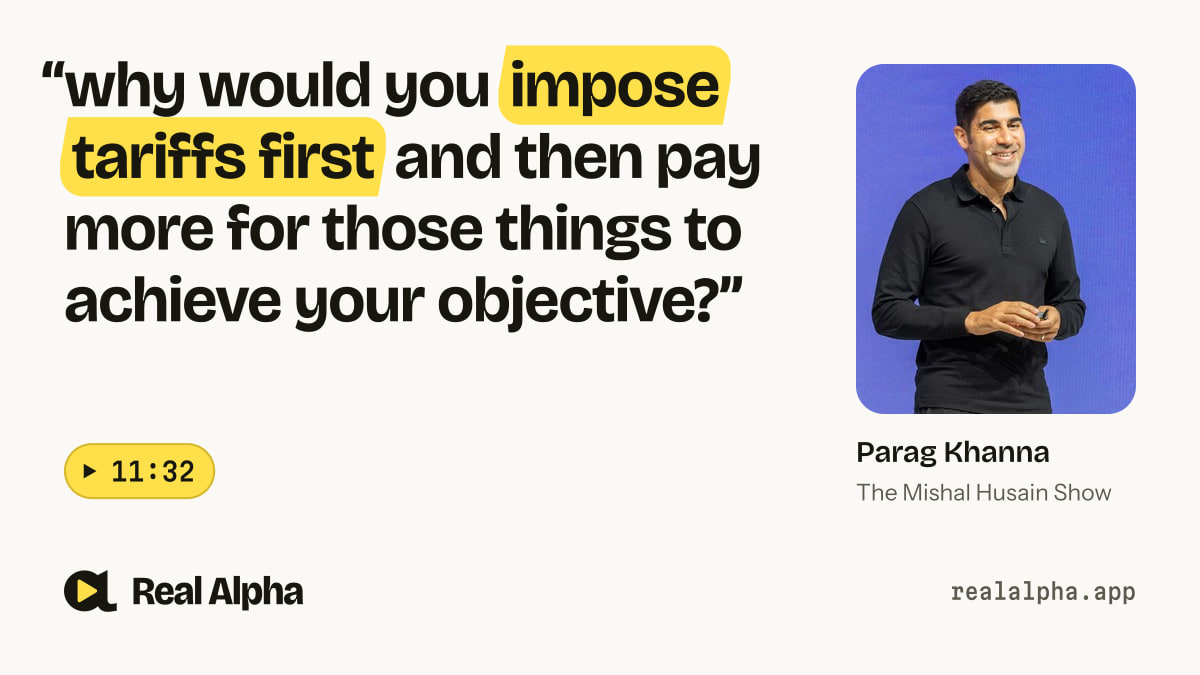
“why would you impose tariffs first and then pay more for those things to achieve your objective?”
 Parag Khannaat 11:32 · The Mishal Husain Show
Takeaways
- Capital flows matter more than goods trade, he argues.
- Countries can redirect exports when US trade routes close.
- Import key inputs before tariffing them to support new industry.
About this segment
Parag Khanna argues that globalization includes capital, people, ideas and data—not just goods. He also explains why tariffs can undermine a country’s effort to rebuild its manufacturing capacity.

Parag Khanna is a geostrategist and author.
Founded AlphaGeo, an AI-powered geospatial analytics platform, and authored seven books on global change and geopolitics.

Mishal Husain, Host · Host, The Mishal Husain Show
From “Globalization, Trade and Trump: Geostrategist Parag Khanna | The Mishal Husain Show”, Nov 20, 2026. Watch the full episode
Thanks. We'll look at and fix what's off.
Transcript
From the transcript The Mishal Husain Show publishes with the episode.
- 8:48
They've been quite wrong. Globalization then in the broadest form of, I think you're saying international trade, right? Countries are always going to trade with each other.
- 8:55
Globalization in its broadest form cannot be reduced to trade. Trade is literally just one measurement of globalization. The flows of global capital and investment, quite frankly, matter a lot more than trade. We have an incredibly reductionist discourse about globalization, which I say globalization, you say trade. That's a very narrow understanding. Globalization, first and foremost, again, if you take a historical view, begins with us and each step we take or took out of Africa, right? Globalization of people, globalization of resources through trade, globalization of capital, globalization of ideas, globalization of data. All of those are dimensions of globalization.
- 9:33
They are co-equal with each other intellectually. Quantitatively, by the way, the movement of capital matters a lot more than the movement of goods, and that globalization is not at all dead.
- 9:43
Yeah, that's interesting. So I guess what President Trump is doing most visibly is really about imports of goods in the most... That's actually what tariffs are targeting. And you would say that is a tiny part of the overall global economy or certainly of globalization as a whole?
- 10:02
I think there's two things. U.S.-China trade, it is not the axis or hinge on which all of global trade depends. However, all of the countries he's targeted, a study of many of them, shows that they are able to redirect the exports that are no longer destined for the United States to other trade partners within a couple of years and still maintain their trade growth. There is a global trading system and there is a global resilience to the movement of those goods. There is an overcapacity issue resulting from China's incredible output that is part of the narrative and that is having an impact on who is able to competitively produce what. But that's different from saying, that protectionism is succeeding in derailing trade. That is not happening. Furthermore, I would say you can sympathize with the notion that
- 10:52
a country has seen labor displacement due to wage arbitrage and, you know, imbalanced approaches to competitive approaches to how trade has been manipulated through currency regimes and so forth. That may be valid. And then you can say, wouldn't it be better given that we've been exposed to by phenomena like COVID and being dependent on supply chains that were so brittle to make more things at home. And then there's the critical national security element. So you can sympathize with any country that says, wouldn't it be better if we did all of these things at home? But if you do agree with that, and there's no reason not to agree with that, you would sequence your policies correctly.
- 11:29
And this is very important because if you depend on copper imports and on machine tools and all of these other things to build the factories that you need to re-industrialize, why would you impose tariffs first and then pay more for those things to achieve your objective? You would sequence things the exact opposite way.
- 11:50
As in you would change what you are making. You'd have to make sure that what you're manufacturing doesn't require those goods from somewhere else in the world.
- 11:56
You would import all of those things while they're cheap, build up your capacity, and then maybe tariff them to support your own industry. Again, I'm not advocating this policy. I'm saying that if you're going to do something, do it right.