The alpha, twice a week
That was 8 min.
Get the best new moments in your inbox every Wednesday and Saturday. It's free.
Check your inbox
We sent a link to your address. Click it to finish signing up. Not there in a minute? Look in spam.
or
AI & I · 8 min · Nov 11, 2026
Teams find different insights because they own different problems
 Dan Shipper
 shows how colleagues found distinct insights in the same customer survey, then explains why AI can generate many answers but struggles to rank them.
The episode’s best minutes
Full analysis- 4:53One person can now do the work of five specialists4 min
- 10:11Teams find different insights because they own different problems8 min
- 17:53Human perspective is the scarce resource as AI improves7 min
- One more moment in the full episode
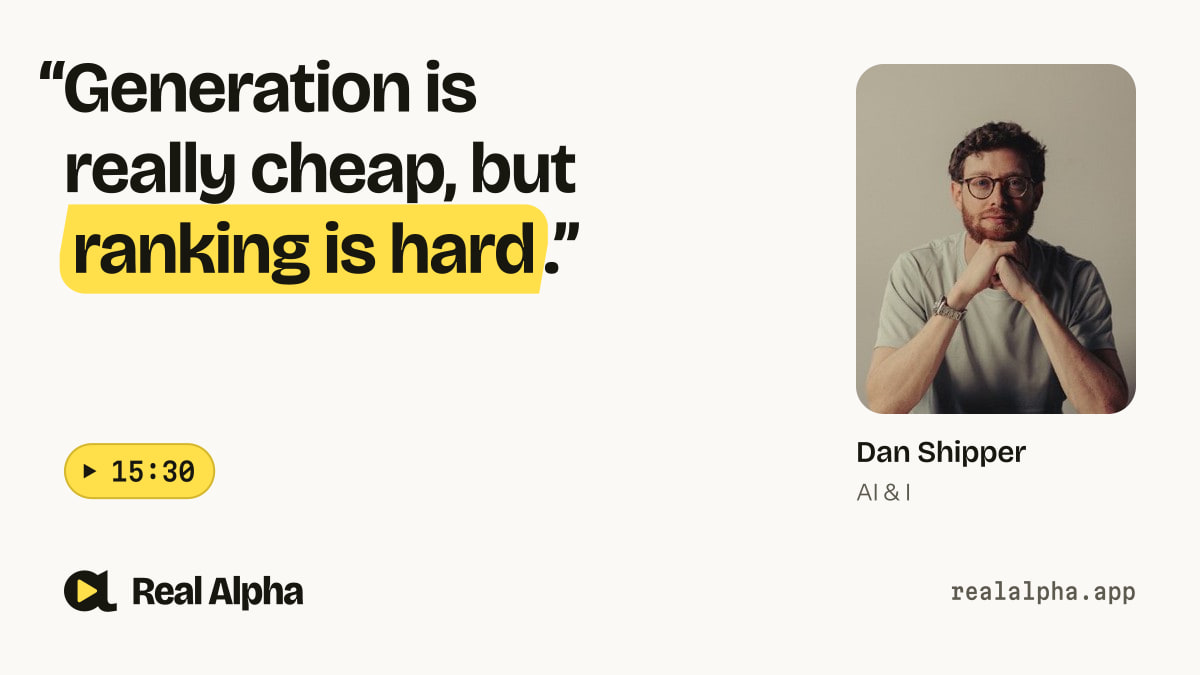
“Generation is really cheap, but ranking is hard.”
 Dan Shipperat 15:30 · AI & I
Takeaways
- The same data and AI can yield different useful insights.
- A default model response may be true but not distinctive.
- Generation is cheap; ranking and choosing are harder.
About this segment
Dan Shipper shows how colleagues found distinct insights in the same customer survey, then explains why AI can generate many answers but struggles to rank them. Perspective and responsibility help people choose what matters.

Dan Shipper, Host
Dan Shipper is cofounder and CEO of Every.
Sold his first startup, Firefly, to Pegasystems; writes Every's Chain of Thought.
From “A New Vision for Human Work After Automation”, Nov 11, 2026. Watch the full episode
Thanks. We'll look at and fix what's off.
Transcript
From the transcript AI & I publishes with the episode.
- 10:13
If we answer this question, it's going to tell us a lot about this larger question that we're trying to answer. And I want to zoom in even more on this particular customer survey that I ran. So when we ran this customer survey, this Q4 customer survey. I gave it to the team. So everybody had access to the data and to do their own analysis. And what I got out of it was, there's actually a really cool opportunity to sell every for teams.
- 10:38
and I made my whole custom CRM and I started emailing people. But what Yash got out of it, and Yash is our go-to-market engineer, what Yash got out of it, he cares, he's a monomaniac about growth, about growing paid subs. And what he got out of it was a lot of first-time subscribers to every churn after the first month because we send too much email. And what Douglas, who is our head of marketing and put together this conference, what he got out of it was, actually a lot of our readers feel lonely.
- 11:14
There's this interesting psychographic of people in this room where we all feel like we love AI, we're using it for all these things, but everyone else at our work and in our lives kind of looks at us like we're crazy. A lot of people in this room and a lot of people on our list come to us because we are the only place where we are like, yeah, you can do great stuff with this. That is what Douglas found.
- 11:40
And Jack, who is a senior editor, he made a Claymation family feud game show explaining the results. It's time for Survey Showdown. And here's your host, Dan Shipper. Thank you. Thank you. Tonight, the vibe checks take on the context windows. Okay, the vibe check... So... Extremely informative, but also very fun. And I want to reiterate, they used AI to do all this. We're using the same survey, we're using the same cloud, but different people on the team found very, very different and important things that they emphasize.
- 12:24
And that's kind of interesting because if you look at what Claude says, because anyone can hand Claude this survey, what Claude says about the survey with just a default prompt, which is just like what do you see in the data, it says the writing is the business, the bundle is what makes people stick, the risk is focused, the risk is focused and too much volume. And all of this is actually, it's true.
- 12:44
These are real insights. But everybody has access to this now, and so it's cheap. And so not a single person on the team just submitted a response to this survey that looked like the default response. They all did something very different. And I think that's really, really interesting to pull on. And another really interesting part of this is for each of these people on the team, they did all of this analysis while getting prepared for this event.
- 13:20
And everybody knows if you've ever put together a conference, it is like an all-consuming thing. And still, Yash and Douglas, for example, who are intimately involved in every part of this, did their own analysis and came up with interesting things. And Yash, for example... He did the analysis and he wrote a PR to make the change to move the number that he wanted to move. And while he was doing that, he was also helping build the live stream experience for this event, which is crazy.
- 13:50
If you have not seen this, we live streamed the entire thing with this custom video player that thousands and thousands of people were watching all day. It's really amazing and he did that. I think he had some help but he did a lot of that and he did it while doing this analysis that took him to do. I know what you may be thinking is, well, couldn't I just have prompted Claude for what Yash and Douglas and Jack found?
- 14:20
And I think that's a really interesting question. And the answer is yes. We've actually experimented with this. So Mike Taylor, who's our head of evals, tried to figure out if he could predict what I would say in Slack. And the answer is yes, he can predict what I would say in Slack. But there's an interesting caveat, which is he can only do it... He can do it 93% of the time, but there's an interesting caveat, which is he can only do it if Claude can give 400 answers for each question.
- 14:54
So, Claude knows when it's trying to predict something in Slack, if Claude can give 400 answers at the same time, one of the things I'm going to say is in there. But it can't rank them. If you ask Claude to rank them, the thing that I say is only in the top 10%, like 60% of the time. So, it's kind of a coin flip. That's really interesting because it means we're getting into this world where, yeah, I could, you know, Claude can predict what I would do or I could get the output that Yash got or Jack got or Douglas got.
- 15:32
Generation is really cheap, but ranking is hard. I actually wouldn't be able to find it in all of the noise that I'd have to sort through in order to get the thing that they would get. Okay. And that should tell you something really important about why teams are valuable in AI and ultimately why humans are valuable in AI. If you're on a team, and you're a human, and all of us are humans. You have a responsibility for a particular area of the world that helps you narrow down what you look for, like how you prompt the model.
- 16:08
And then you have your own perspective. You have a perspective that determines what you pick out of that world and call important, and call important enough to take responsibility for or take action on. And, I think if you want to look at it this way, for all of us who analyzed this survey last week, there were millions and millions of different paths available in the data, millions and millions of different insights we could have pulled out.
- 16:41
And our responsibilities, the things that we are responsible for in the business, helped to narrow down where we look or where they looked. And our perspective lights up a few of those. It helps us to rank those things. And then you pick one and you take it forward. And you've gone from this, you know, millions and millions of latent possibilities to one thing that you're the only one who would rank that because it's you.
- 17:12
It's the thing that lights up for you. And if you zoom out, you know, we just went through one person doing that. A team allows you to explore a much, much larger space of possibilities where each person has a perspective that allows them to rank and filter the parts of the world that they care about based on their responsibility and their perspective. And that's much more powerful than whatever the default answer I would get from a default prompt.
- 17:41
And that's why it's really valuable to have Yash or Douglas or Jack or anybody else on the team accessing the survey data and pulling the insights out rather than just being like, what would Yash think of this?