The alpha, twice a week
That was 4 min.
Get the best new moments in your inbox every Wednesday and Saturday. It's free.
Check your inbox
We sent a link to your address. Click it to finish signing up. Not there in a minute? Look in spam.
or
In Good Company with Nicolai Tangen · 4 min · Sep 16, 2026
Tesla nearly went bankrupt by automating too early
 Jon McNeill
 recounts how Tesla’s digitally designed Model 3 line failed in the real factory, forcing a return to manual production.
The episode’s best minutes
Full analysis- 1:22Tesla cut online car orders from 300,000 configurations to twoPro pick 5 min
- 10:25Speed reveals broken processes before it improves themPro pick 6 min
- 15:47Tesla nearly went bankrupt by automating too early4 min
- 4 more moments in the full episode
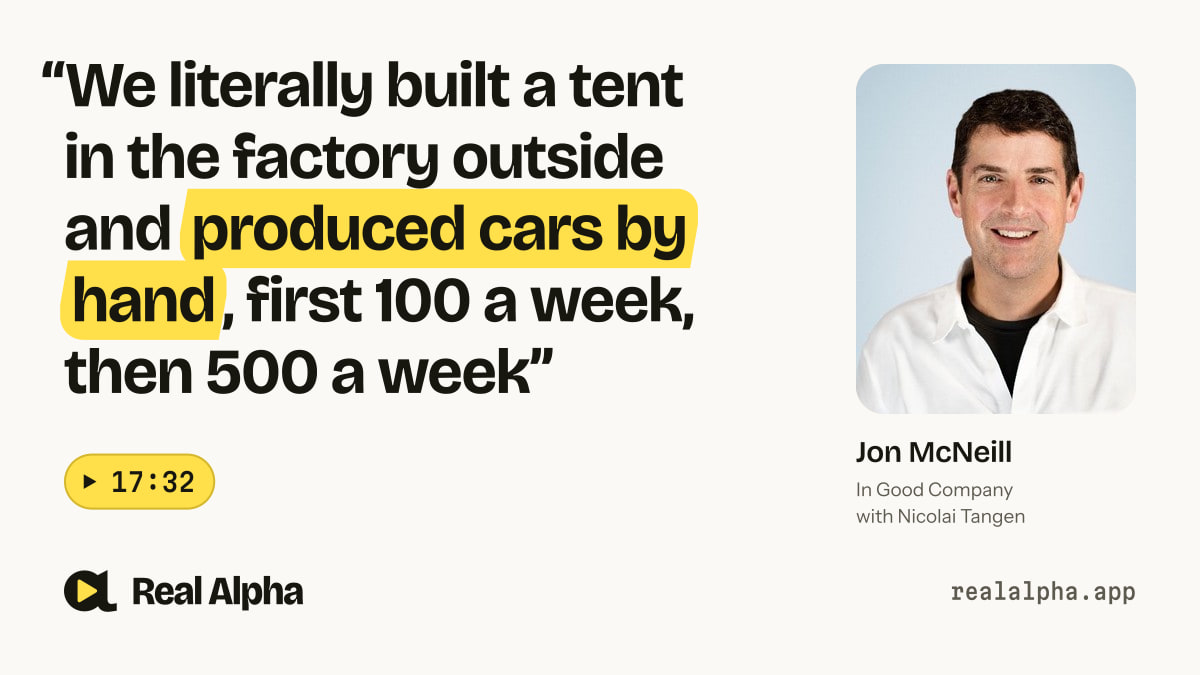
“We literally built a tent in the factory outside and produced cars by hand, first 100 a week, then 500 a week”
 Jon McNeillat 17:32 · In Good Company with Nicolai Tangen
Takeaways
- Tesla’s automated line had problems that digital design missed.
- Manual production helped restore cash flow while the process improved.
- Apply AI to key business levers after simplifying the process.
About this segment
Jon McNeill recounts how Tesla’s digitally designed Model 3 line failed in the real factory, forcing a return to manual production. His lesson: perfect the process before adding automation or AI.

Jon McNeill is CEO and co-founder of DVx Ventures; author.
Founded and scaled six companies, then grew Tesla revenue from $2B to $20B as president.

Nicolai Tangen, Host · CEO, Norges Bank Investment Management
From “Jon McNeill: The Algorithm Behind Tesla and SpaceX | Podcast | In Good Company”, Sep 16, 2026. Watch the full episode
Thanks. We'll look at and fix what's off.
Transcript
Transcribed by machine (Whisper) from the episode’s audio, so a word may be off here and there.
- 15:52
one way or the other and we were going to exceed it if we could. Last step, automate. This is last because automation is like a concrete that you pour over a process. And once you do, to remove it takes a jackhammer. So you got to be very careful when you pour that automation in. And a lot of these steps of the algorithm we learned by making mistakes and doing postmortems and say, how would we avoid this?
- 16:20
And we famously made a big mistake with the introduction of Model 3. We were talking about production hell, but production hell was largely of our own making. we had designed the most automated manufacturing line in the history of automotive manufacturing and we designed it entirely digitally. And we designed the machines digitally and laid out the factory digitally and put all the automation in place before a single brick was laid in the factory. Then we went to install the machines on the factory floor and I remember walking the floor with Elon. And I looked at two machines and I literally out loud said, oh God. And he said, what's the matter? What are you talking about? What's your problem? I said, look at these machines. They have to be calibrated every hour. And that means that humans have to get in there
- 17:10
with tools and the machines are six inches apart. We've designed this digitally. We didn't design it in the real world. And now we're going to have to take this whole thing apart. And that was one of many examples of what went wrong on that line. That line never went into production as a result. We almost went bankrupt because we didn't have the cash flow that we had predicted coming off of Model 3. And the only way we saved ourselves was to go back to the manual process. We literally built a tent in the factory outside and produced cars by hand, first 100 a week, then 500 a week, et cetera, until we could actually build an automated line that reflected reality.
- 17:51
When we looked back on that and said, look, we almost killed the company. What would we do differently? We said, automate last. You've got to perfect the process before you automate, otherwise you just might bury yourself. And in that case, we almost did. What should be automated and what should be kept manual? I think the process, any process that you're experimenting with, simplifying, et cetera, should be manual first. Famously, like the founders of DoorDash, five computer science graduates or undergrads at Stanford started DoorDash not with automation, but they started it with PDFs of menus and a telephone number at the bottom of the screen where you could order food. And they literally went out and picked up the orders, paid for the orders, and started to plot the workflow and removed all the dumb requirements they could. And they automated last.
- 18:41
And John, you'd be pleased to hear that we had the DoorDash founder on the podcast. Oh, fantastic. He talked about it. Yeah. And so they teach this to undergraduate at Stanford. Go manual before you go automation, because it's going to teach you everything you need to know about the business. And that's the key, is knowing when to automate a process is when you've got that process perfected as best you can.
- 19:04
And you've added speed, and now you're ready to add the power of automation to speed it up even further. So when you see people across the world now adding kind of AI automation on top of a lot of old cumbersome processes, what are your thoughts? My thoughts is this is just speeding up disaster because you've got these old cumbersome processes that you're now speeding up and adding expense to versus really being thoughtful about where you apply AI and perfecting your process first. It doesn't take that long. It doesn't take that much work and then adding the power of AI on top of that, but really challenging executives to look for the key levers in their business and applying AI and automation to those key levers so that they have a P&L impact that they can point to that is powerful not only for the organization,
- 19:57
but for those providing capital to the organization.