The alpha, twice a week
That was 4 min.
Get the best new moments in your inbox every Wednesday and Saturday. It's free.
Check your inbox
We sent a link to your address. Click it to finish signing up. Not there in a minute? Look in spam.
or
Uncapped · 4 min · Jan 21, 2026
The best seed investments often look unpopular
 Vinod Khosla
 describes seeing Airbnb's potential early and backing OpenAI and Rocket Lab when their cases were hard to sell.
The episode’s best minutes
Full analysis- 12:37Exceptional founders stand out in at least one dimensionPro pick 7 min
- 25:57The best seed investments often look unpopular4 min
- 38:19AI companies need a different company-building playbook7 min
- 4 more moments in the full episode
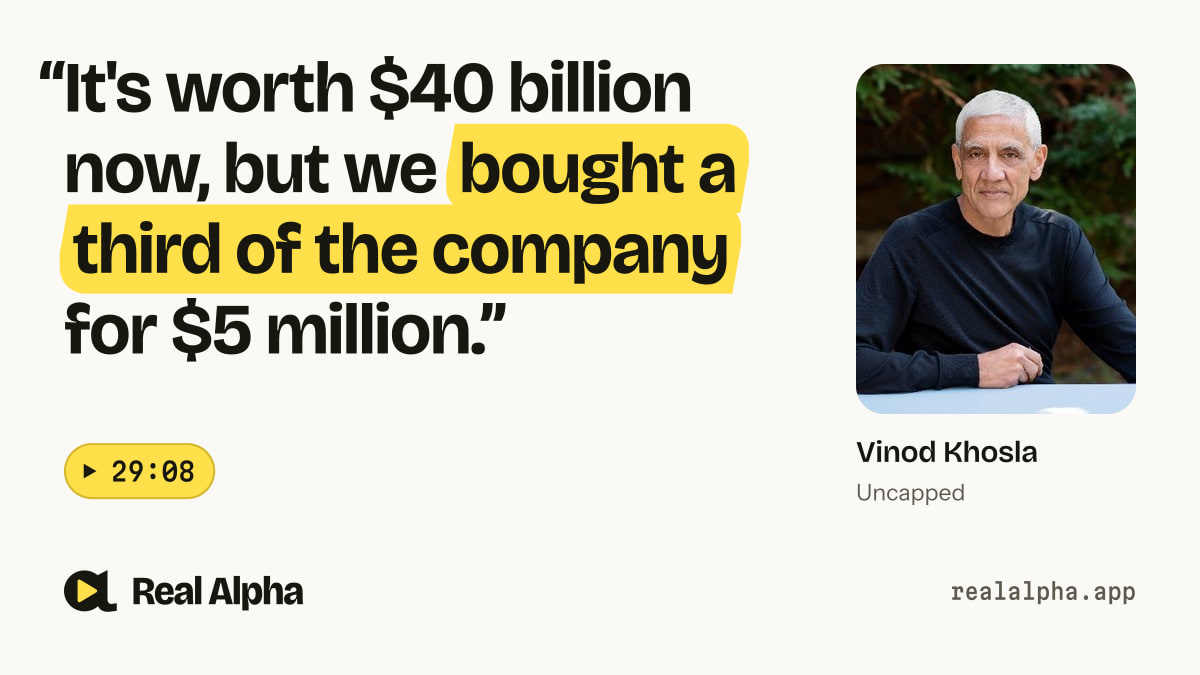
“It's worth $40 billion now, but we bought a third of the company for $5 million.”
 Vinod Khoslaat 29:08 · Uncapped
Takeaways
- Khosla says Airbnb's founding team stood out quickly.
- KV backed OpenAI despite its unusual structure and lack of a product plan.
- Rocket Lab's early backing came when few investors wanted to fund space.
About this segment
Vinod Khosla describes seeing Airbnb's potential early and backing OpenAI and Rocket Lab when their cases were hard to sell. Outlier returns can come from people and ideas the market overlooks.

Managing Director, Khosla Ventures
Founded Khosla Ventures, co-founded Sun Microsystems and backed early investments in OpenAI, Stripe and DoorDash.

Jack Altman, Host · General partner, Benchmark
Co-founded Lattice and ran it until 2023, then started his fund, Alt Capital.
From “Vinod Khosla and Keith Rabois on Building and Investing in Enduring Companies | Ep. 40”, Jan 21, 2026. Watch the full episode
Thanks. We'll look at and fix what's off.
Transcript
Transcribed by machine (Whisper) from the episode’s audio, so a word may be off here and there.
- 26:02
employees in a hot market like you're you're doing some version of that constantly when you look back at like a bunch of like the greatest investments over the last let's say 15 years to go back like a but like and like an airbnb or you know whatever there's like a bunch of companies that were like not hot early and like everybody passed. Is that still the case, do you think? Or do you think that it has become more, like has the consensus become more accurate or is it still the case that like it's random signal?
- 26:28
I don't think it's random at all, by the way. Go ahead. I mean, I think for example, like let's talk about like Airbnb. To me, it was obvious three minutes into Brian's monologue. I was like, this is the coolest thing since YouTube literally told him this, told him exactly why. It was so obvious. I needed to meet him. Yeah. And I didn't like the Airbnb breakfast name that they was using at the time.
- 26:46
So I kept deferring the meeting, which was a very costly decision for me. That's at the end of the day. If you met Brian for three minutes, there was no way of missing this. This team was very special. And he was able to convey a couple, three key things he said in the three minutes that I was like, oh my God, this is really, really amazing. But you saw it, but most people didn't. Yeah, but I'm saying it's not random.
- 27:08
Or like you saw OpenAI, like some of the companies we all know. The key investment decision, literally, like if you read our memo, which he sent to the LPs because it was so much of an outlier at the time, was this outside Google and DeepMind specifically, this was the only critical density of research grade people that could possibly pull off AI. That was the investment hypothesis in like a sentence.
- 27:30
Given all the other stuff, like it was a nonprofit, there was no product plan, no revenue plan, just this AI capability. It's the only time in the 20-year history of Costa Ventures, we sent an apology letter to our LPs when we made the investment because it was twice the largest initial investment we'd ever made. Apology letter, I know it makes no sense, but we're doing it anyway, not asking for permission.
- 28:06
It's really that letter is now part of our fundraising deck, but we sent it in 2018. Yep. And then here's a good example, too, of Raider Grove. Like, it did help a lot that David, me, and Vinod all knew Sam for a long time, a sustained period of time. So you could see certain lines there and the critical density of talent they need to assemble plus certain traits about Sam specifically led to that investment.
- 28:35
Do you think that as time has gone on and like more people are in tech and there's more founders and more investors, do you think that there's any increasing, not from, you know, people who can really see it, but from the average, you know, reception to investors? Do you think that the consensus hot deal is becoming any more or less likely over time? At seed? I don't think so. You think it's still the case that these hot seeds are no better than the non-consensus seeds?
- 29:01
Personal opinion? I agree totally. Because we're talking about Rocket Lab, which is one of the best investments anywhere. No, I mean, I don't think they would have raised money from anybody. It's worth $40 billion now, but we bought a third of the company for $5 million. Because nobody wanted to invest in space. Or Commonwealth Fusion probably. Or Conwell Fusion for Fusion or even OpenAI, right? It wasn't, we were the only venture investor in 2018 that committed because it didn't make sense.
- 29:37
I think at the seed level, consensus hot bets are generally around people, not around the idea. Yeah, it's like, you know, if you have two people who left, you know, pick your super hot current, you know, two people leave cursor. You know, if like an engineer and a, you know, designer leave cursor tomorrow, like what's that going to go at a lot? But a seed investment around, let's say, undiscovered people.
- 30:01
Yeah. I think the consensus ones aren't going to outperform the outliers at all. Maybe just talking about like themes that you guys are interested in.