The alpha, twice a week
That was 4 min.
Get the best new moments in your inbox every Wednesday and Saturday. It's free.
Check your inbox
We sent a link to your address. Click it to finish signing up. Not there in a minute? Look in spam.
or
Decoder · 4 min · Nov 14, 2026
The China argument should prompt scrutiny of security
 Helen Toner
 says the China concern deserves real analysis, not use as a blanket excuse.
The episode’s best minutes
Full analysis- 38:24Safety work needs time, not just a blanket pause5 min
- 51:31AI labs became businesses because the technology was usefulPro pick 3 min
- 58:11The China argument should prompt scrutiny of securityPro pick 4 min
- 5 more moments in the full episode
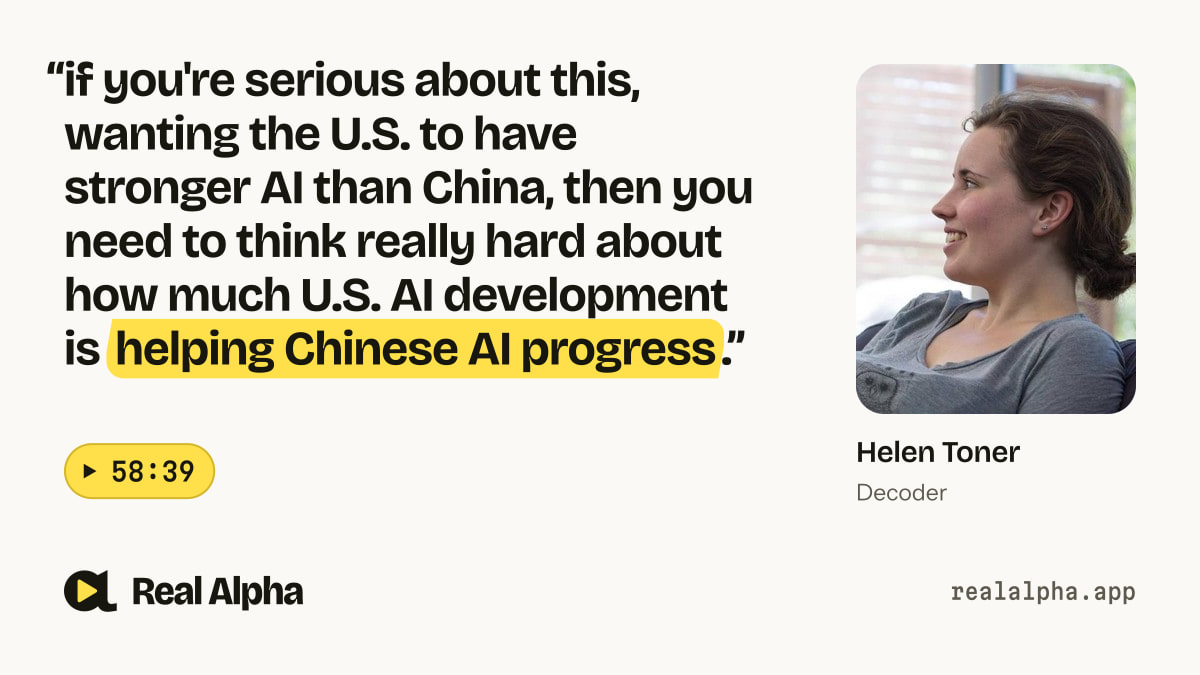
“if you're serious about this, wanting the U.S. to have stronger AI than China, then you need to think really hard about how much U.S. AI development is helping Chinese AI progress.”
 Helen Tonerat 58:39 · Decoder
Takeaways Pro pick
- Distillation can let rivals learn from US models.
- Stolen model weights could erase a lead.
- Better lab security is part of competing with China.
One of Pro's picks, open to you here. Try Pro free for 7 days
One of Pro's picks. The rest of the summary and the 3 takeaways are in Real Alpha Pro; the video, the quote and the transcript stay free.
Read it with Pro, 7 days freeAbout this segment
Helen Toner says the China concern deserves real analysis, not use as a blanket excuse. She points to model distillation and weak lab security as ways US development could help Chinese competitors.

Helen Toner is an executive director of CSET at Georgetown University.
Leads CSET’s analysis of AI policy and national security, drawing on research into China’s AI ecosystem.

Nilay Patel, Host · Editor-in-chief, The Verge
Helped start The Verge in 2011 and has hosted Decoder since 2020.
From “Is AI safety solvable in the time we have left? | Decoder”, Nov 14, 2026. Watch the full episode
Thanks. We'll look at and fix what's off.
Transcript
Transcribed by machine (Whisper) from the episode’s audio, so a word may be off here and there.
- 58:19
Yeah, I think so. I think this is the but China argument, which is like, well, yeah, yeah, we should do we should do this. We should do that. But China. And I think the way to engage with it is like an actual genuine problem that we have to grapple with. And we should like be strategic and thoughtful about and like do our best to try. solve it as a problem, as opposed to using it as like a throwaway excuse of like, oh, yeah, sure, sure, sure, all that stuff would be so nice. But China, so, you know, we're stuck. There's nothing we can do. So what does that look like in practice? I mean, one thing is, I think if you're serious about this, wanting the U.S. to have stronger AI than China, then you need to think really hard about how much U.S. AI development is helping Chinese AI progress. And so the one that people
- 58:58
talk about all the time, as you mentioned, is distillation, which is, are they, you know, using U.S. models to generate massive amounts of training data for their own models and therefore progressing faster than they would otherwise. And so certainly I think it makes sense to try and crack down on that and prevent it from happening. But another one, for example, is security and how easy would it be for Chinese actors or other actors, frankly, to steal algorithmic secrets, to steal wholesale model weights if they can steal the weights of your Astra or your, you know, Mythos and just take them back to their own servers and run, you know, your lead has vanished. You now have a lead of zero. And right now these companies, especially the smaller ones, you know, OpenAI and Anthropic, their security is not very good. So we've seen
- 59:45
both of them over the last few months have external teams managed to hack into spaces that have large amounts of algorithmic secrets. So in OpenAI's case, they're a monorepo on GitHub, which had kind of all of their code. And in Anthropic's case, I think, and actually maybe the OpenAI one also got access to Slack and Anthropic, the hackers got access to Slack. And you're just going to have so insanely much rich information about how to build better AI if you can get that access. So there's one piece here, which is like, okay, if we're grappling with but China is like a serious problem, it's like, okay, we really need to be looking at are we actually, when our AI gets better, are we actually lengthening our lead or are we just pulling China along with us in these different ways? And then the other aspect of this, I think,
- 1:00:23
is just seriously treating China as an actor in the space and trying to think seriously about their motivations and their likely actions and responses. Where in my mind, a huge reason that a lot of things are not happening right now is most people are not convinced about this threat model that AI will become the god machine and will take over and humans will all die or will be subservient or whatever. And I think it's fair for people to not be convinced of that because the evidence is sort of conflicting and unclear. But if that is actually like what we think could seriously happen, then China doesn't want that either. And so then it becomes a question of, okay, how do we try and get them on the same page of like this threat that we're worried about is a real threat to worry about? Because then they will be making their own decisions in their own
- 1:01:09
self-interest. I think an approach of like, well, the US has to force China to do something using some kind of leverage is never, never, ever going to work. But I think an approach of, well, look, if we think this is a serious problem, that's going to affect us as humans. And the people in China are also humans. And also, if we think this is a problem around who has control, the Chinese Communist Party really, really wants to have control. And so they're going to have their own incentives and their own kind of decision making around how to fix that.
- 1:01:38
Well, let me put it on a spectrum for you. This is very dumb and you're going to laugh, but just go with me on this. On the one end, it's nuclear weapons. And the Chinese government wants