The alpha, twice a week
That was 3 min.
Get the best new moments in your inbox every Wednesday and Saturday. It's free.
Check your inbox
We sent a link to your address. Click it to finish signing up. Not there in a minute? Look in spam.
or
Bloomberg Law · 3 min · Nov 18, 2026
The court may uphold the asylum ban despite the statute's text
 Leon Fresco
 thinks the court may side with Trump despite the asylum statute's plain text.
In this episode
Full analysis- 5:33Federal grants cannot be cut based on researchers’ viewpoints4 min
- 21:22The asylum statute clashes with Trump’s entry ban6 min
- 27:39The court may uphold the asylum ban despite the statute's text3 min
- 13:37Library curation as government speech could weaken viewpoint protections5 min
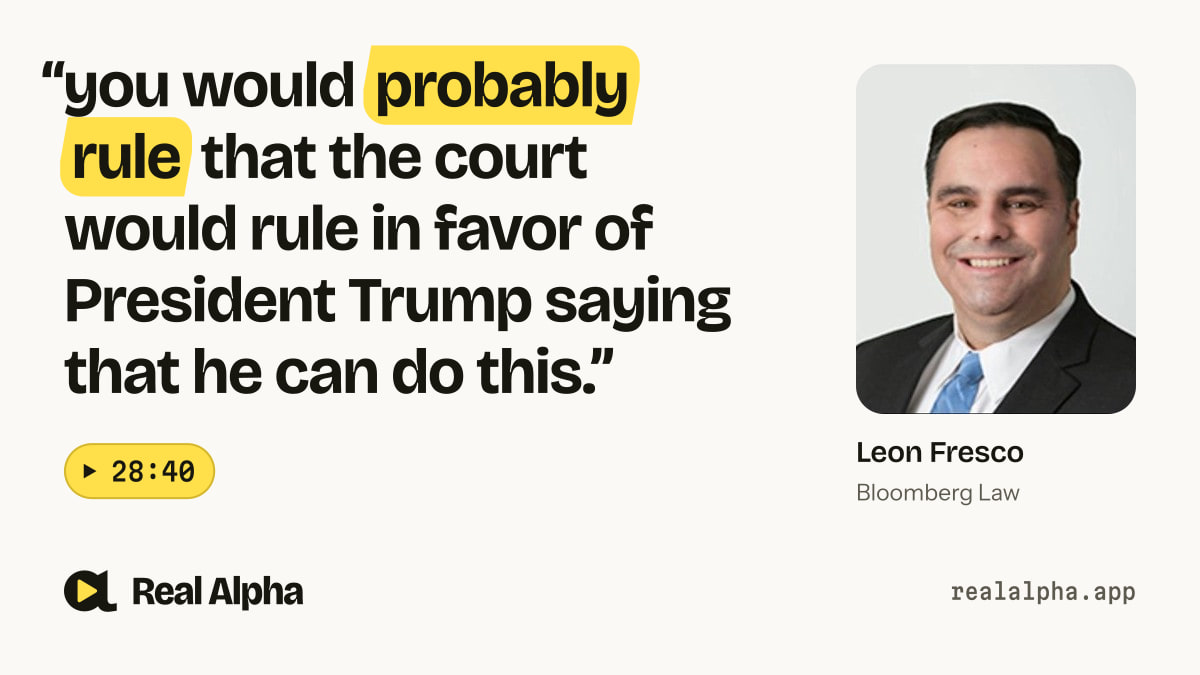
“you would probably rule that the court would rule in favor of President Trump saying that he can do this.”
 Leon Frescoat 28:40 · Bloomberg Law
Takeaways
- Fresco expects the court may favor the administration.
- The asylum statute grants a right to apply after physical entry.
- Blocking access to ports raises a conflict with that right.
About this segment
Leon Fresco thinks the court may side with Trump despite the asylum statute's plain text. He explains how the government uses the entry ban and why blocked access to ports complicates that theory.

Partner, Holland & Knight
Drafted the Senate’s 2013 immigration reform bill and oversaw federal civil immigration litigation at DOJ.
- JG
June Grasso, Host
From “SCOTUS Deals Trump a Loss and DEI a Win & Asylum | Bloomberg Law”, Nov 18, 2026. Watch the full episode
Thanks. We'll look at and fix what's off.
Transcript
From the transcript Bloomberg Law publishes with the episode.
- 27:41
So we've talked many times about how the Supreme Court has consistently, except in what the birthright citizenship case, ruled in favor of the Trump administration and against immigrants rights. So Don't you think they're taking this case to overturn the lower courts?
- 28:00
Well, one, I think this is such a big question and they can't just have a D.C. Circuit case out there that says that it's illegal what the Trump administration is doing without having it fixed. And I do think that even the Department of Justice wanted this solved. So from that standpoint, they took it for that reason. But I also think that at the end of the day, nevertheless, it is very likely, as you've said, because they've been very supportive of President Trump's immigration, everything he's been doing on the tightening realm, with the exception of birthright citizenship.
- 28:34
And even there, that was a much closer case than I anticipated and many others anticipated. I do think if one was betting on this, you would probably rule that the court would rule in favor of President Trump saying that he can do this. But I just think the text of the two statutes, one that says you can apply for asylum, that it says a word for word, you can apply for asylum no matter how you entered the United States, no matter what your status is, you're allowed to apply for asylum if your body is physically present in the United States. And the fact that what the Trump administration is trying to do is basically make that statute meaningless by saying, no, you can't. and saying that the reason they can make that meaningless is by a statute that only bans you from entering the United States.
- 29:21
It doesn't say what to do with you. Can you be banned if you've entered already 500 feet or 1,000 feet? But theoretically, the statute shouldn't work anymore because you've entered already. So that's what the D.C. Circuit found. That's what the district court found. But it may be that there are enough justices in the court that say an entry of 500 feet or 1,000 feet doesn't really change anything here.
- 29:47
And at the end of the day, the Trump administration can have this discretionary reason for denying asylum, which is that you chose to illegally enter the United States. And what that would do, theoretically, is to say, well, you've got to go to a port of entry in order to apply for asylum. And that's always been the talking point of Tom Holman and others. hey, you've got to go to a port of entry. But the problem was earlier this year, the Supreme Court ruled that the Trump administration can block your body from ever getting to a port of entry. So then you really do have no way of applying for asylum. And I do think if you can block a human being from ever getting to the port of entry and you can't challenge that, then you How can the Supreme Court reconcile that decision with a decision ending asylum here? Because then they'd be nullifying
- 30:39
the statute. What would be the point of the statute if nobody could apply for asylum? And I think that's going to be the tough thing for the Supreme Court to have to reckon with.