The alpha, twice a week
That was 3 min.
Get the best new moments in your inbox every Wednesday and Saturday. It's free.
Check your inbox
We sent a link to your address. Click it to finish signing up. Not there in a minute? Look in spam.
or
All-In · 3 min · Sep 21, 2026
The first product will be a rack-scale system
 Naveen Rao
 expects a rack-scale data-center product within two years and says existing models need porting at the model layer.
The episode’s best minutes
Full analysis- 4:43AI data centers are becoming constrained by energy6 min
- 10:22Dynamical computing aims to cut the cost of moving data7 min
- 19:38The first product will be a rack-scale systemPro pick 3 min
- One more moment in the full episode
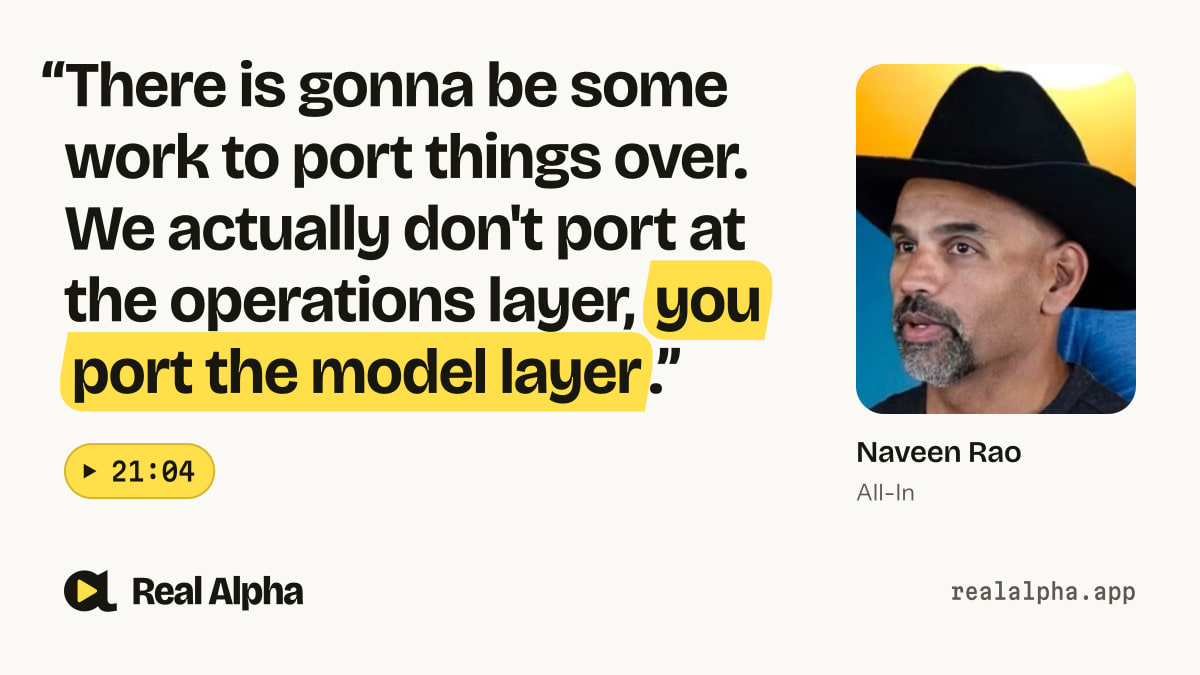
“There is gonna be some work to port things over. We actually don't port at the operations layer, you port the model layer.”
 Naveen Raoat 21:04 · All-In
Takeaways Pro pick
- The first product is a managed rack-scale data-center system.
- Existing models can work, but need model-layer porting.
- Bridging dynamical-systems theorists and chip builders is hard.
One of Pro's picks, open to you here. Try Pro free for 7 days
One of Pro's picks. The rest of the summary and the 3 takeaways are in Real Alpha Pro; the video, the quote and the transcript stay free.
Read it with Pro, 7 days freeAbout this segment
Naveen Rao expects a rack-scale data-center product within two years and says existing models need porting at the model layer. He also describes the challenge of coordinating chip builders and theorists.

Naveen Rao is co-founder and CEO of Unconventional AI.
Co-founder and CEO of Unconventional AI; founded and sold Nervana Systems to Intel and MosaicML to Databricks.

Chamath Palihapitiya, Host · Founder & CEO, Social Capital
Led Facebook's growth team; his firm backed Slack and AI chipmaker Groq.
From “Naveen Rao: 4D Computing, AI's Energy Wall & Beating Biology”, Sep 21, 2026. Watch the full episode
Thanks. We'll look at and fix what's off.
Transcript
Transcribed by machine (Whisper) from the episode’s audio, so a word may be off here and there.
- 19:41
to the extent that this works, Naveen, you probably saw Jensen earlier, there just needs to be an entire ecosystem of people that are beside you and around you whether it's the fabs packagers etc etc what does it take to get from this early version to something that sits in somebody's hand or that people use? And how do you see that path in terms of time and complexity? What does that look like? Yeah, time-wise, we're within two years of getting it to a full product.
- 20:11
I mean, there's a lot of- And what is the product? Yeah, it's a VM that sits somewhere that you guys manage? Effectively, we're building a new data center product for us. So it's a whole rack, it's a system. Right. And the idea is that basically we'll run those models on it. And so tokens in, tokens out through a network cable, but the inner guts are completely different than an existing computer. And do you expect that you'll have to move to support the existing model families and existing architectures? And will this work in a world where, you know, we've spent all of this time, like, okay, KV cache, and let's all, like, it's all just so mechanically reductive based on, as you said, these abstractions that we've lived on. Right. So how do you expect the rest of us to kind of move towards this? Because, I mean, I think you see that efficiency curve,
- 20:53
we'd all want it. So how do we take advantage of it? Yeah. So I think there's a sliding scale between how much better something is and how much pain you'll take to move to it. And I basically took the attack of like, let's make it really, really compelling to move. There is gonna be some work to port things over. We actually don't port at the operations layer, you port the model layer. So yes, the existing models will work, but there's a fair bit of compute required to make that transition happen.
- 21:19
And very basic elements like matmul, does that exist in your idea? It doesn't exist. I mean, you can characterize it as matmul, but it doesn't implement it as matmul. It implements it as a sort of time varying behavior. But each one of those time steps you can analyze is basically a matrix of the current state times a transition matrix. And when you're building a team like this, like who are these people? These are biologists plus physicists plus what are these people? Yes. Like it's sort of like theorists that come up with these like dynamical systems theory has been around for a hundred years. Yeah. So we got people from that world and then we got people who actually build chips and they don't talk to each other they don't talk to each other so we had to facilitate that that's actually one of the
- 21:57
most challenging things about this company is the span of talents that we have is so big that getting them to kind of all coordinate and build one thing is actually pretty hard well and what is this like cuda like equivalent if you will just use a bad analogy that allows these people up here to talk to these people down there yeah so we actually have built a set of libraries in python in python it's python it's not cuda but it's uh you know it's it's a language of sorts that allows to kind of express time-varying elements that have stochastic behavior.
- 22:24
I mean, it's incredibly impressive. It's so ambitious.