The alpha, twice a week
That was 4 min.
Get the best new moments in your inbox every Wednesday and Saturday. It's free.
Check your inbox
We sent a link to your address. Click it to finish signing up. Not there in a minute? Look in spam.
or
Bloomberg Surveillance · 4 min · Nov 4, 2026
The lame duck will fund the government but not boost defense
 Patrick McHenry
 expects a continuing resolution and a narrowly bipartisan defense authorization by Christmas, but no defense spending increase.
In this episode
Full analysis- 14:56Democrats will need compromise to prove they can govern3 min
- 19:22War strategy needs clear objectives, not just new technology3 min
- 3:53The lame duck will fund the government but not boost defense4 min
- 23:59Iran mattered to voters through its effect on daily costs3 min
- 8:14Immigration enforcement weakened Trump's MAGA coalition2 min
- 12:14Permitting reform could move in the lame-duck session3 min
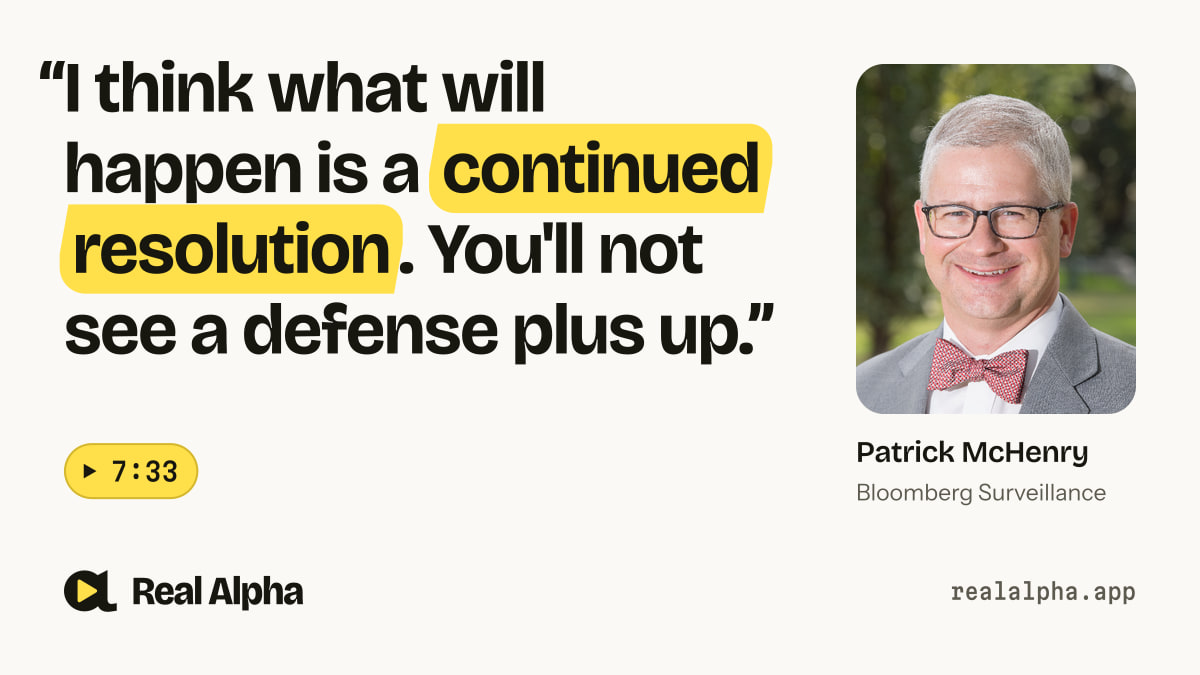
“I think what will happen is a continued resolution. You'll not see a defense plus up.”
 Patrick McHenryat 7:33 · Bloomberg Surveillance
Takeaways
- He expects a continuing resolution to keep the government open.
- He predicts no defense spending increase in the lame duck.
- He expects the defense authorization to pass by Christmas.
About this segment
Patrick McHenry expects a continuing resolution and a narrowly bipartisan defense authorization by Christmas, but no defense spending increase. His forecast maps the major bills Congress may still pass after the election.

Contributor, Bloomberg
Chaired House Financial Services, shaping U.S. policy on crypto, fintech and AI during two decades in Congress.
- TK
Tom Keene, Host · Bloomberg
- PS
Paul Sweeney, Host · Bloomberg
From “Dem Midterm Sweep | Bloomberg Surveillance”, Nov 4, 2026. Watch the full episode
Thanks. We'll look at and fix what's off.
Transcript
From the transcript Bloomberg Surveillance publishes with the episode.
- 3:55
Absolutely, Tom. Patrick, what is President Trump or how does the Republican Party work with its president over the next two years, given what just happened? in the last 12 hours here. How does this party work with its president?
- 4:11
Well, long term, this president still has mastery over the Republican Party, not just the mechanics of it, but even at this stage where the president is not popular with the voting electorate. You heard that like a siren sound like 1994, 1974. That is the magnitude of what we saw last night. But he still, at this stage of the game, is one of the most popular presidents Republicans have ever had within their own party. That gives him enormous stick to say, you cannot run away from me, even though we had a very, very bad night. The challenge is going to be in the short term, because we've got to go back. Congress has to go back to session next week for the rest of the lame duck.
- 5:02
You've got a set of issues you have to wrestle with there. And you're going to see this in the Senate. We knew this with the likes of Senator Tillis leaving the chamber. They're going to make their voices heard. But now we have this in the U.S. House, where you're going to see a group– we're sitting now at over 240 Democrats in the U.S. House.
- 5:32
This is a massive majority that the Democrats will have. A lot of people are going to lose their jobs and they're going to be out of their offices within days of returning back to Washington. The mood is going to be insanely sour for Republicans. When they go back. That's going to be the first speed hump, which is this first coming to grips that You had a job. You thought you had a job yesterday until the votes started getting counted, and now you've got no job.
- 6:01
Right. You have no staff and no office now in Washington. Chairman, I make a joke about it, folks. He's congressman because I think he started out running for office when he was 15. Yeah, exactly. I think it was something like that. He was chairman of the House Financial Services Committee looking at our military budget. Now, in this lame duck, I believe somehow we have to pay the sailors on board three aircraft carriers. We've got to pay fighter pilots in Iran money. Give us a window into the debate in a lame duck session over defense appropriations.
- 6:39
Sure. You have the president asking for a trillion and a half dollars of new spending.
- 6:44
You have the secretary of defense who has faced impeachment charges in the House with a a few Republicans being willing to side with Democrats on those charges. You have the senators that appointed. Him having buyer's remorse and wanting to take action against Pete Hagseth. And at the same time, you have a continuing resolution that the government's operating under that expires December 11th. And a defense policy initiative that we've passed successfully every single year since Truman was president.
- 7:22
Yeah. Called the National Defense Authorization Act. This is tough. This confluence of events and election results makes it tough to pass the policy and the dollars to keep the government open. That's going to be the first pressure point. I think what will happen is a continued resolution. You'll not see a defense plus up. But you'll see the defense policy NDAA bill get signed into law barely by Christmas because much of that can be bipartisan and limited in nature.
- 7:52
So I think that's what we'll see. Permitting reform is the next thing on the docket.
- 7:57
We'll see about the mood here among Democrats on whether or not they want to continue. Those negotiations.
- 8:03
Paul, on the oil barometer here, we're trying to bring the markets into the discussion this morning. Brent crude down to one oh one ninety six down a dollar sixty four. Call that the Iran barometer.