The alpha, twice a week
That was 5 min.
Get the best new moments in your inbox every Wednesday and Saturday. It's free.
Check your inbox
We sent a link to your address. Click it to finish signing up. Not there in a minute? Look in spam.
or
Bloomberg Business of Sports · 5 min · Oct 30, 2026
The Mavericks want an arena that feels built for Dallas
 Rick Welts
 describes a proposed 100-acre Dallas entertainment district and an arena designed for fans at every price point.
The episode’s best minutes
Full analysis- 20:55Scarcity and live media keep team values rising3 min
- 14:19The Mavericks want an arena that feels built for Dallas5 min
- 30:24Premium spaces now serve more audiences and days3 min
- 3 more moments in the full episode
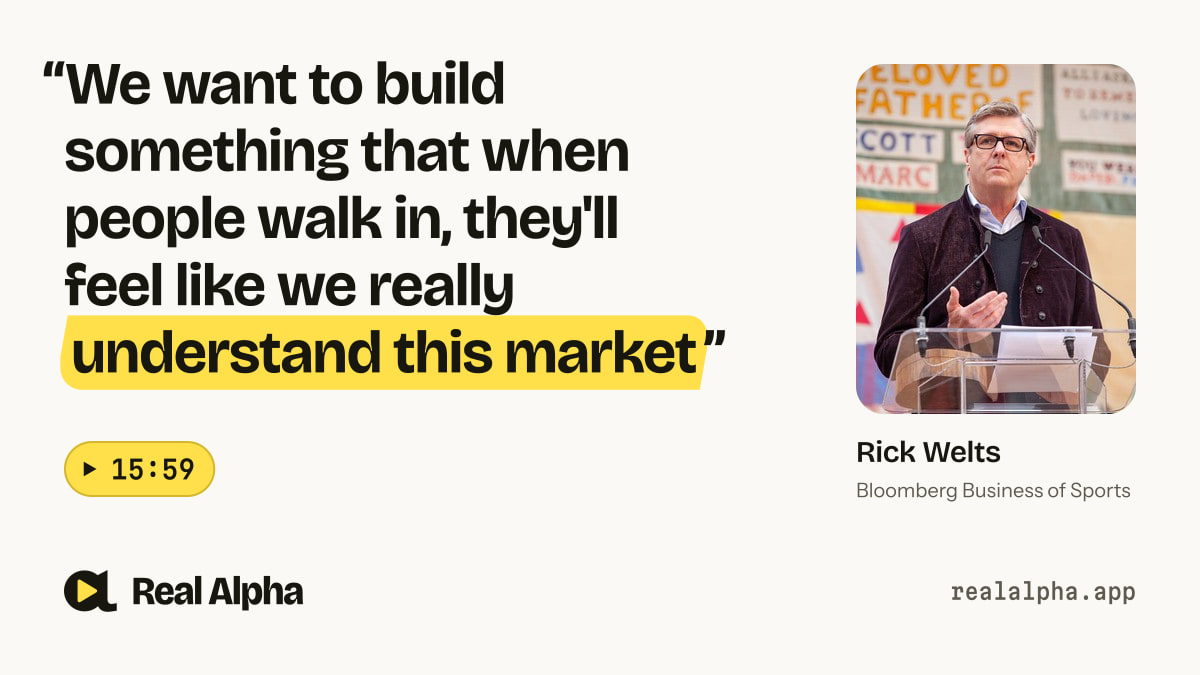
“We want to build something that when people walk in, they'll feel like we really understand this market”
 Rick Weltsat 15:59 · Bloomberg Business of Sports
Takeaways
- The proposed Dallas project is much larger than Chase Center.
- The design aims to improve hospitality throughout the arena.
- Welts sees community memories as part of a team's civic value.
About this segment
Rick Welts describes a proposed 100-acre Dallas entertainment district and an arena designed for fans at every price point. He argues public investment can be justified by the shared memories teams create.

CEO, Dallas Mavericks
Created NBA All-Star Weekend, marketed the Olympic Dream Team, and helped launch the WNBA.
- VP
Vanessa Perdomo, Host
- MB
Michael Barr, Host
- RW
Randall Williams, Host
From “Dallas Mavericks CEO Rick Welts on Team Investment | Bloomberg Business of Sports”, Oct 30, 2026. Watch the full episode
Thanks. We'll look at and fix what's off.
Transcript
From the transcript Bloomberg Business of Sports publishes with the episode.
- 14:21
Well, you mentioned San Francisco and, of course, the Golden State Valkyries are playing in the WNBA finals at Thrive City and all around that arena that you played a very big part in. Now, of course, we're here with a very Dallas crowd. You're looking to do something similar here. Talk about the challenges and really what people can expect when that time comes.
- 14:41
Well, the project that we're envisioning right now is actually much bigger than the project we did in San Francisco was the arena and 10 acres of other development, which was office buildings. Retail, restaurants. Here, we have an option to buy over 100 acres in Dallas right now and create an entertainment district much bigger than the one that we did in San Francisco in an arena.
- 15:05
But You know, it all starts with the arena. And I actually spent three hours today with Patrick in a design meeting. He's intimately involved in every aspect of the design. And I'm really excited about where the design of the arena is. It's going to set a new level of hospitality, not just for all those people who can afford to have seats on the floor, but there's as much focus on the experience of a fan in the top row of the upper bowl and what that hospitality experience can be different than what's been done in sports before. So I'm really excited about where we are in the project. We're still five years away. We have a lease at American Airlines Center until 2031. But our goal is that when this audience walks into that building for the first time, their first reaction is, wow, they get Dallas. We don't want to build Chase Center in
- 15:58
San Francisco. We don't want to build Intuit Dome in Los Angeles. We want to build something that when people walk in, they'll feel like we really understand this market and the special nature of North Texas.
- 16:10
Now, you don't have to give me a scoop, but you can give the crowd a scoop and tell us where are you planning to build this arena?
- 16:16
Well, we have the option to buy 100 acres in what's called the Valley View location, which is in Dallas. That's job number one. We have said from day one that we want to be the team that has Dallas on their jersey that actually has our playing facility in Dallas, and that's what we're planning to do.
- 16:39
You've been around this a lot. There are so many twists and turns in these stories. We're at the beginning of the beginning.
- 16:47
It was a seven-year process in San Francisco to get Chase Center built and get the Warriors moved from Oakland to San Francisco. So I wish I could predict what that path was going to look like, but we're very focused right now.
- 17:01
A couple more questions on the arena site. Something that comes up a lot, not just with arenas, but with stadiums, is public versus private. And if there's going to be a split and how different markets view private dollars versus that split, what do you think is the expectation from the Mavericks as far as what they're going to contribute to this new arena versus what the public can expect to?
- 17:24
You know, it's a city-by-city decision on what cities feel like they can devote to projects and the value of that project in their city, right? So it's an ongoing discussion we're having with the city right now. I'm, you know, it won't surprise you. I'm in the camp that I think these add value to the fabric of a city. And I think public investment at some level is very justified because I do think what professional sports teams bring to any city enhances the.
- 18:00
Quality of life for a lot of people. We're in the business of creating memories.
- 18:05
My dad and I, our currency of our relationship was going to games. I was going to University of Washington football games when I was that.
- 18:16
Tall, and that's where we had our time together. And then this new team came to town called the Seattle Supersonics, the first professional, major league professional. It could be Beckson. I'm hoping. It could be Beckson. That was 1967. We started going to those games. And, yeah, I fell in love with, you know, NBA basketball, and I loved that. But there was something going on where 14,000 people got together in the Seattle Center Coliseum and celebrated something when that's the only thing they had in common. And fast forward, you know, and that really is what drew me to this.
- 18:48
We create memories, like we create lifetime memories. I'll never forget, you know, those games. And I think that, you know, there's real value to that. There's real value in our communities for that. So it's up to any city to just make their own decision about what they feel a level of investment that can be justified. But I think it's money well spent.