The alpha, twice a week
That was 4 min.
Get the best new moments in your inbox every Wednesday and Saturday. It's free.
Check your inbox
We sent a link to your address. Click it to finish signing up. Not there in a minute? Look in spam.
or
The Information's TITV · 4 min · Nov 13, 2026
The merger trades away a clean valuation story
 CJ Gustafson
The guests see few traditional cost-cutting synergies; the case is more about shared projects, flexibility and Elon’s control.
The episode’s best minutes
Full analysis- 14:44Tesla shareholders may demand about 51% of the combined companyPro pick 6 min
- 20:10The merger trades away a clean valuation story4 min
- 5 more moments in the full episode
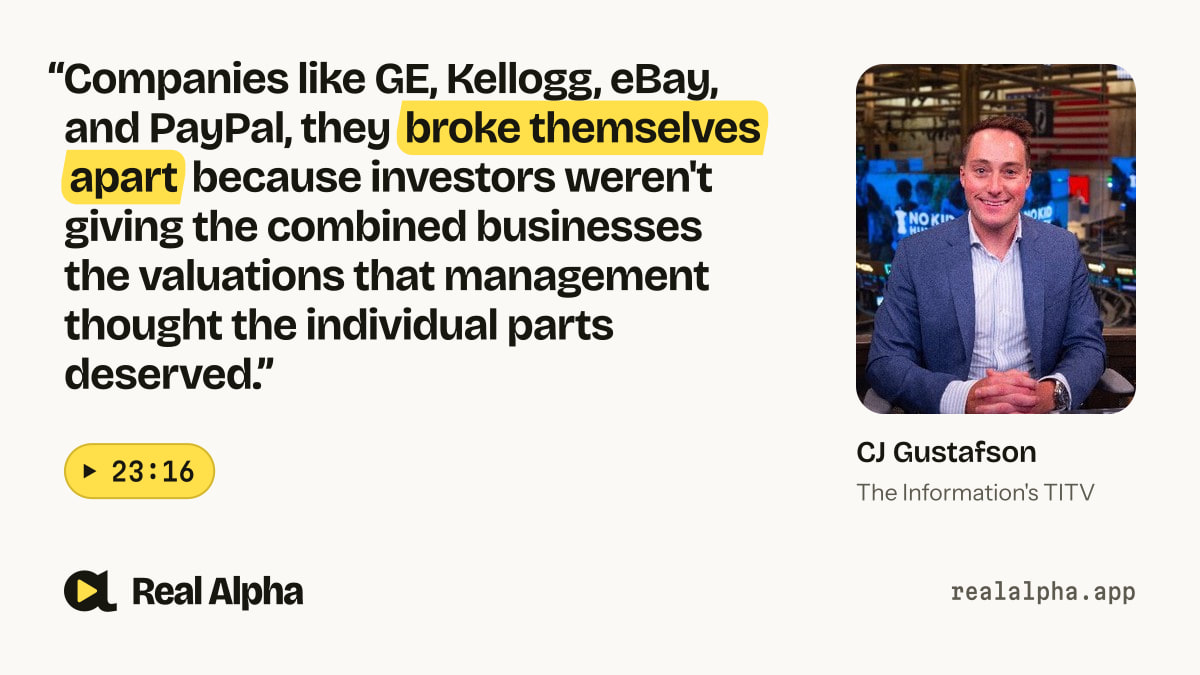
“Companies like GE, Kellogg, eBay, and PayPal, they broke themselves apart because investors weren't giving the combined businesses the valuations that management thought the individual parts deserved.”
 CJ Gustafsonat 23:16 · The Information's TITV
Takeaways
- The TerraFab project could be a major source of shared value.
- Elon could move engineers across businesses with fewer governance hurdles.
- A complex conglomerate may be harder for investors to value.
About this segment
The guests see few traditional cost-cutting synergies; the case is more about shared projects, flexibility and Elon’s control. Combining the businesses could also leave SpaceX shareholders unhappy with the valuation.

Founder & CEO, Mostly Media
Built Mostly Metrics into a finance-media business with 75,000+ readers and hosts the Run the Numbers podcast.

Akash Pasricha, Host · Host, TITV
Led The Information's Pro subscription and co-wrote its flagship newsletter, The Briefing.
From “Inside Jensen Huang’s Nvidia Exit, the Math Behind a Potential Tesla–SpaceX Merger”, Nov 13, 2026. Watch the full episode
Thanks. We'll look at and fix what's off.
Transcript
Transcribed by machine (Whisper) from the episode’s audio, so a word may be off here and there.
- 20:14
redundancies synergies you know this was this was i mean cj when i was in business school like this was this was the thing you know where are the synergies i i think i think the the biggest component is the terra fab project so um that's the biggest investment that's going into basically creating vertical ai infrastructure in the physical world where um you control multiple layers, including the chips. They don't have to rely on NVIDIA anymore. And so both of these companies have very complicated supply chains. I think the biggest savings would come from the suppliers and having negotiating power. They probably all already do to a certain extent because of the Elon ties, but being able to streamline that. And then I think like the said part and i wouldn't really call this like a cost efficiency but i would definitely call it a
- 21:05
capital market deficiency is your debt capacity is a lot larger in the public markets if these two were to be combined uh what do you think seth where else are they going to look for uh redundancies well elon musk tends to run these companies pretty flat and so you know you don't have this traditional merger where two companies are in a similar industry and you can say move to one back office system and eliminate some dual corporate overhead positions, I think largely you would just have two companies that have their each siloed businesses that are all running in a very flat organizational standpoint. So I don't think you're doing this for redundancies.
- 21:48
I think what you're doing this for is not having to worry about as much corporate governance going forward for Elon Musk. This would let him put engineers where he wants to, where he thinks is the best use of their time, whether that's software developers, whether that's, you know, your propulsion engineers. Sometimes they can work on auto projects. Sometimes they can work on rocket projects. Your software developers, sometimes they could work on, you know, your XAI, AI type of projects. Sometimes they could work on your real world AI, autonomous driving and robot type of projects. And you don't have these corporate governance issues that could lead to, you know, having to go through all this extra layers of red tape just to get something done.
- 22:31
And this would let Elon basically consolidate his empire and, you know, give him a lot more freedom. And it gives him control back of Tesla, assuming that SpaceX is the acquiring entity. And, you know, basically under nearly any valuation scenario, Elon's super voting shares at SpaceX mean he gets voting control over the whole company. And I think that's something that's valuable to him as well. cj last question for you uh do you see any losers in this deal uh you know based on the numbers who who who would conceivably not benefit from from this whoa it's funny you ask about who could be the loser here because this this cuts directly against what history has taught us in conventional wisdom around trying to create a clean valuation story. Companies like GE, Kellogg, eBay, and PayPal, they broke themselves apart because investors weren't giving the combined businesses
- 23:29
the valuations that management thought the individual parts deserved. Now Elon's combining a car manufacturer potentially with a rocket company, a satellite interprovider, and AI infrastructure um that that is going against the opposite of decades of corporate restructuring i think um what i wonder is could this be a scenario where similar to ebay and paypal breaking apart they still they were still able to get a lot of synergies um from the partnerships that they had and these two companies already work really closely together so i think the loser would be potentially the shareholders in SpaceX getting their shares valued at a multiple that they don't think is right because the story is pretty complicated.
- 24:16
All right.