The alpha, twice a week
That was 4 min.
Get the best new moments in your inbox every Wednesday and Saturday. It's free.
Check your inbox
We sent a link to your address. Click it to finish signing up. Not there in a minute? Look in spam.
or
Bloomberg Surveillance · 4 min · Nov 19, 2026
The U.S. may no longer be able to deter China near Taiwan
 James Crabtree
 explains why the first island chain is central to U.S.-China rivalry and how China's military growth has changed the balance.
The episode’s best minutes
Full analysis- 12:02Anthropic's IPO could validate the AI infrastructure buildout4 min
- 25:02Europe's capex wave will test its financing system5 min
- 33:20The U.S. may no longer be able to deter China near TaiwanPro pick 4 min
- 4 more moments in the full episode
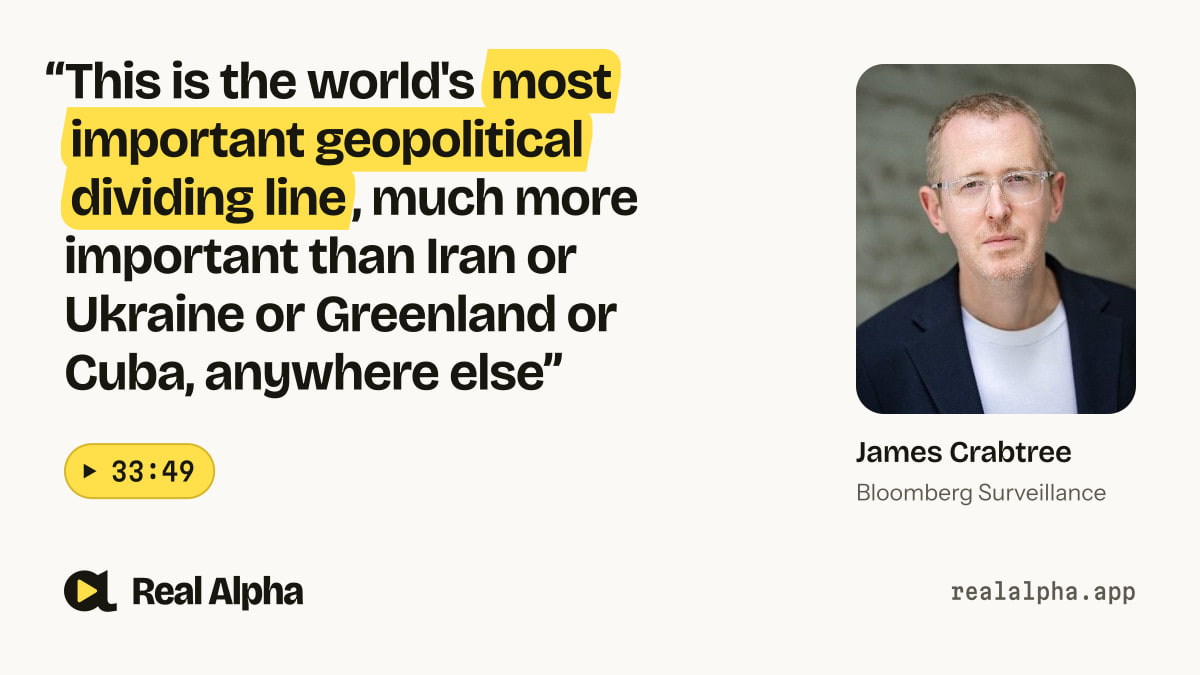
“This is the world's most important geopolitical dividing line, much more important than Iran or Ukraine or Greenland or Cuba, anywhere else”
 James Crabtreeat 33:49 · Bloomberg Surveillance
Takeaways Pro pick
- The first island chain is the key U.S. defense line in Asia.
- China's missiles and military expansion have pushed U.S. forces back.
- Whether U.S. power can deter a Taiwan conflict is an open question.
One of Pro's picks, open to you here. Try Pro free for 7 days
One of Pro's picks. The rest of the summary and the 3 takeaways are in Real Alpha Pro; the video, the quote and the transcript stay free.
Read it with Pro, 7 days freeAbout this segment
James Crabtree explains why the first island chain is central to U.S.-China rivalry and how China's military growth has changed the balance. That shift raises doubts about whether the U.S. could deter a conflict over Taiwan.

Distinguished Fellow, European Council on Foreign Relations
Led the Shangri-La Dialogue and wrote The Billionaire Raj; analyzes geopolitics across Asia and the Indo-Pacific.
- TK
Tom Keene, Host
- PS
Paul Sweeney, Host
From “Anthropic Debut and Trump's Xi-Putin Trilateral Meeting | Bloomberg Surveillance”, Nov 19, 2026. Watch the full episode
Thanks. We'll look at and fix what's off.
Transcript
From the transcript Bloomberg Surveillance publishes with the episode.
- 33:22
Douglas MacArthur looking at the moat that is the Pacific. For America, is the Pacific Ocean still a moat?
- 33:32
That's a great question. Thank you so much for the kind words. I think that's the big question. You know, since 1950, when Dean Asherson was Secretary of State, the United States has had its line of defense along what's called the first island chain, Japan, Taiwan, the Philippines. And the question is, well, is it going to be able to hold this? This is the world's most important geopolitical dividing line, much more important than Iran or Ukraine or Greenland or Cuba, anywhere else, because this is the only place where the two superpowers could plausibly come into conflict directly with one another. And so the United States has had this piece of prime geopolitical real estate for a long time. And Donald Trump is a real estate guy.
- 34:14
The question is, does he understand how important this geopolitical real estate is?
- 34:19
How can we show the flag in the Pacific Rim if we have three aircraft carriers in the Middle East? Well, that's the big question.
- 34:26
I mean, at the moment, the US's misadventure in the Middle East is drawing resources away from what it needs to be doing in the Indo-Pacific.
- 34:35
This isn't a new story. This has been going on for a long time. And this administration and previous administrations have said that they're really focusing on deterring China, but their actions don't seem to suggest that way. So there are a lot of people who think that this is gradually slipping away. And make no mistake, the purpose of this book is to tell the story of the fact that China wants the United States out of its own backyard. And so Washington has a fight on its hand if it wants to keep its place in the island chain.
- 35:06
James, arguably the first flashpoint, if there is one, will be Taiwan. What is the current status of Taiwan vis-a-vis China in the United States?
- 35:16
Well, you might see this in the coming days when President Xi and President Trump meet for the third time this year. The current status is that the United States hasn't changed its position, but that whenever President Trump sits down with President Xi, the China hawks in Washington and the government in Taipei get very nervous because the assumption is President Trump doesn't care very much about Taiwan. He doesn't care about the fact that it's a democracy. He thinks Taiwan stole the U.S. semiconductor industry. And he has come out and said that he sees Taiwan as a kind of bargaining chip. So there are those in Washington who see Taiwan as enormously strategically important, both because of the geostrategy and because of semiconductors. And the worry is that President Trump might decide to change that policy in
- 36:02
exchange for something else that China offers. We continue with James Crabtree, again, breaking my rule. The book is out. Norton has the book. I mean, Norton has the book, you know. It's in English. James Crabtree, the book is The Perimeter, America's Struggle for Primacy in the Pacific. Why are we doing this? Robert D. Kaplan and Chris Miller say, just shut up and read it. And I like that. On page 238, James Crabtree, you have the heart of the matter. Because I remember this.
- 36:28
This is 30, ready? 30 years ago. Yeah, bring it. Third Taiwan Strait crisis. And we had Admiral James Ellis off the, you know, sitting there in the East China Sea showing China, don't you dare. And even Admiral Ellis says things have changed. Can the U.S. Navy say to China right now, don't you dare? No.
- 36:53
I mean, I think that's the big story of the last 20, 30 years, is China has built a military with long-range missiles and submarines and aircraft carriers of its own, capable of pushing the United States further away. So what happened in 1996? The U.S. Sailed these two aircraft carriers into Taiwan, and the Chinese were forced to back down. Now, that couldn't happen anymore. So the question is, how does this military balance stack up?
- 37:19
Would it be possible in the event of that China decided that it wanted to go to war over Taiwan, that the U.S. could dissuade it simply because its military was too powerful. Open question. We don't know the answer, but there. Are a lot of people who are very worried about the direction of travel, of the military balance between the United States and China. And they think that at some point, President Xi is going to decide that enough is enough, and he wants to force this issue.