The alpha, twice a week
That was 3 min.
Get the best new moments in your inbox every Wednesday and Saturday. It's free.
Check your inbox
We sent a link to your address. Click it to finish signing up. Not there in a minute? Look in spam.
or
Sourcery · 3 min · Nov 21, 2026
Transparency helps employees feel included
 Andrew Feldman
 describes answering employees’ questions openly, even about his salary and stock.
The episode’s best minutes
Full analysis- 10:08Employees should diversify and take time with sudden wealthPro pick 6 min
- 3:50Infrastructure is most vulnerable during upgrades2 min
- 19:18Transparency helps employees feel included3 min
- 2 more moments in the full episode
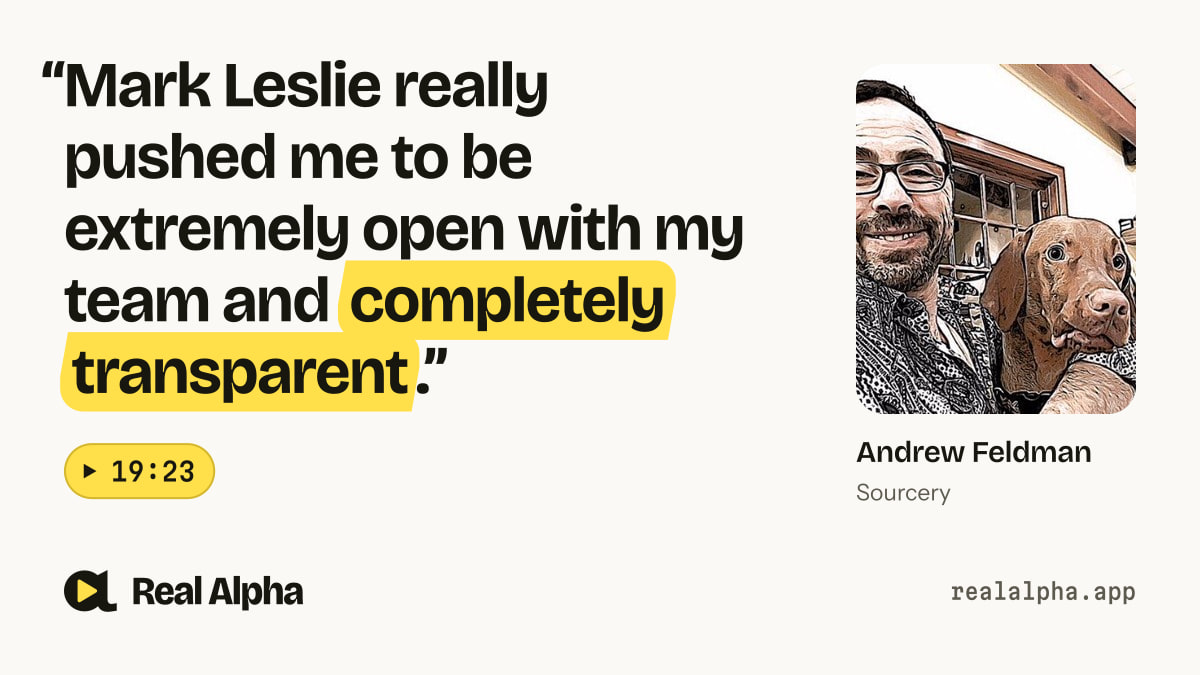
“Mark Leslie really pushed me to be extremely open with my team and completely transparent.”
 Andrew Feldmanat 19:23 · Sourcery
Takeaways
- Answer questions openly, including uncomfortable ones.
- Many supposedly hidden details are ordinary and unremarkable.
- Transparency can help employees feel included.
About this segment
Andrew Feldman describes answering employees’ questions openly, even about his salary and stock. He says sharing removes the sense that information is being hidden and has supported a lasting team culture.

Andrew Feldman is cofounder and CEO of Cerebras.
Co-founded and leads Cerebras Systems, whose wafer-scale engine is the largest processor in computing history.

Molly O'Shea, Host · Founder, Sourcery
Ex-Upfront Ventures investor; has interviewed Alex Karp and Palmer Luckey.
From “Cerebras CEO: The Truth About IPO Wealth, AI Infrastructure & What Comes Next”, Nov 21, 2026. Watch the full episode
Thanks. We'll look at and fix what's off.
Transcript
Transcribed by machine (Whisper) from the episode’s audio, so a word may be off here and there.
- 19:27
and why you might have made that decision or a different decision. I mean, Mark Leslie really pushed me to be extremely open with my team and completely transparent. And while we were private, I would answer any question, any question on our all hands. I mean, I asked questions about our position in the U.S. military, about the war in the Middle East. I asked the question about how much I made, what my salary was, how much stock I had.
- 19:57
None of this was public. Oh, wow. I I chose it because I think there is a fear that some stuff's being hidden, that the good stuff isn't being shared. And one of the things Mark Leslie told me is he said most of the stuff people fear is so dead boring that if they actually learned it, they would never think about it again. And so I thought a long time about that, and I think it's true. People think in your staff meeting there are big things being discussed, and oftentimes it's painfully boring.
- 20:28
And if you let anybody who wants to come in, they're like, I don't want to come back to this. Why would I waste my time? I mean, talking about the Christmas party? I mean, what? And so I think by sharing, you remove some of the veil that's over a lot of stuff. And it turns out that stuff is mostly ordinary. Right. And as a result, people feel like included. They feel like nothing's being hidden from them.
- 21:00
And that's a nice feeling in a company. And so it's sort of part of the culture you choose to feel. That was sort of something Mark encouraged me to think about and sort of became my own. That's good advice. I think. I think. It's served us well. We have really, really low attrition. We have people who've been with me now for 25 years. We have some of the, been with me over four companies, five companies.
- 21:36
That's stuff to be really proud of. It is. Okay.