The alpha, twice a week
That was 3 min.
Get the best new moments in your inbox every Wednesday and Saturday. It's free.
Check your inbox
We sent a link to your address. Click it to finish signing up. Not there in a minute? Look in spam.
or
All-In · 3 min · Jan 31, 2025
Travis declined Masa's money because it funded competitors
 Travis Kalanick
 says he rejected Masa's money because SoftBank backed competitors and could learn from portfolio companies.
In this episode
Full episode- 18:59DeepSeek’s headline training cost leaves out its compute investment7 min
- 51:04China copied Uber quickly, then began innovatingPro pick 4 min
- 1:26:50Grid capacity could bottleneck autonomous ride-hailing3 min
- 5:04CloudKitchens is rolling out its bowl builder with five customers8 min
- 42:08AI startups need a shim to switch models easily3 min
- 1:02:28Travis declined Masa's money because it funded competitors3 min
- 1:33:51Autonomous ride-hailing could free up a fifth of city land4 min
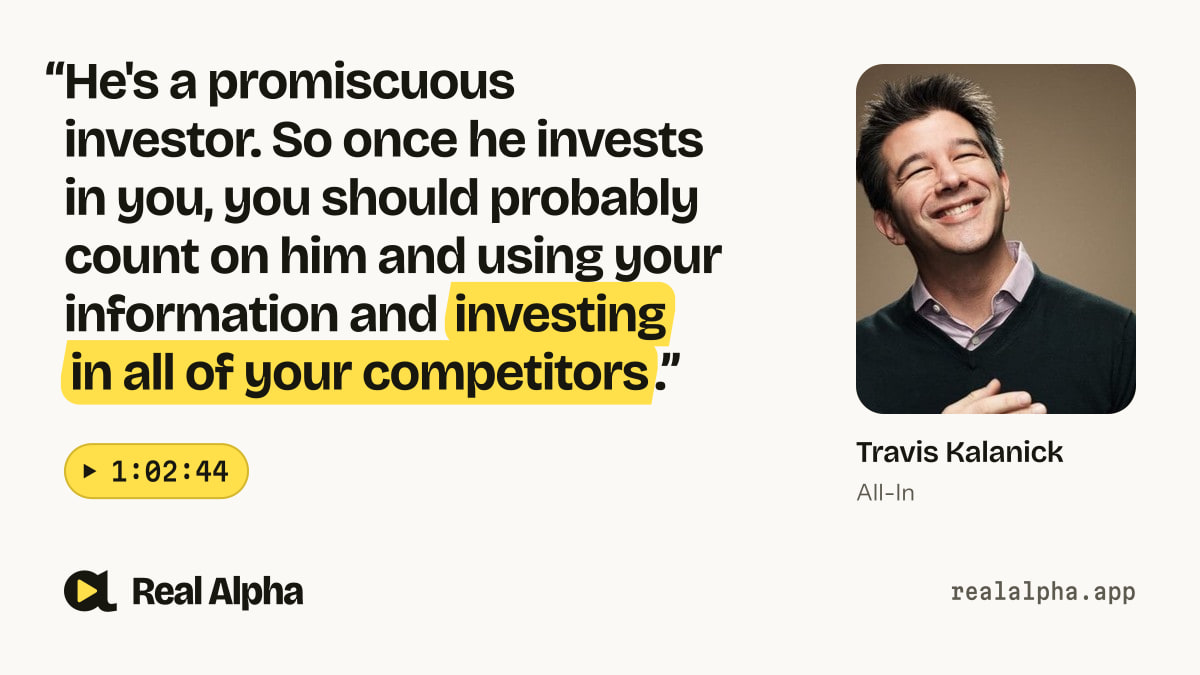
“He's a promiscuous investor. So once he invests in you, you should probably count on him and using your information and investing in all of your competitors.”
 Travis Kalanickat 1:02:44 · All-In
Takeaways
- Travis says Masa sought to invest in Uber for years.
- He worried information from an investment could inform bets on rivals.
- Declining the cash meant competitors could use it to subsidize markets.
About this segment
Travis Kalanick says he rejected Masa's money because SoftBank backed competitors and could learn from portfolio companies. He later saw the trade-off: rivals used that capital to subsidize their markets.

CEO, Atoms
Built Uber and now leads Atoms, applying industrial AI and specialized robotics to automate food, mining and transport.

Chamath Palihapitiya, Host · Founder & CEO, Social Capital
Led Facebook's growth team; his firm backed Slack and AI chipmaker Groq.

Jason Calacanis, Host · Founder & CEO, LAUNCH
Early Uber angel; sold Weblogs Inc. to AOL; hosts This Week in Startups.

David Friedberg, Host · CEO, Ohalo
Founded The Climate Corporation, sold to Monsanto for about $1.1B in 2013.
From “DeepSeek Panic, US vs China, OpenAI $40B?, and Doge Delivers with Travis Kalanick and David Sacks”, Jan 31, 2025. Watch the full episode
Thanks. We'll look at and fix what's off.
Transcript
Transcribed by machine (Whisper) from the episode’s audio, so a word may be off here and there.
- 1:02:35
So, okay. So I need to bust a myth. I did not take money from Masa. So he begged me to take money for years and we did not take it because he is a, he's a, what's the word I'm looking for? He's a promiscuous investor. So once he invests in you, you should probably count on him and using your information and investing in all of your competitors. At least that's historically what he's done. So I didn't go there, but then he just kept investing in all my competitors and they kept subsidizing these markets.
- 1:03:10
And then I'm like, maybe I should have just saturated, soaked up the money that was there. So the, one of the things you should think about, like when you look at like, oh, is OpenAI taking a lot of money from a MASA type situation is it's a little bit of like a double edged sword is if you don't take that money, it goes somewhere else. But if you do take that money, just know that whatever intelligence they get when they go through the process of giving you the money and maybe hanging around the board or who knows what is going to be used to do other things.
- 1:03:39
And that is the nature of the MASA machine. So you're damned if you do, damned if you don't. But you got to pick. And if the money's going and it's flowing and access to capital is a strategic, competitive weapon or advantage, you must play ball. Now, we were able to, we did stuff with the Saudis before even vision. existed. They stroked a three and a half billion dollar check when that was like the biggest thing that ever happened. So we were okay with not having the MASA money, but that MASA money then went to all of our competitors. DoorDash. And so in this OpenAI context, Travis, I mean, like just knowing what you know about AI, is this going to be a competitive advantage for Sam to raise 40 billion? Where does it go when he's up against, we don't know what in China, Microsoft, Alphabet, and Meta.
- 1:04:31
Well, look, I think this goes to some of the things that Shamath is saying, which is like, if constraint is the mother of invention or whatever that euphemism is, the aphorism is, if that's the case, you get into a real weird spot when you get over-capitalized. In the Uber model, the war was subsidizing rides for market share, essentially being the wrapper for transportation and using the parlance we were using earlier in this discussion.
- 1:05:05
So it was necessary. You're screwed if you don't.