The alpha, twice a week
That was 2 min.
Get the best new moments in your inbox every Wednesday and Saturday. It's free.
Check your inbox
We sent a link to your address. Click it to finish signing up. Not there in a minute? Look in spam.
or
Bloomberg Surveillance · 2 min · Nov 19, 2026
U.S. chip controls are closing a route to Chinese compute
 Elizabeth Economy
 says to judge the administration by its actions, not just its rhetoric.
The episode’s best minutes
Full analysis- 5:02Fed uncertainty is spilling into equity valuations3 min
- 13:59Chip financing needs to be judged by lease risk and deal supplyPro pick 4 min
- 11:06U.S. chip controls are closing a route to Chinese compute2 min
- 3 more moments in the full episode
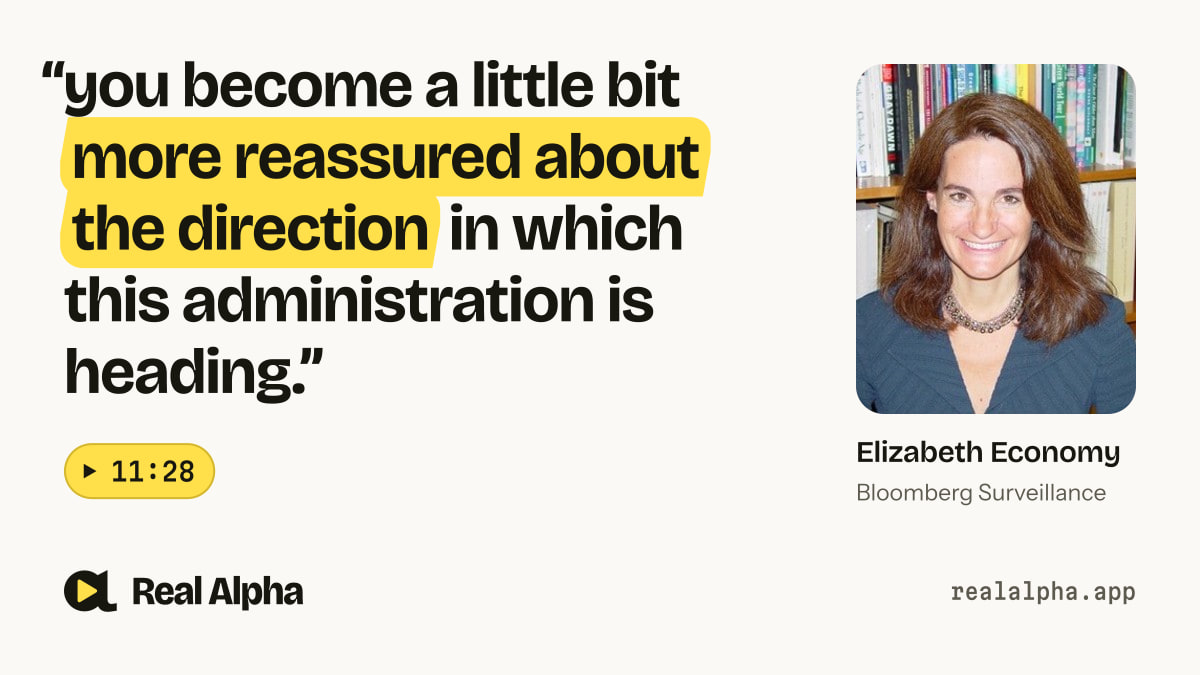
“you become a little bit more reassured about the direction in which this administration is heading.”
 Elizabeth Economyat 11:28 · Bloomberg Surveillance
Takeaways
- The interim rule targets remote access to advanced chips through Southeast Asia.
- The five identified countries will need licenses and must know their customers.
- Congressional bills could further restrict Chinese access to chips.
About this segment
Elizabeth Economy says to judge the administration by its actions, not just its rhetoric. New licensing rules target Chinese access to advanced chips through remote servers in Southeast Asia.

Senior Fellow, Hoover Institute
Explores Chinese domestic and foreign policy; authored The World According to China and The Third Revolution.
- TK
Tom Keene, Host
- PS
Paul Sweeney, Host
- LM
Lisa Mateo, Host
- MB
Michael Barr, Host
From “Bloomberg Surveillance TV: November 19th, 2026 | Bloomberg Surveillance”, Nov 19, 2026. Watch the full episode
Answers “Should AI be regulated?” See all 145 answers
Thanks. We'll look at and fix what's off.
Transcript
From the transcript Bloomberg Surveillance publishes with the episode.
- 11:08
but let's look at what tangible outcomes there are, you know, from these meetings. And, you know, I could spend 24-7 with my hair on fire if I just paid attention to, you know, what President Trump says on a daily basis around a whole range of issues. But frankly, when I look at some of the steps that his administration has taken, for example, in Indo-Pacific security, or even technology controls now, you become a little bit more reassured about the direction in which this administration is heading. So I try to look not so much at what the president says and does as what his administration actually does.
- 11:41
On that level, Elizabeth, do you have a sense of just how restrictive the new guidance is in terms of closing that loophole with chips being able to go to Southeast Asia to provide compute for Chinese companies?
- 11:53
So, you know, this is an interim rule, and so there's going to be some time for it to solidify, and changes can still be made. It, I think, addresses an important loophole, which is basically the ability of Chinese companies to access the most advanced chips capabilities through remote servers, primarily in Southeast Asia. So they'll have to get licenses. These countries, these five countries that have been identified, will have to get licenses. And they're going to have to know their customers.
- 12:29
So it does close a loophole. It doesn't mean that companies. Like Alibaba, for example, couldn't access some of these advanced chips, but they could do so with sort of at a much lower level. And so I think we'll have to wait to see how it all plays out. There are also a number of bills in Congress right now that are likely to move forward that will further restrict Chinese access to these chips or give congressional oversight. So I think there are a lot of things in play at the moment. We'll have to wait to see how it all plays out. But I think this was a very important step and one apparently enforced by the Treasury Secretary as opposed to the Commerce Secretary, who traditionally plays this role of guidance and enforcement when it comes to chip controls.