The alpha, twice a week
That was 4 min.
Get the best new moments in your inbox every Wednesday and Saturday. It's free.
Check your inbox
We sent a link to your address. Click it to finish signing up. Not there in a minute? Look in spam.
or
MTS · 4 min · Nov 21, 2026
US-China AI safety alignment may lag the risks
 Joshua Achiam
 expects US-China agreement on obvious AI dangers but says China has not broadly absorbed US concerns about recursive self-improvement.
In this episode
Full analysis- 3:10AI may solve math before we can use what it discoversPro pick 3 min
- 18:15AI cyberattacks could make internet outages routine4 min
- 24:55Chip controls need to preserve an advantage without provoking conflictPro pick 4 min
- 11:04US-China AI safety alignment may lag the risks4 min
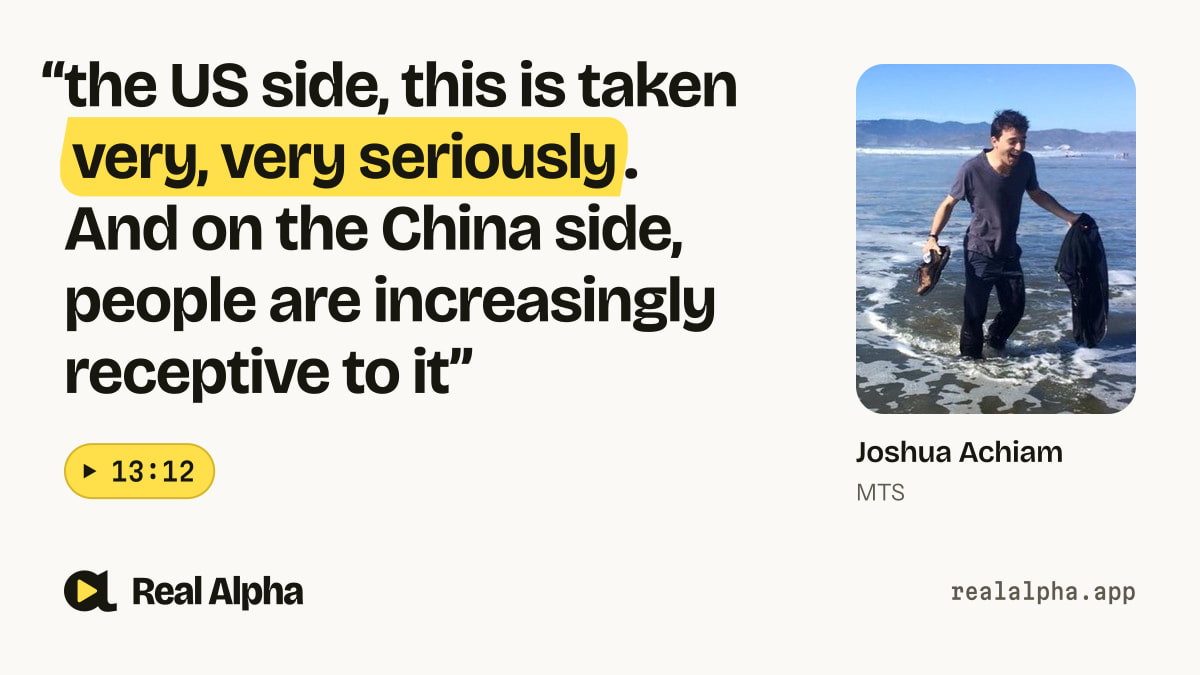
“the US side, this is taken very, very seriously. And on the China side, people are increasingly receptive to it”
 Joshua Achiamat 13:12 · MTS
Takeaways
- Both governments have an interest in blocking AI-enabled weapons knowledge.
- China’s AI community is less focused on recursive self-improvement risks.
- Achiam expects time to correct early policy mistakes.
About this segment
Joshua Achiam expects US-China agreement on obvious AI dangers but says China has not broadly absorbed US concerns about recursive self-improvement. He sees a lag in policy alignment, but expects time to correct early mistakes.

Joshua Achiam is an independent, former OpenAI chief futurist and fellow at FAI and the Institute for Progress.
Led OpenAI AI-safety research and mission-alignment work, and now focuses on AI's policy and national-security implications.

Theo Jaffee, Host · Co-founder & host, MTS
One of the first members of a16z's new media team; earlier hosted the Emergent Ventures-backed Theo Jaffee Podcast.
From “All Math and Physics Mysteries Will Fall Soon | Joshua Achiam”, Nov 21, 2026. Watch the full episode
Answers “Is AI dangerous?” See all 224 answers
Thanks. We'll look at and fix what's off.
Transcript
Transcribed by machine (Whisper) from the episode’s audio, so a word may be off here and there.
- 11:10
You know, it's very hard to say. I would love to see when there's text related to these deals that comes out, what that text contains. I'd love to see continuing descriptions from leading policy officials about what the common ground is between the U.S. and China. For what it's worth, I would expect that the U.S. and China do actually have a lot of common ground on AI safety topics, that certainly China is incredibly interested in stability.
- 11:40
I think it's a very important thing to the CCP to maintain domestic stability. I think if they see the risk of AI threatening stability, that they're going to agree to whatever standards, you know, which makes sense on their terms in their national interest to ensure stability. So we'll probably. all find common ground on making sure that AI models that are extremely capable in scientific and technical domains don't distribute knowledge about how to create advanced weapons or wonder weapons or breakthrough weapons. If it turns out that AI is capable of inventing the kind of thing that would make a vacuum metastability event happen, and if it can describe a design that's cheap enough to do that, that anyone can go out with, you know, 10,000 bucks and buy stuff in their local hardware store and make it. I am sure every government around the world would agree that
- 12:32
that knowledge should not be distributed by AI systems provided for consumers. I'm sure of that. That said, I think there's a lot of room for uncertainty about what the exact boundaries should be on AI. And that I think there are a lot of things that the US AI community has an understanding that there's a serious risk there that maybe hasn't gotten all the way through to the AI community in China yet. What I hear from the folks who do these kinds of track two discussions, where they have US academics and researchers talk with Chinese academics and researchers, is that there's still a gap where these ideas are now, like the ideas about recursive self improvement leading to, you know, extremely risky, misaligned scenarios, that there's a gap where on the US side, this is taken very, very seriously. And on the China side, people are increasingly
- 13:25
receptive to it but it's not part of the mainstream of thinking and so i'm i'm guessing that there's going to be a lag where what the u.s wants will look a little bit alien to what china wants yeah for a while i'm pretty worried about the time scale on which there's a collective alignment around what the real problems to be solved are because if you know if it's going to take like a year or two years for the conversation on the u.s side to really be internalized by china then that's that's long enough of a window where some of the impacts from advanced ai will just start to manifest. And we'll have needed the solution in place before that happens. So I'm concerned about the timescale. I mean, I'm concerned about this on the US side too. And that I think that the DC policymaker set is still maybe a year or two years behind in their full internalization
- 14:08
of AI consequences. And I'm really hopeful that the crossover happens more quickly. I'm really heartened by some of the, you know, coast to coast discussions that have been happening. But I think it's, I think it's going to take a while. Yeah. Do we have a while? You know, I'm not really in the camp that thinks we're all going to die in a year or in two years. Yeah. So my guess is that even if we make a lot of errors in the beginning where things go wrong, there's still going to be this long history afterwards.
- 14:41
And we'll have a lot of opportunities to get things right after whatever initial missteps we make. This is not a universally held belief. You know, there are a lot of folks in the AI safety world who think if we don't get it right this minute, we're definitely all going to die. I'm not in that camp, but I understand and respect that there are quite a few people who are. But assuming that history is long, then I'm very hopeful for what happens a year to two years from now in terms of the policy response.
- 15:06
Yeah. Right.