The alpha, twice a week
That was 5 min.
Get the best new moments in your inbox every Wednesday and Saturday. It's free.
Check your inbox
We sent a link to your address. Click it to finish signing up. Not there in a minute? Look in spam.
or
Uncapped · 5 min · Apr 3, 2025
Venture fundraising can reward scale more than returns
 Sarah Guo
 explains why growing a venture firm can be easier and more rewarding than delivering top returns.
The episode’s best minutes
Full analysis- 18:12Venture fundraising can reward scale more than returnsPro pick 5 min
- 27:15Traditional market knowledge can reveal the right bets5 min
- 8:03Conviction built its brand by making its network visible5 min
- 5 more moments in the full episode
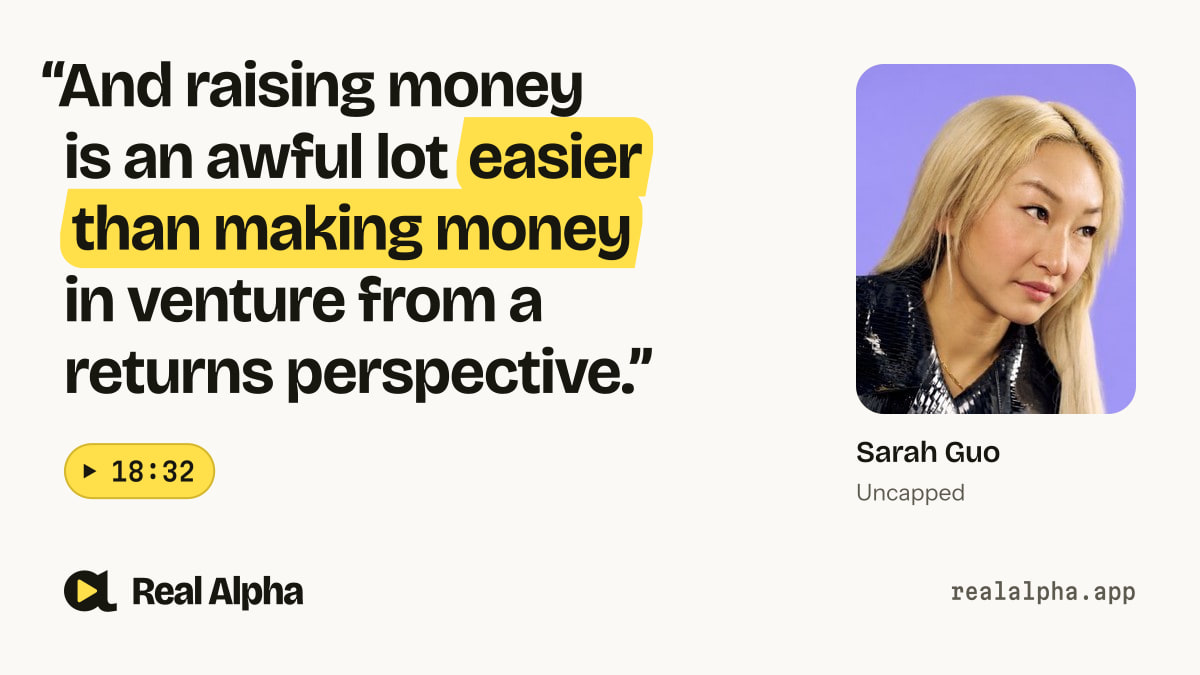
“And raising money is an awful lot easier than making money in venture from a returns perspective.”
 Sarah Guoat 18:32 · Uncapped
Takeaways Pro pick
- Raising capital is easier than producing venture returns.
- Firm growth can be fueled by fees, hiring and available capital.
- She sees today’s expansion as a skew that may not end well for returns.
One of Pro's picks, open to you here. Try Pro free for 7 days
One of Pro's picks. The rest of the summary and the 3 takeaways are in Real Alpha Pro; the video, the quote and the transcript stay free.
Read it with Pro, 7 days freeAbout this segment
Sarah Guo explains why growing a venture firm can be easier and more rewarding than delivering top returns. She expects the industry’s current growth to hurt returns, but not disappear.

Sarah Guo is a startup investor and founder of Conviction.
Ex-Greylock partner; early investor in Cognition, Harvey and Mistral.

Jack Altman, Host · General partner, Benchmark
Co-founded Lattice and ran it until 2023, then started his fund, Alt Capital.
From “Investing with Conviction | Sarah Guo, Founder of Conviction | Ep. 5”, Apr 3, 2025. Watch the full episode
Thanks. We'll look at and fix what's off.
Transcript
Transcribed by machine (Whisper) from the episode’s audio, so a word may be off here and there.
- 18:17
But like what's your read on that sort of market map? Starting a venture firm has like made me slightly more cynical about the industry. I'm like a – I'm the opposite of a cynic in many ways. Like I'm a deep optimist about technology. I like working with really earnest people. I try to be an earnest person. But it is clear to me that raising money – like the capital markets are really deep. And raising money is an awful lot easier than making money in venture from a returns perspective.
- 18:41
I think like if you actually think about the economics of a venture firm to the investors, there's a crossover point of like you could be a like a best in class in any vintage investor delivering, let's say, like respectable eight to 10 times multiple returns on a small fund and make not that much more money than somebody who's charging traditional venture fees on a fund 10 plus times your size. Right. And so I think there's a very rational thing happening in the maturation of certain asset platforms where it is very easy to unconsciously be attracted by growth because like, you know, you've built a company, growth feels good.
- 19:24
Growth is not a natural state for venture. It changes your ability to invest. Right. But people are growing their firms. It's also like a natural organizational thing, right? If you hire young people and then you hire 10, then you hire 50, like they got to go somewhere. And that also means like that means opportunity. That means comp. That means agency. So I think that like a very natural thing has been happening where these things that were little boutiques are acting like businesses. The businesses naturally grow. There's capital available to them. The feedback loop for whether or not the returns are supported are also distorted by the fact that.
- 20:00
Lots of people see the backwards-looking multiple of the best funds of the vintage right before Zerp and were under-invested in venture and are still trying to invest in venture. And the outcome of all that to me is there's obviously secular increasing opportunity in technology over time, and that's the thing we index as venture investors. And so I think there should be some growth in the venture industry. I think this is like a skew from that. And it will not end well in terms of returns for folks. But it is also just maturation of the asset class.
- 20:38
And so I don't know that it goes away. If you like take private equity as an asset class prior or those platform businesses, it is very hard to make money in private equity at a top tier and people are not moving money out of the asset class. Does it skew the ability for small firms to make money? Because these big firms, though, are going to play at every stage. And in the same way that, you know, the crossovers got into late stage growth, and sort of we're sort of starting to do non-economic things, do the venture firms that are huge? Or is it rational for them to do non-economic things at seed? Because, you know, it fills the pipeline, and they know that they're just going to play, you know, a different game on the winners and take sort of like a different IRR on that? And does that impact the whole ecosystem in a big way?
- 21:25
I think it does. And so I think the like if you ask me what is a what could I be wrong about in the whole like strategy or the ecosystem? I think there is a point of view of like you can't make money in venture anymore in terms of like an outsized multiple in early because it's just a sourcing funnel for the late stage firms and the expectation on multiple, like the cost of that capital is lower, right? And so like, and you can just spend resource on it subsidized by the growth firm to, you know, be more competitive at early, right? In terms of like marketing or people or whatever. We have eight people today. We had six people until last week. I guess like I would posit until proven wrong, like I think in the very early end of the ecosystem, like we're not trying to win everyone. We only have $200 million of capital. We need to have a couple
- 22:19
really important companies to have a hugely winning fund in every cycle. You don't need that many people and that much money to compete because people are looking for different things. And the experience of working with you or working with a very specific set of people that have an opinion and have some certain understanding is quite different than working with a very large business. And people choose different things. It's not a homogenous market.