The alpha, twice a week
That was 4 min.
Get the best new moments in your inbox every Wednesday and Saturday. It's free.
Check your inbox
We sent a link to your address. Click it to finish signing up. Not there in a minute? Look in spam.
or
Lightcone · 4 min · Mar 27, 2026
Verifiable rewards explain why coding agents work
 François Chollet
 says coding agents improve rapidly because code has rewards that can be checked, letting models learn through trial and error.
The episode’s best minutes
Full analysis- 6:08Verifiable rewards explain why coding agents work4 min
- 12:27Gradient descent struggled to discover generalizable reasoning7 min
- 35:13Chollet expects AGI to use a compact intelligence enginePro pick 5 min
- 5 more moments in the full episode
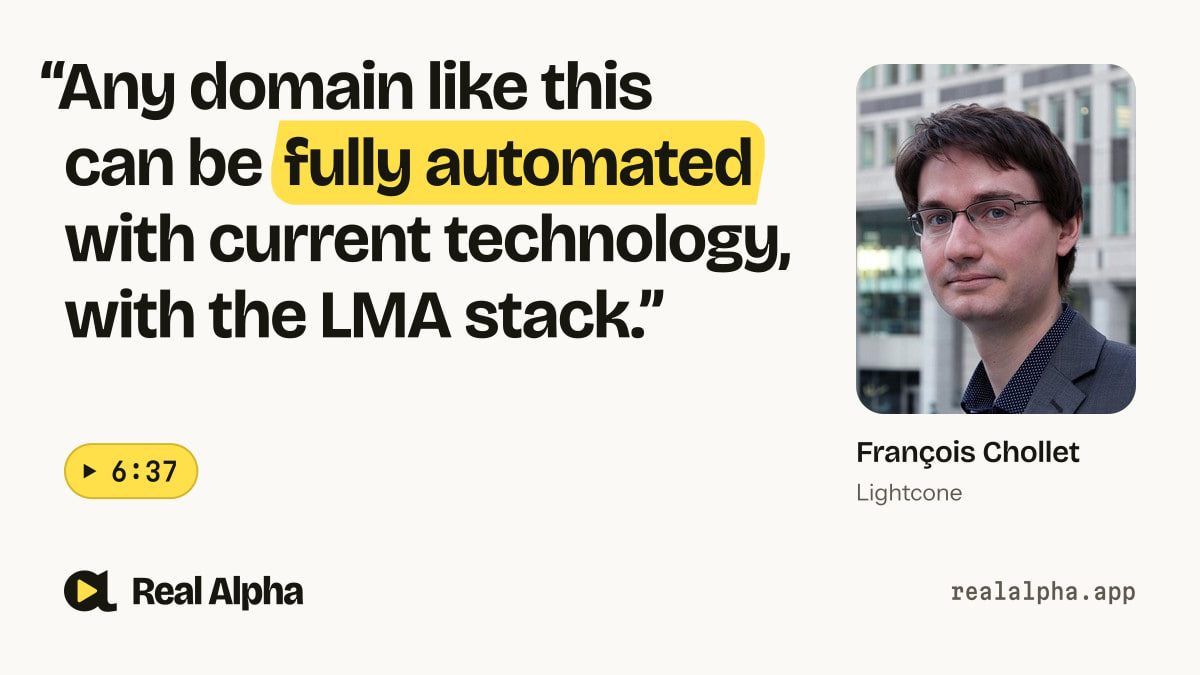
“Any domain like this can be fully automated with current technology, with the LMA stack.”
 François Cholletat 6:37 · Lightcone
Takeaways
- Verifiable rewards let models improve without relying only on human annotations.
- Code execution traces help models track what a program does.
- Essay writing lacks the reliable feedback loop that code has.
About this segment
François Chollet says coding agents improve rapidly because code has rewards that can be checked, letting models learn through trial and error. Domains without reliable verification may advance much more slowly.

François Chollet is founder of ARC Prize and Ndea.
Created Keras and the ARC-AGI benchmark at Google, then co-founded Ndea with Mike Knoop to pursue AGI through program synthesis.

Garry Tan, Host · President & CEO, Y Combinator
Co-founded Posterous and Initialized Capital, an early Coinbase backer.

Harj Taggar, Host · Managing partner, Y Combinator
Co-founded Auctomatic with the Collison brothers and later Triplebyte.

Diana Hu, Host · Managing partner, Y Combinator
CTO of Escher Reality; after Niantic bought it, ran AR for Pokémon GO.

Jared Friedman, Host · Managing partner, Y Combinator
Co-founded Scribd, which YC funded in 2006; has advised 20+ YC unicorns.
From “François Chollet: Why Scaling Alone Isn’t Enough for AGI”, Mar 27, 2026. Watch the full episode
Thanks. We'll look at and fix what's off.
Transcript
Transcribed by machine (Whisper) from the episode’s audio, so a word may be off here and there.
- 6:20
like, has their success surprised you at all? And in particular, like, say, over the last six months or so? Yeah, absolutely. I think it has surprised many people. It definitely did surprise me. If you look at why everything is starting to work so well with coding agents, it's really because code provides you with a verifiable reward signal. And I think right now we're in this situation where any problem, where the solutions you propose can be formally verified and you can actually trust the reward signal.
- 6:48
It's not just some guess made by a model. Any domain like this can be fully automated with current technology, with the LMA stack. And code is sort of like the first domain to fall, but there will be many others in the future. I think mathematics is also primed to see a revolution in the next few years for the same reasons, again, because the domain just gives you verifiable rewards. I guess the challenge for a formally verified domain is you have to somehow take a domain and make it verifiable, which is the trick.
- 7:21
I mean, code is very natural. You can test, there's bugs, compiles, et cetera, and mathematics as well, whether all the theorems and proofs work out. I guess it becomes more nebulous when you go a couple degrees off where there are fields that are not naturally formally verified. You need to come up with a, again, with some sort of a function to come up with that reward that makes it verifiable with very fuzzy things like, let's say, English language and composing the perfect essay.
- 7:52
How do you make that formally verifiable? Yeah, yeah. Absolutely. I mean, writing essays is, you know, the typical example of... domain that's not verifiable. And so what you're going to see is that progress of reasoning models and Bayes LLMs on this type of domain is going to be very slow because the stack we're using, like the LLM stack, is very, very reliant on its trained data. It's basically just operationalizing the trained data.
- 8:19
And for writing essays, the trained data is coming from human experts, like annotating answers, and that's costly. So you're going to see this very, very slow progress. Maybe it's even going to stall. But for any very favorable domain, like tech code, for instance, which was the big unlock is when people started creating this code-based training environment for post-training, where the reward signal, the verification signal is provided by things like unit tests and so on.
- 8:50
And so that means that the model was not just working from human-provided annotations. It was actually trying its own things. verifying the answer and generating a lot, lot more string data in the process, a much denser coverage of the problem space. And not just coverage in terms of is the answer right or wrong, but also starting to build models of the execution traces so that the models could start incorporating an execution model.
- 9:20
Very much the way that human programmers, when they look at code, they're sort of like executing the code in their minds, they keep track of the value of variables and so on. It's also what the models are trying to do now. And this is why it's working so well. And it's possible because you're working with this very formal, fully verifiable environment. You cannot do that with assess.