The alpha, twice a week
That was 5 min.
Get the best new moments in your inbox every Wednesday and Saturday. It's free.
Check your inbox
We sent a link to your address. Click it to finish signing up. Not there in a minute? Look in spam.
or
Balance of Power · 5 min · Nov 12, 2026
Weak enforcement lets China access US AI chips
Ben Buchanan says the administration stopped enforcing a rule meant to block chip transfers through third countries.
The episode’s best minutes
Full analysis- 8:34Weak enforcement lets China access US AI chips5 min
- 31:52The spy allegations undermine Huang’s case for China access3 min
- 2 more moments in the full episode
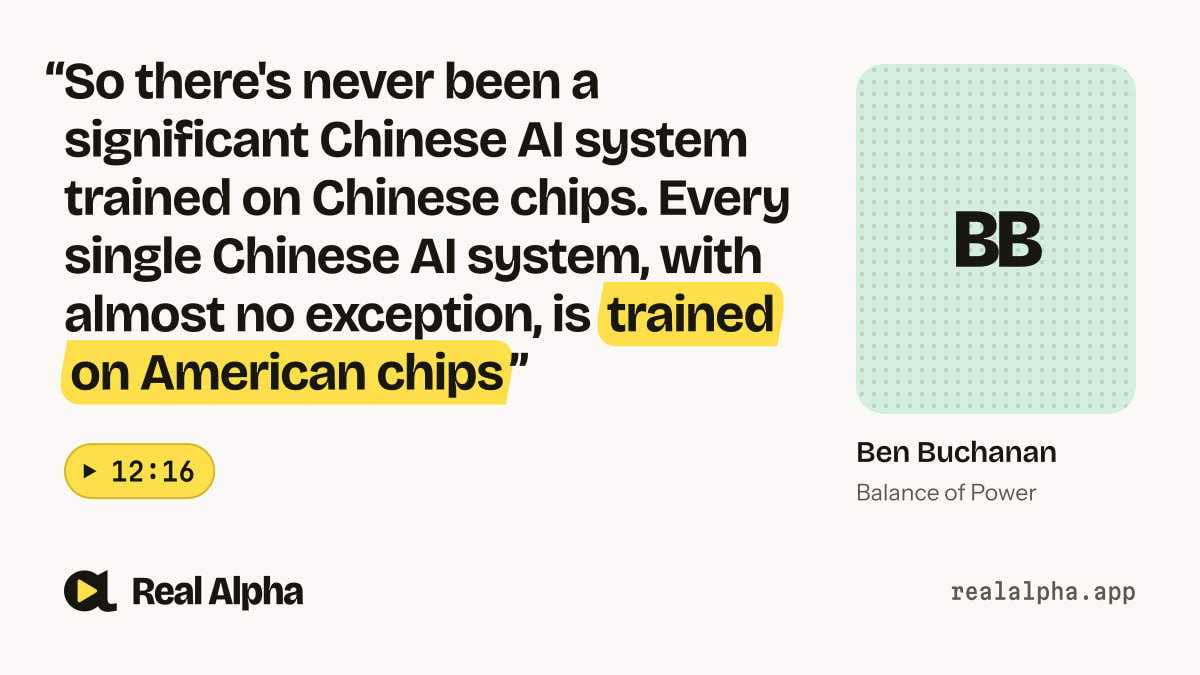
“So there's never been a significant Chinese AI system trained on Chinese chips. Every single Chinese AI system, with almost no exception, is trained on American chips”
Takeaways
- The diffusion rule targeted transshipment and overseas data-center access.
- Buchanan says Chinese AI systems rely on American chips.
- He cites a roughly 100-to-1 US and allied edge in chip production.
About this segment
Ben Buchanan says the administration stopped enforcing a rule meant to block chip transfers through third countries. He explains why US chip production gives democracies a major advantage over China.
Former White House Special Advisor for AI, Biden Administration

Joe Mathieu, Host · Washington Correspondent, Bloomberg
Co-anchors Bloomberg’s Balance of Power and covers Washington; founded and hosted SiriusXM’s POTUS political news channel.

Kailey Leinz, Host · Washington Correspondent, Bloomberg
Co-anchors Bloomberg’s Balance of Power, interviewing presidential candidates, administration officials, lawmakers and regulators on policy.
From “Trump Backs Lutnick Despite Uproar Over Nvidia Chip Controls | Balance of Power”, Nov 12, 2026. Watch the full episode
Answers “Is China catching up in AI?” See all 40 answers
Thanks. We'll look at and fix what's off.
Transcript
From the transcript Balance of Power publishes with the episode.
- 8:37
Well, so talk to us about that, because we now have lawmakers who have told Joe and I, they're saying it publicly, that they see this as underscoring the need for further legislation around tightening export controls. And yet, with the questions we now have about Megaspeed, about Alice Wong's affiliations with Supermicro as well, there is the question of whether or not products were able to get to China anyway.
- 8:57
Walk us through the difficulty in not only setting the controls themselves, but making sure that they are enforced and in these kind of third-party situations? It starts with the administration.
- 9:07
So the administration, the Trump administration, made a decision to not enforce something called the diffusion rule, which was built specifically for this purpose, to guard against companies in third countries, to guard against transshipment, to also guard against remote access to data centers overseas. This was how China began working around the export controls that were put in place on Chinese companies in 2022 and 2023. The Trump administration said they would not enforce that. That, I think, enabled some of this activity to continue. And certainly there's bipartisan concern in the Congress about this technology going to China. And it seems like bipartisan calls for action to say we've got to do more than we're doing right now.
- 9:42
We spoke earlier with Anna Ashton about the idea of export controls preventing activities like this. If this was, in fact, an espionage operation, it can be difficult to control what took place here. Are there other ways to approach this? Should we put tracking devices? On Blackwell's, how much does an Apple AirTag cost compared to what these are? I mean, shouldn't we be able to know where these chips are?
- 10:07
We should. And there's legislation in Congress to do that, the Chip Security Act and others like that. I'm in favor of keeping track of the chips, for sure. But the first thing is getting the policy right and enforcing the policy. And the Trump administration reversed some key moves that had bipartisan support that was making it illegal to send chips through these countries to China. And that's the place to start.
- 10:27
Well, and when you're referring to the Trump administration here, are we really talking about the Commerce Department? I just wonder what you would be asking Howard Lutnick right now. What did you know? When did you know it?
- 10:37
I think it's really important to understand what the Commerce Department knew about Megaspeed, companies like Megaspeed, why it chose not to, in general, enforce the diffusion rule that guard against activities like this. and what it's going to do now to make sure we really plug these leaks and tighten these loopholes.
- 10:52
Well, we know that company had been flagged, right, by our intelligence, and we know that there was an awareness of this relationship. Reportedly, no one ever told Jensen Wong from this administration. We'll find out, I guess, if that's true. But based on just that limited amount of information, how does Howard Gluttony keep his job?
- 11:09
Certainly, the New York Times reporting here, which is what you're referencing, I think is very concerning and suggests that this– is something that needs to be taken much more seriously by the administration and by the Commerce Department, which has the statutory authority unique amongst the agencies to implement and enforce export controls.
- 11:24
And this is a top priority, I think, for both parties. Of course, you have suggested this administration, or at least you've said this recently, gets a C- so far on their export control policy. Does this Jensen Long episode actually potentially reveal that it was worse than previously thought? Now that we have all of this information coming to light around whether Commerce had access to information it chose not to act on or decided not to, act on. Is this actually worse.
- 11:50
Than you previously thought? What grade would you give it now? In the modern context, a lot of great inflation, but now we're in the D territory, I think, because you can't get much below C-minus without getting into the D territory. And this is certainly, I think, an incident where the enforcement is just not good, and I think the decision-making has not been good.
- 12:08
You consider the gap in knowledge. It's frequently said that China's about six months behind us. Would export control's increase that gap?
- 12:18
So there's never been a significant Chinese AI system trained on Chinese chips. Every single Chinese AI system, with almost no exception, is trained on American chips that were either smuggled, they were sold legally through the Trump decision to reverse, or they're from a data center accessed overseas.
- 12:32
So there'd be no deep-seek. If it weren't for it. The company would probably exist, but they wouldn't be nearly as good. And I think this is an opportunity. This is certainly what we saw in 2021 and 2022 to build a very big lead for the United States inventing this world-changing technology.
- 12:44
Well, and of course you can build the moat because chips are hard to make. There are barriers to being able to develop this kind of advanced technology to do so at scale in the way in which NVIDIA has. But with that in mind, how hard would it be for any other chip maker, Chinese or not, to try to fill the shoes of... of NVIDIA if this does lead to somewhat of a material change in the company's dominance in this area.
- 13:09
Chip making is incredibly difficult. I think it's the hardest thing we do as a species. NVIDIA does chip design. The Chinese are a little bit closer on chip design. But on the chip manufacturing side, which really is the crux of what we're talking about here, the Chinese are very far behind. And you don't take my word for it. Secretary Lutnick, who you just mentioned, testified in 2025 that China will make 200,000 chips, each of which is worse than their NVIDIA counterpart. It's not nearly enough for even a single data center. Some of the modeling I've seen suggests the United States and its allies are Something like a hundred to one advantage in chip production over China when you factor in Taiwan.
- 13:40
And all that. So this really is, in a landscape that's very competitive in AI, this is by far chip making the dominant thing democracies have going for them.