The alpha, twice a week
That was 4 min.
Get the best new moments in your inbox every Wednesday and Saturday. It's free.
Check your inbox
We sent a link to your address. Click it to finish signing up. Not there in a minute? Look in spam.
or
Pod Save America · 4 min · Nov 15, 2026
Why Buttigieg says the popular-vote compact is fairer
Pete Buttigieg backs the interstate compact and argues the presidency should go to the national popular-vote winner.
In this episode
Full analysis- 22:15Why Buttigieg says Democrats cannot return to the old status quo4 min
- 38:37Why Buttigieg sees state law as a route around Citizens UnitedPro pick 3 min
- 8:56Why Buttigieg favors multi-member House districts4 min
- 32:46Why Buttigieg says the popular-vote compact is fairer4 min
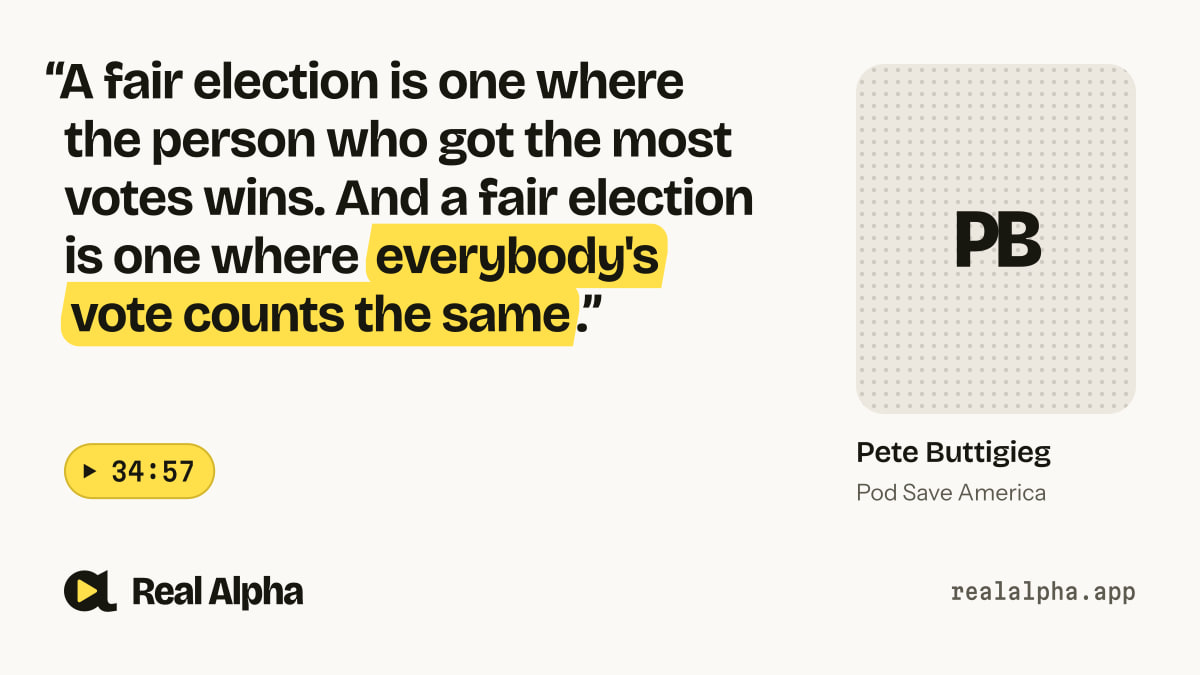
“A fair election is one where the person who got the most votes wins. And a fair election is one where everybody's vote counts the same.”
Takeaways
- He supports states awarding electors to the national popular-vote winner.
- He says each person's vote should count equally.
- He argues rural voters still receive attention in statewide races.
About this segment
Pete Buttigieg backs the interstate compact and argues the presidency should go to the national popular-vote winner. He says equal votes are a basic test of a fair election.
Pete Buttigieg is a former U.S. secretary of transportation.

Dan Pfeiffer, Host
From “Pete Buttigieg on the end of the Trump and MAGA + what comes next”, Nov 15, 2026. Watch the full episode
Thanks. We'll look at and fix what's off.
Transcript
Transcribed by machine (Whisper) from the episode’s audio, so a word may be off here and there.
- 32:59
you talk about structural reform to the system that's something that was very very in vogue in the party and Trump won. It was a part of the 2020 campaign. Not everyone was on Supreme Court expansion, but, you know, abolished the filibuster. Electoral College, we're talking a lot about that. So I'm going to go through a couple of those with you. Electoral College, you said we want to get rid of it.
- 33:18
Yeah. You ran on it in 2020. I've heard you say it several times this year on podcasts. Requires a constitutional amendment. Now, there's also the national popular vote, interstate compact. Which is suddenly viable. That's what's important. And so for people to understand, that's a process where states get together. And once you get to 270 electoral votes among those states, those states all agree to award their electors whoever wins the popular vote.
- 33:39
We now, with all the trifectas that we now have, have the capacity to do it. Do you think that is a good way to go about it in electoral college? Yeah, we should totally do that. And just to back up to a bigger pattern, when we study the right, when we study Trumpism, we should notice what seems like a paradox, which is a bias toward action with like immediate i mean especially the shock and awe of trump 2.0 like just doing things and also a kind of a long-termism you got the heritage foundation you know the project that was the iterative effort that became project 2025 started in 1980 yeah right so same for our priorities i think we need to hold out like big long-term ambitious things, including things that require updating the Constitution, and ask ourselves, like, what could we get done by September?
- 34:28
And we should be, like, basically, it's getting the base hits every time we can, and also, you know, taking the big swings. So on the National Popular Vote Compact, there are obviously a lot of legal questions about it that are out there. But even beyond those, one of the questions, one of the criticisms you hear about or one of the questions people have is that at a time in which there is tremendous distrust of the system, the fact that a handful of states all governed at some point in time by Democrats would give the popular vote, would give the presidency to someone who maybe did not win the Electoral College under traditional means. Like, what's your level of concern about that?
- 35:08
I think it's a little backwards. A fair election is one where the person who got the most votes wins. And a fair election is one where everybody's vote counts the same. And for all the stuff people think up to somehow defend this weird arcane twisted system we have at the end of the day i've never heard a serious principle argument for why everyone's vote shouldn't count the same as each other or why the person who got less votes should every other election we have for senate for governor for county assessor for dog catcher for class president always person who gets the most votes it's what an election is it's arguably not an election if and by the way like small communities get uh a lot of attention when you're running for governor you don't like apply some different weight to a different county that has less people in rural communities still get a lot
- 36:03
of attention in a race for governor so we we know this uh i think just any time you're thinking up some reason why one american's vote should count more than another's or why the person who gets and most votes wouldn't be the winner.