The alpha, twice a week
That was 5 min.
Get the best new moments in your inbox every Wednesday and Saturday. It's free.
Check your inbox
We sent a link to your address. Click it to finish signing up. Not there in a minute? Look in spam.
or
Pod Save America · 5 min · Nov 6, 2026
Why El-Sayed argues U.S. policy should apply standards evenly
 Abdul El-Sayed
 argues that U.S. policy should treat Palestinian and Israeli children as equally deserving of peace and apply standards evenly to Israel and Egypt.
In this episode
Full analysis- 13:27Why Pfeiffer says candidate brands and turnout drove the winsPro pick 3 min
- 36:58Why El-Sayed sees Medicaid cuts as a bipartisan opening4 min
- 1:14:22Why Pritzker says Democrats should answer GOP redistricting3 min
- 1:17:37Why Pritzker says Democrats cannot match big-donor spending3 min
- 32:04Why El-Sayed argues U.S. policy should apply standards evenly5 min
- 1:10:11Why Pritzker wants Democrats to send bills one by one3 min
- 28:06Why El-Sayed says Democrats must confront Trump directly3 min
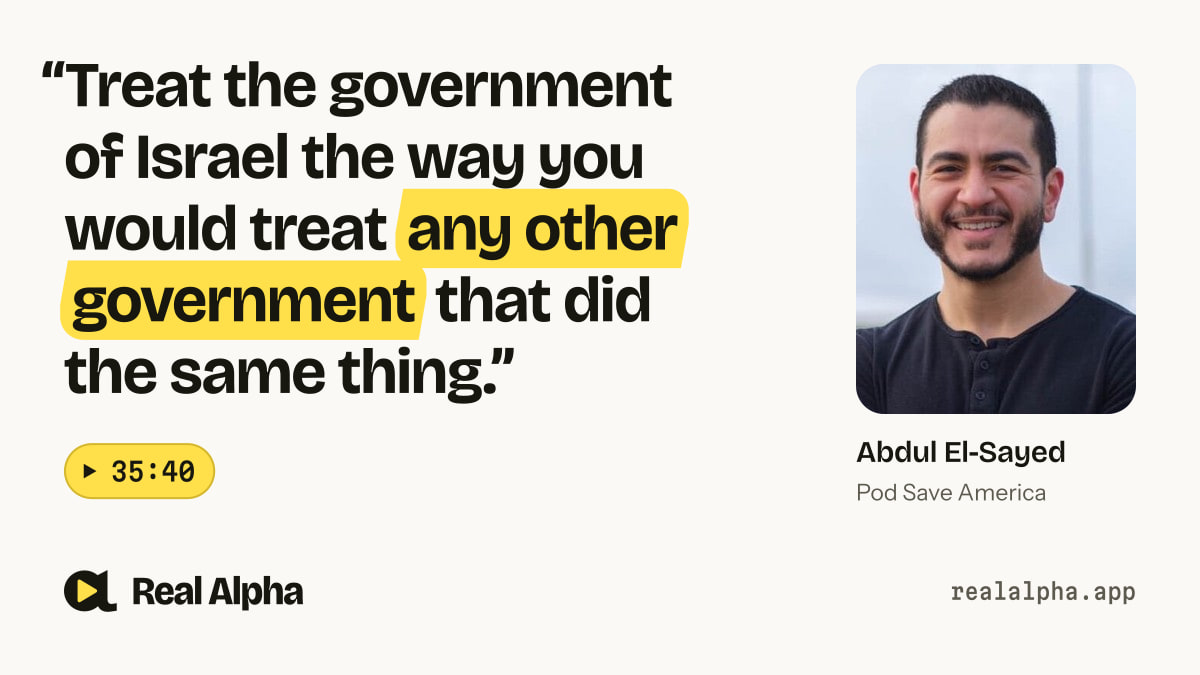
“Treat the government of Israel the way you would treat any other government that did the same thing.”
 Abdul El-Sayedat 35:40 · Pod Save America
Takeaways
- He starts from equal rights and security for Palestinian and Israeli children.
- He says U.S. support enables actions that undermine a two-state solution.
- He argues human-rights standards should apply to Israel and Egypt alike.
About this segment
Abdul El-Sayed argues that U.S. policy should treat Palestinian and Israeli children as equally deserving of peace and apply standards evenly to Israel and Egypt. He says this is a way out of the current impasse.

Democratic Senate candidate
Rebuilt Detroit’s Health Department, restructured Wayne County’s health agency, and authored Medicare for All: A Citizen’s Guide.

Jon Favreau, Host

Jon Lovett, Host

Tommy Vietor, Host

Dan Pfeiffer, Host
From “Republicans and Trump In Shambles After Democratic Midterm WIPEOUT (ft Abdul El-Sayed + JB Pritzker)”, Nov 6, 2026. Watch the full episode
Thanks. We'll look at and fix what's off.
Transcript
Transcribed by machine (Whisper) from the episode’s audio, so a word may be off here and there.
- 32:17
nuanced question about this issue, and we can step back and ask, what is our goal here? Very simply put, if I have one political philosophy, it's what would we build if we treated all of our kids like all of our kids? If you take seriously that a Palestinian child in Gaza and a Jewish Israeli child Intel Aviv deserve the same right to grow up, look forward at their future and think, I have a clear way forward and violence isn't going to curtail my opportunities. That's what you want to build. What then can we do?
- 32:59
And the challenge that we have right now is we've told ourselves a series of lies. We've told ourselves that we are in pursuit of a two-state solution. The problem though is that we've been actively aiding, arming, and abetting the very people who are trying to foreclose on a second state. And even then their idea of a second state does not start from the premise of equal rights to peace, dignity, and self-determination. It is essentially unjust. It's like saying, you know, you and I are going to split a meal. And so you get the meal first, you eat what you want, and then you give me the rest, but we split the meal. That's bullshit. An actual splitting of the meal is saying, okay, we got a burger and some fries here. You take half the fries. I'll take half the fries. You take half the burger. I'll take half the burger. And maybe you like the
- 33:40
ketchup, so take the ketchup. Sometimes the rule is whoever cuts goes second, because the person who cuts chose the size of each side. And I don't think if you should apply what I'm saying to a very complicated region, and I regret... Who said a Muslim issue couldn't figure this thing out? Look, sort of a veil of ignorance thing you could do. Sorry, continue. No, but the point that I'm making is this right is that we are right now in a cul-de-sac where we keep going around and around and around and nobody wants to back out and ask all right like where do we really want to go it is an unstable equilibrium because if you start from the premise that both of these kids deserve the ability to live a good life neither of them have that one because of state violence and one because of the risk of terrorism so i want to start there and then ask ourselves where do we go
- 34:30
you have a government that is actively foreclosing on the possibility of a second state that has not been good faith. We are actively funding their military. We're selling them the equipment that they're using to do genocide, maintain apartheid, and take us to wars. We have no business fighting the attempted annexation of southern Lebanon. And then we use the argument that if you push back on this state of affairs, it must be because you hate somebody. No, it is because I love both that Jewish Israeli child and that Palestinian child to the same degree and so I think we just have to go back to our principles what is it that we want how do we get what we want and then what is it how is it that we want to behave in the world we've allowed a certain kind of realpolitik since Kissinger to go to us into thinking that we can somehow dictate the future by just figuring out
- 35:23
what's in our best interest in the next five minutes I believe international law we built a lot of that international law after World War II. And we have become the chief violator of international law. So how is it that we should be engaging with a country that is using our money to do terrible things, war crimes at the minimum, genocide at the maximum, that we are running cover for at all of the institutions that are supposed to enforce international law? My approach is simple. Treat the government of Israel the way you would treat any other government that did the same thing. And my family comes from Egypt and I want to do the same thing with Egypt. Egypt violates human rights law. Egypt shouldn't be getting 3.3 billion dollars of our tax dollars. And I would hate if somebody would be like, well, because you share the ethnicity of 95% of the people in Egypt,
- 36:18
for us to say that the Egyptian government is doing terrible things must be anti-Egyptian. No, it is just applying our principles evenly everywhere.