The alpha, twice a week
That was 4 min.
Get the best new moments in your inbox every Wednesday and Saturday. It's free.
Check your inbox
We sent a link to your address. Click it to finish signing up. Not there in a minute? Look in spam.
or
The Weekly Show with Jon Stewart · 4 min · Nov 5, 2026
Why Longwell says Twitter doesn't reflect most voters
Sarah Longwell says online conflict is amplified by anonymity and algorithms, while most focus-group participants talk about family, school and household costs.
In this episode
Full analysis- 28:00Sarah Longwell says like-minded groups help voters speak candidly3 min
- 30:44Sarah Longwell says a Daily Show interview changed her pathPro pick 8 min
- 50:27Sarah Longwell says voter stories reveal more than polls alonePro pick 3 min
- 15:39What Longwell heard from Republicans who voted Democratic3 min
- 10:47Why Longwell says focus groups changed her view of voters3 min
- 55:38Why Longwell says Republicans won't return to the McCain era3 min
- 46:18Why Longwell says Twitter doesn't reflect most voters4 min
- 1:05:28Why Longwell thinks Trump's opponents may change politics3 min
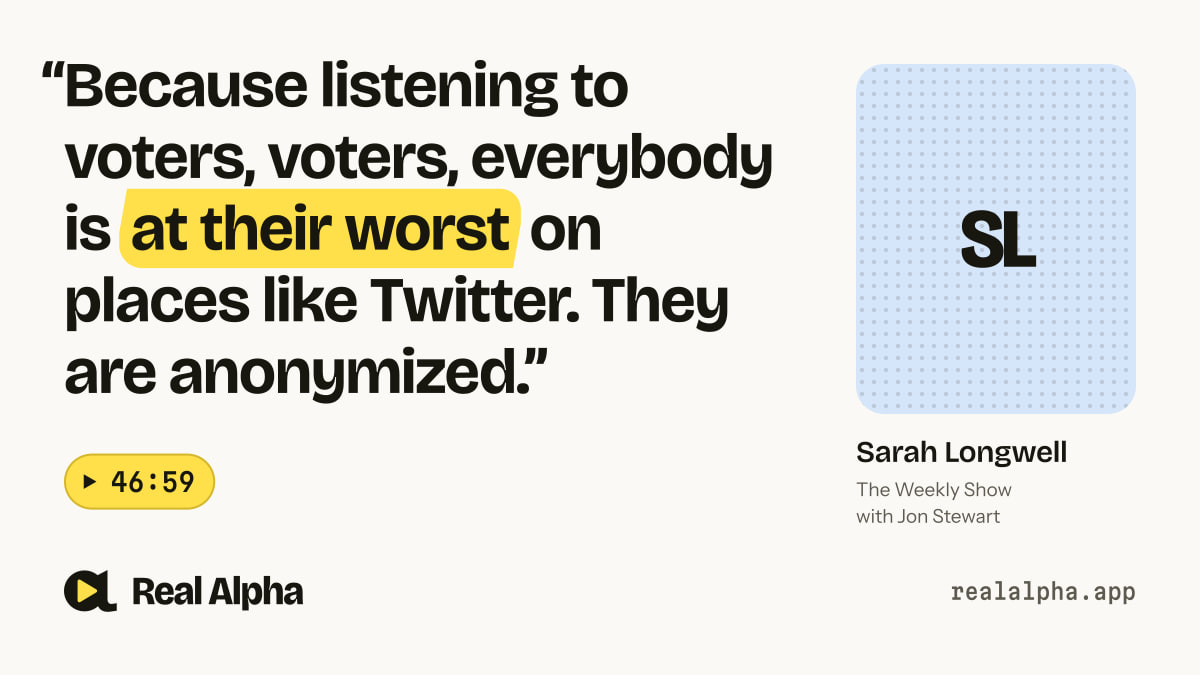
“Because listening to voters, voters, everybody is at their worst on places like Twitter. They are anonymized.”
Takeaways
- She says anonymity makes people harsher on Twitter.
- She says most participants talk about family and everyday costs.
- She says algorithms add fuel to fear and anger.
About this segment
Sarah Longwell says online conflict is amplified by anonymity and algorithms, while most focus-group participants talk about family, school and household costs. She sees those offline concerns as a truer picture of voters.
Sarah Longwell is a publisher of The Bulwark, author, and host of The Focus Group podcast.

Jon Stewart, Host
From “A Bulwark Against Trump with Sarah Longwell | The Weekly Show with Jon Stewart”, Nov 5, 2026. Watch the full episode
Thanks. We'll look at and fix what's off.
Transcript
Transcribed by machine (Whisper) from the episode’s audio, so a word may be off here and there.
- 46:27
Yeah, it's mostly the latter. It's mostly through their own experiences with a bit of like a covering of the vibes of like they all swim in kind of a MAGA soup, like the Trump voters, right? A lot of it is we are geographically sorted in many ways, right? And so and polarized. And so people who live in these really red areas, right, they find it mutually reinforcing with each other. But mostly when I listen to voters, we were joking about Twitter earlier.
- 46:58
One of the reasons that I can kind of like throw down on Twitter and fight with people from the far left and people from the MAGA right and whatever is that I know it's not real life. Because listening to voters, voters, everybody is at their worst on places like Twitter. They are anonymized. Sure. It is flattened. Like, are you talking to somebody from Nairobi or are you talking to an 18-year-old?
- 47:23
from, you know, you don't know. And the algorithm incentivizes that conflict and that totally and that hatred. And they silo us and they are meant it is meant to it is a they put an algorithmic like gasoline on fear and anger. Right. They take our fear and anger and they say that's why we're going to keep them on this platform. But out in the world, they might swim in this soup or whatever, but like they don't walk around their neighborhood, you know, screaming slurs at people they can take the cape off they can put it on and take it off although there's always two houses in the neighborhood that do like there's a house in my neighborhood that's got like fuck joe biden still up on like a job like you know when you go by a high school and they have the giant sign that's lit up that's like welcome back students he's got one of those
- 48:10
handmade on his lawn that just says like you know let's go brandon still but that guy doesn't have many friends. But that's what I'm saying. Right. There's always a couple of houses where you go, oh, he doesn't he's now lost to that dimension. He's not living in the world. But that's because for those people, it has become their personality to be that person. Right. Like they've taken it on as a. Do you see them in groups? Are they like, are they there? Yeah. I guess this is what I mean about the groups is like you see the people that you're like, I see you. You're Twitter pilled like you're a Twitter pilled person and you can recognize it but it's not most of the people most of the people are like well i had to drop my kids off and here's how i'm thinking about their local school and like i walk
- 48:56
into the grocery store and this is what everything cost and like this is the trade-off i had to make between driving to this place or being able to do this other thing because gas prices are so expensive like that's how most people talk and most people talk about what they do for their families they they still volunteer this is the thing i get actually filled up more by the groups People are often say to me, like, how can you listen to all these dumb voters or whatever?
- 49:18
And I'm like, no, Twitter is where all the terrible people are in the groups. Mostly people are pretty normal and you hear people say terrible things sometimes, but mostly you don't. Mostly what I hear is people struggling to be decent and live decent lives. And I just I won't lose faith in Americans because, you know, after we've exhausted all the wrong choices, we'll do the right thing. And that's what happened last night.