The alpha, twice a week
That was 8 min.
Get the best new moments in your inbox every Wednesday and Saturday. It's free.
Check your inbox
We sent a link to your address. Click it to finish signing up. Not there in a minute? Look in spam.
or
Pod Save America · 8 min · Nov 17, 2026
Why Maddow says DOJ's founding mission mattered
 Rachel Maddow
 recounts how Attorney General Amos Ackerman pursued the Ku Klux Klan after the Civil War.
The episode’s best minutes
Full analysis- 51:46Why Maddow says DOJ's founding mission mattered8 min
- 1:32:17Why Van Hollen wants a vote on Iran war funding4 min
- 1:01:38How Maddow says Louis Post challenged illegal deportations4 min
- 5 more moments in the full episode
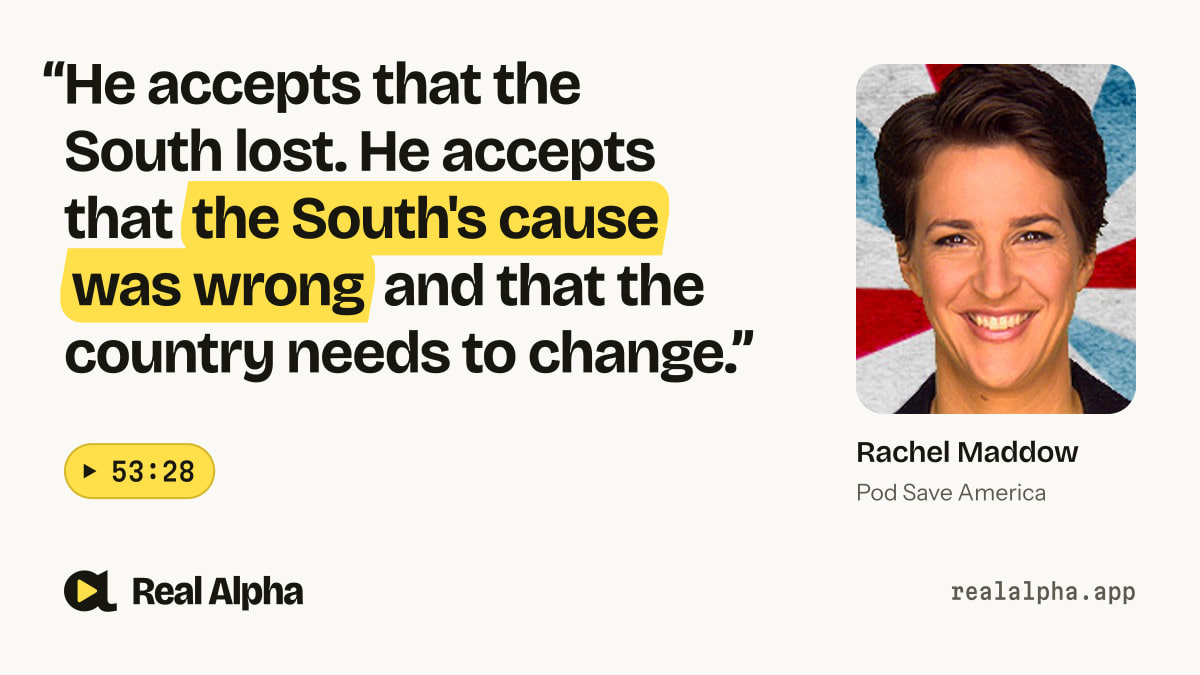
“He accepts that the South lost. He accepts that the South's cause was wrong and that the country needs to change.”
 Rachel Maddowat 53:28 · Pod Save America
Takeaways
- Maddow says Ackerman accepted the South's defeat and the need for change.
- She describes his prosecutions and commitment to due process.
- Maddow says his actions alienated cabinet members and Reconstruction later ended.
About this segment
Rachel Maddow recounts how Attorney General Amos Ackerman pursued the Ku Klux Klan after the Civil War. She argues that enforcing constitutional protections required confronting the people exercising power.

Host, MS NOW
Hosts MS NOW’s Rachel Maddow Show and creates history podcasts including Ultra and Burn Order.

Jon Favreau, Host

Jon Lovett, Host

Tommy Vietor, Host
From “Nationwide Outages Cause CHAOS as Trump SCRAMBLES for Answers”, Nov 17, 2026. Watch the full episode
Thanks. We'll look at and fix what's off.
Transcript
Transcribed by machine (Whisper) from the episode’s audio, so a word may be off here and there.
- 51:58
Let's talk about some of the examples from the past. I want to get to your thoughts on where we need to go from here. But you talk about Amos Ackerman, who was the attorney general under Grant. He becomes attorney general before there's really even a department, right? The department is set up behind him. And this is a former slaveholder. He goes to the South, and he has something like an epiphany about what it is going to take to actually defeat the Ku Klux Klan and the terror it's inflicting.
- 52:30
I think there's an interesting lesson there about legitimacy in a polarized time. And so I'm curious what you took away from his story and what you think people should know about it. The thing about Ackerman is that it was not at all like a chronicle foretold that that is how it would go. As you know, there was no Justice Department. There was just an attorney general. And before the Congress created Department of Justice in 1870 after the Civil War, the attorney general was just kind of the lawyer for the president and the lawyer for the cabinet.
- 53:02
And it was a small enough job that most people had a side hustle to while they did it. And they had to kind of raise their own funds and stuff. And under Ackerman, they stood up the Justice Department. And it was in the wake of the Civil War. And it was in the wake of the civil or the constitutional amendments, like the 14th Amendment, protection, every equal protection under the law, and all those important things that were supposed to make us into the multiracial democracy that we fought the Civil War to establish. And Ackerman is the only Southerner in Grant's cabinet as the former slaveholder, former Confederate officer. He, as a Southerner, just comes to this realization.
- 53:40
He accepts that the South lost. He accepts that the South's cause was wrong and that the country needs to change. But he, as a Southerner, believes that as long as there is effectively terrorist rule in the South, we're never going to get to where we need to get to. The North will never really have one. And the Constitution will just be paper, and it will not be anything that reflects the way we live. And so he decides to go uproot the Klan in South Carolina. And he has remarkable success. And it brings thousands of prosecutions, gets lots and lots and lots of convictions. They suspend habeas corpus and give him a division of the army to work with, but he nevertheless decides to give people due process and afford people their constitutional rights, even though he legally doesn't have to. And he's just like a really remarkably
- 54:33
morally farsighted person. And then, of course, his political support collapses in Washington, and it all falls apart and we end Reconstruction. But in 1870 and 1871, what he did was, I think, the founding moral vision of what the U.S. Department of Justice is and should be, which is not allowable under a leader like this one. What was striking about that story is this is someone might roll their eyes, but I was thinking about Merrick Garland and the conception of legitimacy that some have had about the Department of Justice, which is trying to prove that it is independent, right? And trying to kind of prove even to its enemies that it can be trusted, right? That is not what you have with Ackerman. You have someone who is saying, no, there is a deeper kind of moral legitimacy that we are striving for here. And that requires doing
- 55:30
things that are going to antagonize a lot of people. But those things are necessary because we are trying to achieve an outcome that we believe is legitimate, even if there are people that don't ascribe to it. He thought the country wouldn't survive. We just barely made it through the Civil War. And he thought the country would not survive unless we lived up to the ideals that we established in the Constitution at the end of the Civil War. And in order to live up to those ideals, all those guys needed to be prosecuted. And the thing about the Klan, which he understood and which was an operational principle for the way they brought those prosecutions was that the guys who were the mayors and the bankers and the business leaders and the ministers and all of the leading white men of York County, South Carolina, were running the town and were the establishment of the day by daylight.
- 56:25
And at night they put on hoods and raped and murdered their way through the countryside. And he knew. that they had every resource on their side in terms of trying to prosecute them. And he factored that into the way that he went after them. And they were, of course, total cowards. And they lied and they tried to make other people take the blame for what they'd done. And a whole bunch of them fled and went to Canada.
- 56:47
He went to Canada and chased them and brought them back. I mean, he was really aggressive and really committed. and it really alienated him from everybody else in the cabinet who did not want to keep fighting these fights. And so Reconstruction ends, the amendments, the implication, the Supreme Court limits the civil rights law and the reach of these amendments. And then all of a sudden, a lot of these people who had been denying their involvement suddenly feel proud and start bragging about their involvement in the Klan and some of the killings and the lynchings that they participated in. We talk about Trump and pardoning of insurrectionists. There was a successful coup in Wilmington, North Carolina, and then there was a debate about whether to go after those responsible, and the administration decides not to. Can you talk about that? Let the coup stand,
- 57:41
exactly. I mean, that and the Tulsa race massacre. I mean, the Grant administration is willing to let Ackerman fight this fight to a certain extent. They tire of him immediately. The other thing that happens, though, in addition to sort of losing the appetite for that fight, is that Ackerman is the first attorney general that has a Department of Justice. He does this incredibly effective thing with the Department of Justice. I mean, it just turns out to be this very potent tool. And when he is pushed out, part of the reason he's pushed out, I believe, It's sort of it's a little bit of a controversial assertion historically, but I believe I have convinced myself that it's in part because people in the cabinet realized, oh, there's this new, very effective tool that we can use for our purposes.
- 58:32
We would prefer to be using it for the things that we want rather than using it to stir up this fight with the South again or to stand up for the freedmen. Who cares about them? And they very quickly start to use the new Department of Justice for the purposes of standing up for the rich and moneyed and white supremacist interests in the country. And so, you know, by 18, by the 1890s, Ackerman's there in 1870. By the 1890s, you've got Richard Olney in there using the Justice Department to crush the labor movement. Like that was not what the department was founded for. And you wouldn't have thought under Ackerman that it could have ever been something like that. But you get the wrong guy in there with a real understanding about how to use power. And the Justice Department just has absolutely unparalleled
- 59:17
power to shape the course of the nation, to ruin people's lives, to end people's lives, to wield physical force against the population, but also just to change the way the country works like no other agency does. What Ackerman does is a kind of creative use of power and this structure and the law suspends habeas corpus, never had been done in peacetime, and does it to root out the Klan. You also have Olney abusing the Sherman Antitrust Act, which had not been used effectively against corporations, but used really the first time effectively against unions, not the intent.
- 59:55
Yeah, to help corporations. To help corporations.