The alpha, twice a week
That was 8 min.
Get the best new moments in your inbox every Wednesday and Saturday. It's free.
Check your inbox
We sent a link to your address. Click it to finish signing up. Not there in a minute? Look in spam.
or
Pod Save America · 8 min · Nov 13, 2026
Why Pfeiffer sees Nvidia's case as a national security risk
 Dan Pfeiffer
 argues the alleged spying, chip sales and ties to Trump raise national security and economic questions.
The episode’s best minutes
Full analysis- 33:26Why Pfeiffer sees Nvidia's case as a national security risk8 min
- 42:24Why Pfeiffer sees Colom's campaign as a model for state organizingPro pick 6 min
- 57:37Why Pfeiffer sees arguments for and against Schumer staying leaderPro pick 6 min
- 4 more moments in the full episode
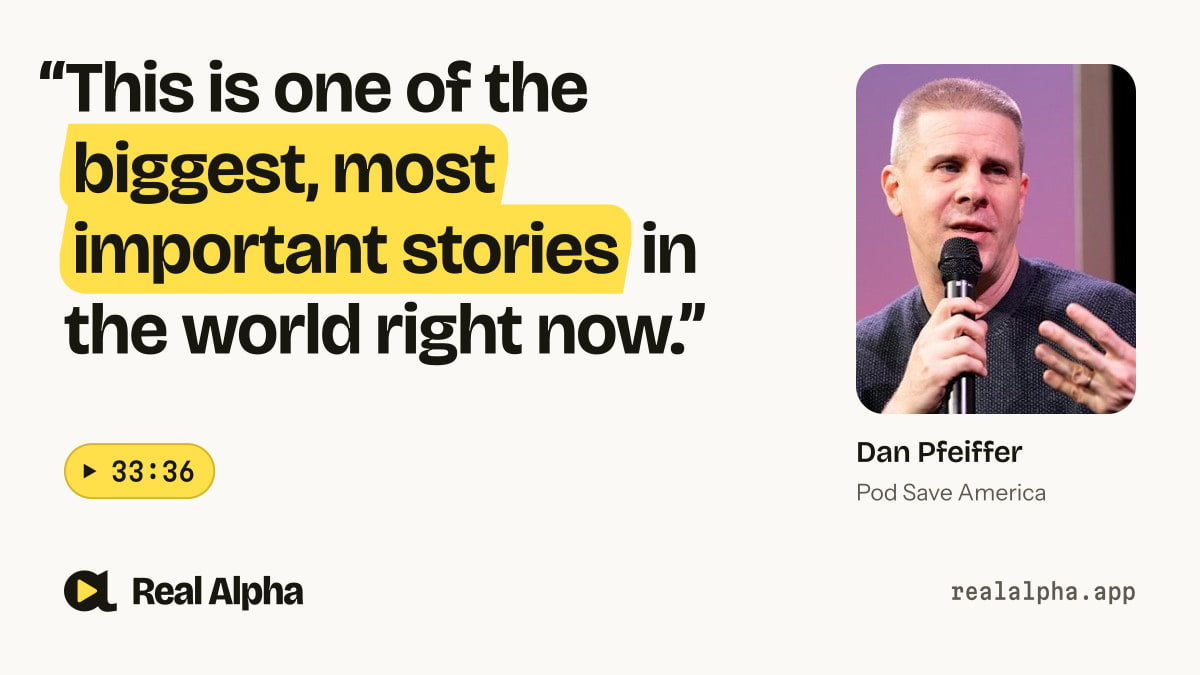
“This is one of the biggest, most important stories in the world right now.”
 Dan Pfeifferat 33:36 · Pod Save America
Takeaways
- Pfeiffer says the story has implications beyond the administration.
- He questions whether the alleged spy was needed to influence chip policy.
- He says business interests complicate arguments about AI competition with China.
About this segment
Dan Pfeiffer argues the alleged spying, chip sales and ties to Trump raise national security and economic questions. He says the case also exposes conflicts in arguments about competing with China on AI.

Dan Pfeiffer, Host

Jon Favreau, Host
From “Trump White House in Complete CHAOS After Crushing Midterm Defeat”, Nov 13, 2026. Watch the full episode
Thanks. We'll look at and fix what's off.
Transcript
Transcribed by machine (Whisper) from the episode’s audio, so a word may be off here and there.
- 33:39
So many questions, massive implications for AI, national security, the entire economy. But let's start here. How big of a scandal do you think this is for the Trump administration? This is one of the biggest, most important stories in the world right now. And if we weren't just coming off this giant midterm, it would be getting so much more attention than it currently is. this has as you say huge national security implications it has real potential for corruption here because wong is not just friends with trump and they are good friends or at least to the extent trump doesn't really have friends they are regular acquaintances they trump they talk on the phone all the time there is this obviously mortifying and cringing clip of wong at the all-in conference where he called trump calls him on just calls him on the phone and she puts him on speakerphone for
- 34:23
everyone else he is as far as we know a major financial supporter support of all the president's various projects 25 million for the um the ballroom yep um i'm sure whatever library fund he's they're they have a financial relationship and the president was aware of this did nothing about it his administration did nothing about it and it has real implications for the world economy there's NVIDIA plays such a gigantic role in the ability for ai companies not just the hyperscalers in the united states but the open model ones in china we so they need their chips wong is like he is NVIDIA right and he has this very complicated supply chain relationship in asia to get all the stuff built it's all really all based on his personal relationships with him leaving we don't really know what that's going to do you know you know everyone worries about ai being in a bubble
- 35:15
These are the kinds of things that could pop bubbles. It had like just tremendous implications there. And just the national security implication that there was a intelligence operation using a honeypot to get a friend of the president to convince the president to give China access to our chips, which is the one thing we always said. Even Trump was saying we should not do because his argument for why we let AI cook, we don't need regulations, build every daddy center is because we're in this fierce competition with China for AI dominance.
- 35:49
And he helped gave China all the tools they had to keep up with us. Just like massive implications here. Yeah. I mean, the only question here is, was the spying even necessary? Because it was in Wong's interest, financial interest, to sell the chips to China, even if this alleged spy wasn't a spy. There's a CNN story I just saw that, like, some people in the intel community are like, was she actually a spy?
- 36:19
Was she recruited by Beijing? We can't prove this yet. But, like, either way, like, Wong has been making an argument that we should give the chips to China because his argument on this is, well, if we give our chips to China, then we control the supply to China. And so then it's like U.S. chips that are – you know, the Chinese are then dependent on U.S. chips and that's good because otherwise they would like just create their own, I guess.
- 36:48
And it's like – it's a kind of a fucking weird argument. Like it never really made much sense to me. Well, the only point that makes sense is he gets to sell them. That's what I'm saying, right. It does make sense if you're invading. And you're just a chip seller. Right. So, again, like, did you need the spy to try to have Jensen Wong go around export controls and sell to a company in Singapore so that they could potentially divert those chips to China?
- 37:12
That's the part. So there's there's two elements to where how this three elements, I guess, to where the spy, the spying or whatever you want to say could be problematic here. One is just that U.S. national security and secrets. You have a spy who spends a lot of time with someone who is talking and texting, I assume, texting with Trump all the time. So there are huge just sort of national security secrecy questions there.
- 37:37
Then there is did the spy convince Wong to convince Trump to do this? As you say, you may not have needed the spy because Wong always believed that. But then the other thing in which we need a lot more information about is whether the Alice Wong, who just sort of had a very rapid rise from television reporter to head of a major chip buyer, which, I mean, look, anything can happen in China. Anything can happen.
- 38:02
That's right. Yeah. It's a land of opportunity. That's right. And then that company becomes a cutout to illegally send chips to China, and all sorts of potential protocols to prevent that from happening are not followed both within NVIDIA and the U.S. government, and perhaps maybe because the head of NVIDIA was having an affair with the person who was giving the chips to China. But here's the other thing that's fucked about it.
- 38:31
Every time someone is like, hey, maybe we should regulate artificial intelligence because the heads of these AI companies are telling us that it could escape human control, that it could kill us all. Those aren't like just random doomers online and AI safety researchers. That's like, you know, the people who are running these companies. And every time there's a call for regulation, they say, all the people who stand to make a lot of money from this pretend it's not about the money and say, well, actually, we just don't want we don't want China to win. Right.
- 39:04
And if you're really serious about not wanting China to win the AI race for national security reasons, which I understand there are national security reasons for this, then certainly you shouldn't be on the side of selling a bunch of chips to China, advanced U.S. chips to China, or just having a personal relationship with a chip maker who is sleeping with an alleged spy, right? Right. Like I thought I thought we were trying to do everything possible to make sure that China didn't win the race.
- 39:37
But of course, and, you know, I cover this on offline to like the the worry has been for a while now that like this whole idea of like beating China to the punch and like is that China was going to steal the secrets of how to get to advanced AI anyway from us. that like one of the tools in their toolbox is espionage and that like whatever company here is figures out how to get, you know, develop advanced AI that like China is going to be able to figure it out to either on their own or by spying on us. And so like the only real way to do this is to both regulate U.S. companies here and to enter into serious talks and international diplomacy with China to make sure we all don't develop a fucking AI model that we lose control of. Also, the people who make the argument that we can't regulate because it allows China to beat
- 40:27
us are the same people who want to send the chips to China because they have a bunch of companies that are invested in that use the Chinese open source models as the basis for their work. Right. To compete with the hyperscalers. Right. So it is everyone everyone is conflicted here. And by the way, that's the other danger out here. We haven't talked about the open source models is like you let chips get out all over the world, you know, in violation of export controls or they're based on someone spying or they're based on someone's financial interest or Howard fucking Nutlick is not paying attention. Now you've got all these open source models getting a bunch of chips and who knows who the fuck has those, like, you know, you start realizing why some of these AI people are like, yeah, the world is ending because not the right administration to have in place while the
- 41:10
AI race is at this stage. Tell you that much. All right. Let's talk about the latest with