The alpha, twice a week
That was 5 min.
Get the best new moments in your inbox every Wednesday and Saturday. It's free.
Check your inbox
We sent a link to your address. Click it to finish signing up. Not there in a minute? Look in spam.
or
TRIGGERnometry · 5 min · Oct 28, 2026
Why Robert Pape says blockades rarely force concessions
 Robert Pape
 argues international blockades cannot compel durable concessions because no court can enforce the bargain.
The episode’s best minutes
Full episode- 10:08Why Robert Pape says blockades rarely force concessions5 min
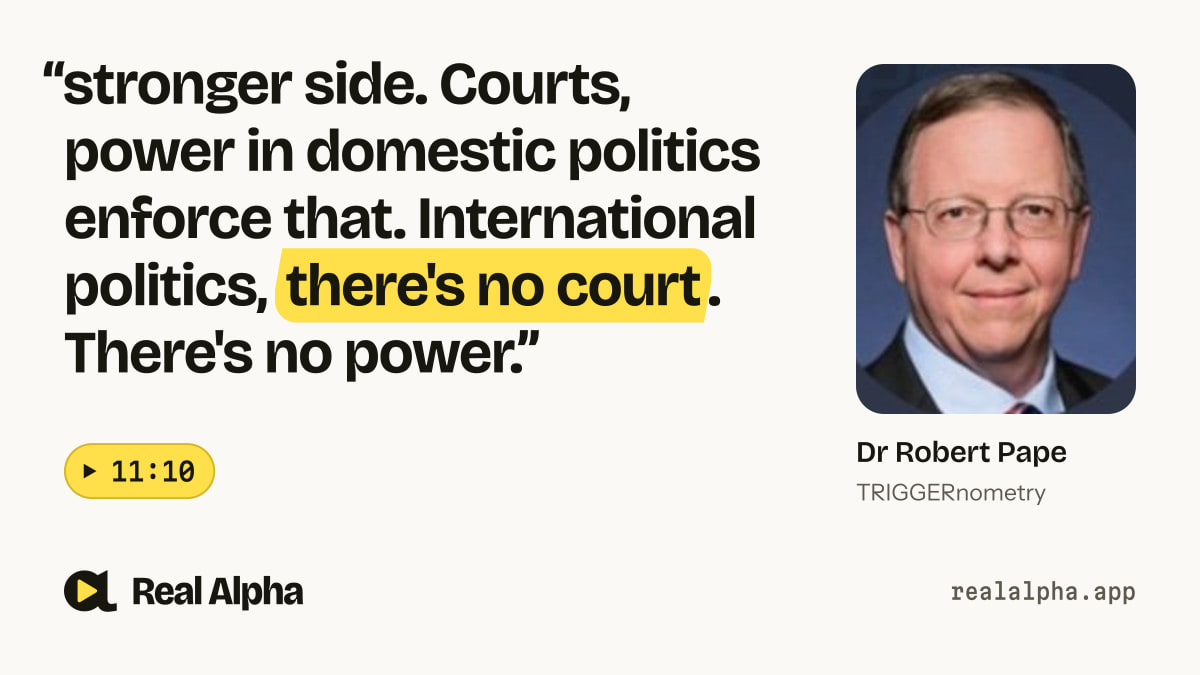
“stronger side. Courts, power in domestic politics enforce that. International politics, there's no court. There's no power.”
 Dr Robert Papeat 11:10 · TRIGGERnometry
Takeaways
- He says a concession can signal vulnerability to future pressure.
- Without an international enforcer, he says a signed deal may not hold.
- He says Germany surrendered after a ground war, not a blockade alone.
About this segment
Robert Pape argues international blockades cannot compel durable concessions because no court can enforce the bargain. He points to Germany in World War I, where mass civilian deaths did not end resistance.

Robert Pape is a political scientist and University of Chicago professor.
Founded and directs CPOST, and developed the Escalation Trap model of modern warfare.

Konstantin Kisin, Host

Francis Foster, Host
From “"This Is the Age of Political Violence" – Dr Robert Pape”, Oct 28, 2026. Watch the full episode
Thanks. We'll look at and fix what's off.
Transcript
Transcribed by machine (Whisper) from the episode’s audio, so a word may be off here and there.
- 10:21
People with no expertise, but the sort of a logical, rational perspective might go, hold on a second. If Iran is so reliant on their oil and gas and diesel and fertilizer and whatever exports, and we cut that off and they can't get any money in, surely that's a great solution. We are the bigger power. The world is a much bigger economy than Iran, that's a no-brainer. If this was a business deal, that would be exactly the way to approach it. A lot of folks, and I've talked to many, many, many folks in business about this, because they make deals all the time. Well, what do you mean that there's not an incentive for Iran? The problem is that the difference is in a domestic business deal, if I get squeezed and we cut a deal and we sign on the dotted line, there's some court, there's a judge.
- 11:16
there's a power to enforce your side. I'm the weaker side. I've made the deal. You're the stronger side. Courts, power in domestic politics enforce that. International politics, there's no court. There's no power. The only enforcement tool is my power to hit you back again. That's a very different world. And so what that means is if I concede because you're hurting me now and I give you that concession, I am going to be weak now with my own public. My government is embarrassed and so forth, but it's worse than that because I'm now incentivizing you six months from now, a year from now to come back for another bite of the apple.
- 12:06
I already if I give in to you now at stage one, I am demonstrating to you I am vulnerable at stage two, three and four. And there is nothing holding you back. There is no court out there. The U.N. is not an international government that has an army that will come and sit on top of New York City and enforce any deal that Trump signs. That's why Trump could sign the MOU literally in front of all of our eyes and five days later break it almost four or five different articles.
- 12:43
And it all just falls apart as I one of the big predictions after your show, one of the big predictions I made. So I think on our notes, they're going to lay out all the eight predictions and you'll see the dates that I made those predictions. They're on the sub stack. You'll see that these are predictions before the fail. and you'll see that eight out of eight correct calls over these months. And one of them was what I just laid out, the failure of the MOU in exactly those terms.
- 13:13
So it goes to attempted counter-blockade effectively, right? That's right. So the blockades in history on their own are known failures and they lead to then ground forces usually to actually succeed. So in World War I, Britain with Winston Churchill as First Lord of the Admiralty did a major economic blockade on Germany in World War I. 700,000 German civilians died due to that blockade. Let me say that again. World War I, the British blockade kills 700,000 German civilians. Germany doesn't concede. Now, Germany does ultimately concede when there's a massive ground war and influx of a huge amount of new fresh troops from America. That changes the balance of power that had been stalled for so long. So it's not that the blockade wasn't there. It's not that the blockade wasn't incredibly vicious on German
- 14:26
civilians here. It's that this logic I just explained, which is once you concede to that punishment, you're just making yourself more vulnerable for another round. And there's nobody out there to protect you. You have no protector of a court. So that's why this is not a business deal. See, I think we went into this war with not a great understanding among our leaders of how international politics really works. They might have good understanding how business works. I'm really not challenging that issue here. I'm really challenging the issue of whether what works in business is going to translate into international politics directly. And this war is showing no.
- 15:16
No, there's a huge disconnect here.