The alpha, twice a week
That was 3 min.
Get the best new moments in your inbox every Wednesday and Saturday. It's free.
Check your inbox
We sent a link to your address. Click it to finish signing up. Not there in a minute? Look in spam.
or
Pod Save America · 3 min · Nov 10, 2026
Why Slotkin says Gaza changed her vote on Israel aid
Elissa Slotkin says the use of humanitarian aid and her Iraq service changed how she viewed the military-aid resolutions.
In this episode
Full analysis- 24:02How McBride would build a Democratic economic agenda3 min
- 58:31Why Landrieu says ICE enforcement alienated Trump voters3 min
- 1:23:40Why Slotkin wants a new approach to Senate leadership4 min
- 1:01:36Why Van Hollen says he went to El Salvador for Abrego Garcia5 min
- 44:13Why Landrieu says Medicaid cuts moved a Trump voter3 min
- 1:32:15Why Slotkin says Gaza changed her vote on Israel aid3 min
- 50:07Why McBride thinks Trump may bargain over Democrats' priorities6 min
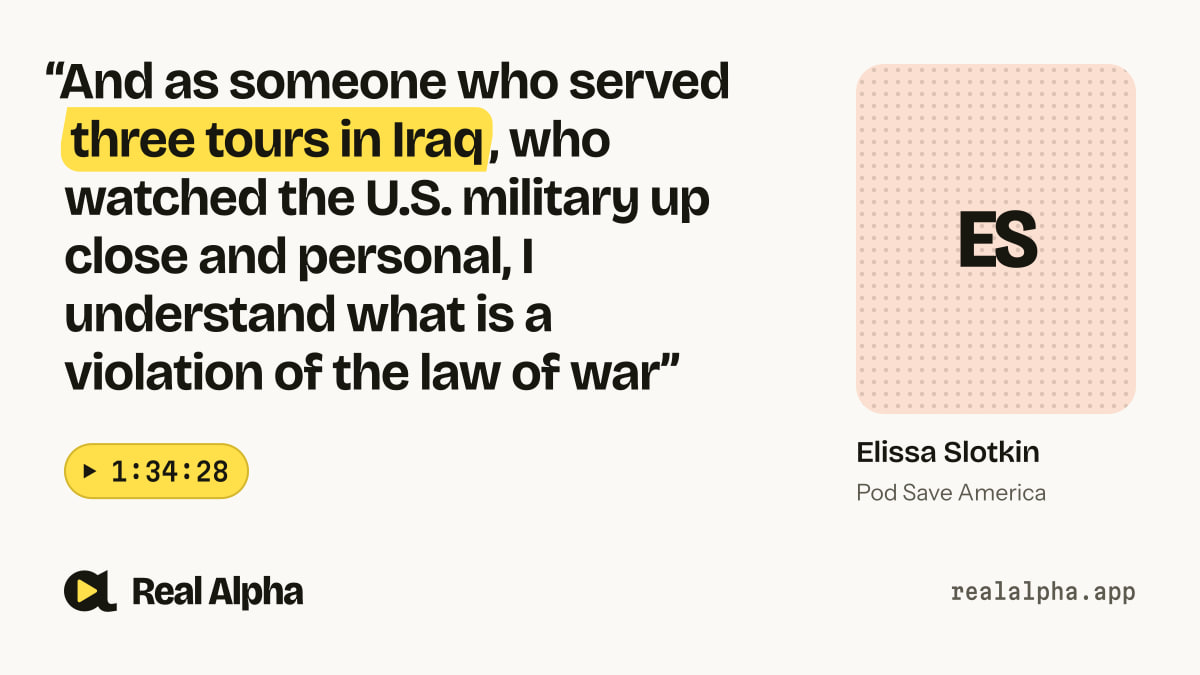
“And as someone who served three tours in Iraq, who watched the U.S. military up close and personal, I understand what is a violation of the law of war”
Takeaways
- Slotkin says humanitarian aid's use changed her vote.
- She cites three Iraq tours as shaping her view of wartime conduct.
- She argues the U.S. should use its leverage appropriately.
About this segment
Elissa Slotkin says the use of humanitarian aid and her Iraq service changed how she viewed the military-aid resolutions. She argues the U.S. should use its leverage appropriately in a changed relationship.

Jon Favreau, Host

Jon Lovett, Host
From “Democrats' 2027 Priorities: Fight To End Trump's Iran War, Lower Prices & Medicare For All”, Nov 10, 2026. Watch the full episode
Thanks. We'll look at and fix what's off.
Transcript
Transcribed by machine (Whisper) from the episode’s audio, so a word may be off here and there.
- 1:32:24
So you were among the majority of Democrats who voted yes on a resolution in April. That was about ending a subset of military aid to Israel. There's two resolutions. You were a yes on both. Some of your colleagues were a yes on one. The number that have been supporting resolutions like that has grown, including your vote, right? The previous April, you had been a no. So I'm curious what changed for you and how you see your role going forward. I talked about this with Brad Lander, who's an incoming freshman. I talked about this with Abdul and what it looks like for Democrats to shape a policy that's not just about stopping what is clearly not working, but shaping something that is a positive view of how to use our leverage with Israel towards both a solution but also the dignity and and human rights of Palestinians yeah I mean I think
- 1:33:27
I would just say that the resetting of the relationship is happening in real time I mean it was the day before the election but the president of the United States said Bibi Netanyahu asked me to not send more money I mean there there is meaning over three billion So I think there's a real conversation, especially with the Israeli elections as well, that what is the future of the U.S.-Israel relationship look like?
- 1:33:55
And how do we graduate from this model of financial dependence and U.S. taxpayer dollars funding huge portions of their defense budget? How do we change that to right-size it for a very different moment in our history and a very different moment in their history? And there's, you know, Bebe gave a speech. about this. I mean, this is, it's interesting to me that it's happening on both sides of the ocean.
- 1:34:22
And I think that that is right. I think that for me, what was different last April or two Aprils ago, maybe, was the literally weaponizing of humanitarian aid. And as someone who served three tours in Iraq, who watched the U.S. military up close and personal, I understand what is a violation of the law of war, what is the use of military force, excessive use of force, in a way that the United States would never be able to do in a war zone. So that, to me, kind of broke me.
- 1:35:04
And, um, that's why I, I voted the way I did and have since then. Um, but I think the, um, the, the, the kind of overall message, um, is the country wants something different. Um, and we need to hear that, um, and need to use that leverage appropriately.