The alpha, twice a week
That was 4 min.
Get the best new moments in your inbox every Wednesday and Saturday. It's free.
Check your inbox
We sent a link to your address. Click it to finish signing up. Not there in a minute? Look in spam.
or
The Weekly Show with Jon Stewart · 4 min · Oct 28, 2026
Why Zitron says AI labs depend on a brittle customer base
 Ed Zitron
 says 80% of OpenAI and Anthropic revenue comes from 1% of customers, many venture-backed startups.
In this episode
Full analysis- 22:53Why Zitron says AI labs’ compute commitments require huge growth5 min
- 27:49Why Zitron says AI labs depend on a brittle customer base4 min
- 33:31Why Zitron says AI labs' spending differs from Amazon's buildout3 min
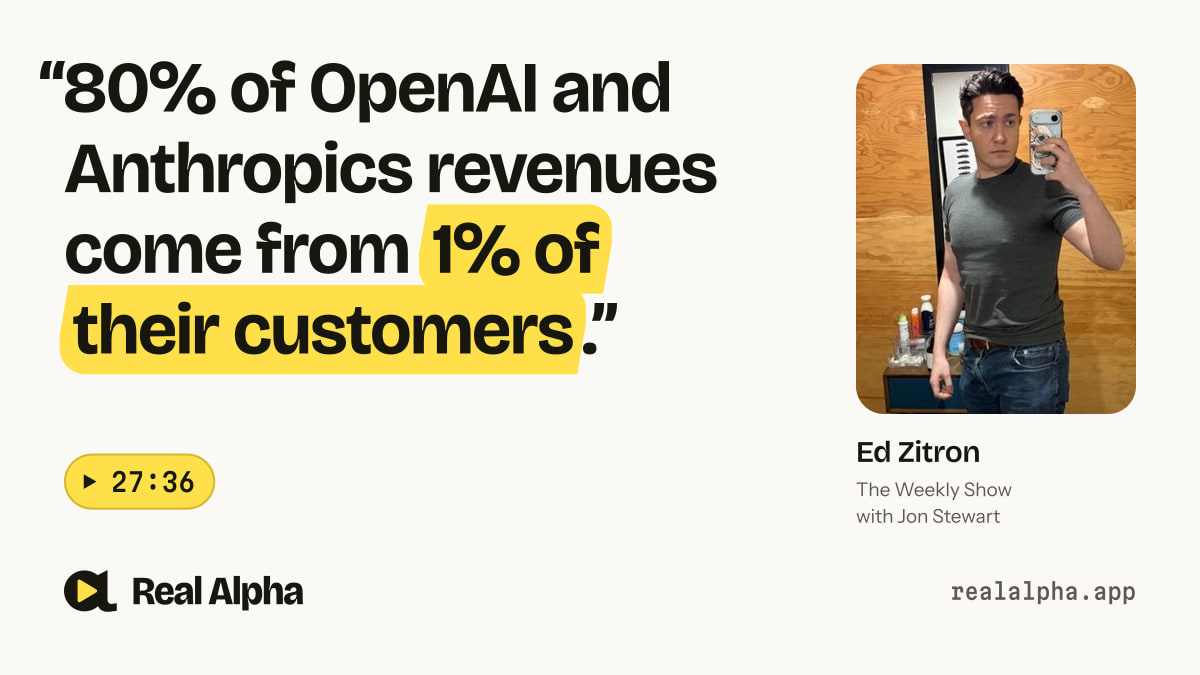
“80% of OpenAI and Anthropics revenues come from 1% of their customers.”
 Ed Zitronat 27:36 · The Weekly Show with Jon Stewart
Takeaways
- Zitron says 80% of revenue comes from 1% of customers.
- He says many are venture-backed AI startups running at a loss.
- He argues that makes the labs’ customer base brittle.
About this segment
Ed Zitron says 80% of OpenAI and Anthropic revenue comes from 1% of customers, many venture-backed startups. He argues their losses make that demand fragile.

Ed Zitron is CEO of EZ Primary Research, writer of Where’s Your Ed At? and host of Better Offline.
Hosts Better Offline and writes Where's Your Ed At, a prominent critic of AI industry hype.

Jon Stewart, Host
From “Data Centers, Debt & the Risks of AI’s Finances w/ Ed Zitron | The Weekly Show with Jon Stewart”, Oct 28, 2026. Watch the full episode
Thanks. We'll look at and fix what's off.
Transcript
Transcribed by machine (Whisper) from the episode’s audio, so a word may be off here and there.
- 28:01
card company called Ramp, 80% of OpenAI and Anthropics revenues come from 1% of their customers. And most of those customers are venture-backed AI startups that run their services at a massive loss. Okay. Okay. Okay. I want to roll this one back because this one... All right. So my understanding of all of this is probably steeped in the television business. Again, Netflix streaming. I'm thinking of it in terms of customers who pay a fee to utilize a service that is necessary for them to run their business.
- 28:27
So we're talking about the $100, $200 a month, whatever they might charge a company to use their compute. You're saying that's only 20% of their revenues. 80% of their revenue are actually other AI startups. And those AI startups, they're not paying a user fee. What are they paying for? So remember I mentioned the API earlier. So connecting your stuff to the models? Yes. What is API? I'm going to forget the term, but it just means the way that you connect your service to another service.
- 29:07
So you're running, there's a AI legal service called Harvey. They use the API so that their software runs using OpenAI or Anthropics models. Jillian just popped into the chat. Application programming interface. They're going to have my guts for garters for getting that one. Software that talks to each other. So they have to connect to the big brain or their AI startup does not function. Yes. And then there's the other problem, which is on these companies, and when you use, say, Perplexity, which is an AI search company, and you pay them 20 bucks a month, you can run up a token spend of like 60 bucks or 70 bucks or 80 bucks a month.
- 29:52
So they're running at a loss. Exactly. And what's crazy is, is that everyone says, wow, Anthropix growth, OpenAI's growth, it's so impressive. How is it so impressive? The answer is, is that they have a bunch of venture-backed startups that run their services at a loss and have users who say, hey, I want to use the latest models, the latest more expensive models. The latest models as well, the prices may seem lower or similar, but they burn more tokens and they actually output tokens. So they create the thing that it gives you. Those are more expensive.
- 30:28
So everyone is crediting the growth of these companies to some sort of diverse revenue model when a large chunk of that revenue is based on basically the ninja borrowers from the great financial crisis of the AI generation. These people that can only afford to pay for all these tokens as long as venture capital holds them up. And this is a genuinely scary thing because it means their customer base is inherently, definitionally brittle.
- 31:02
So everybody's burning money on all ends of this. This is a house of cards held up by other houses of cards. and is the assumption here, because it's a, and we'll deal with this