The alpha, twice a week
That was 5 min.
Get the best new moments in your inbox every Wednesday and Saturday. It's free.
Check your inbox
We sent a link to your address. Click it to finish signing up. Not there in a minute? Look in spam.
or
Bloomberg Business of Sports · 5 min · Oct 24, 2026
WNBA teams are reaching a largely new fan base
Morgan Shaw Parker says women’s sports audiences differ sharply from traditional men’s sports audiences, citing low overlap and family attendance.
The episode’s best minutes
Full analysis- 5:06Atlanta rebuilt community trust before selling more inventory7 min
- 12:28WNBA teams are reaching a largely new fan basePro pick 5 min
- 17:15Atlanta tested demand before committing to a larger arenaPro pick 4 min
- One more moment in the full episode
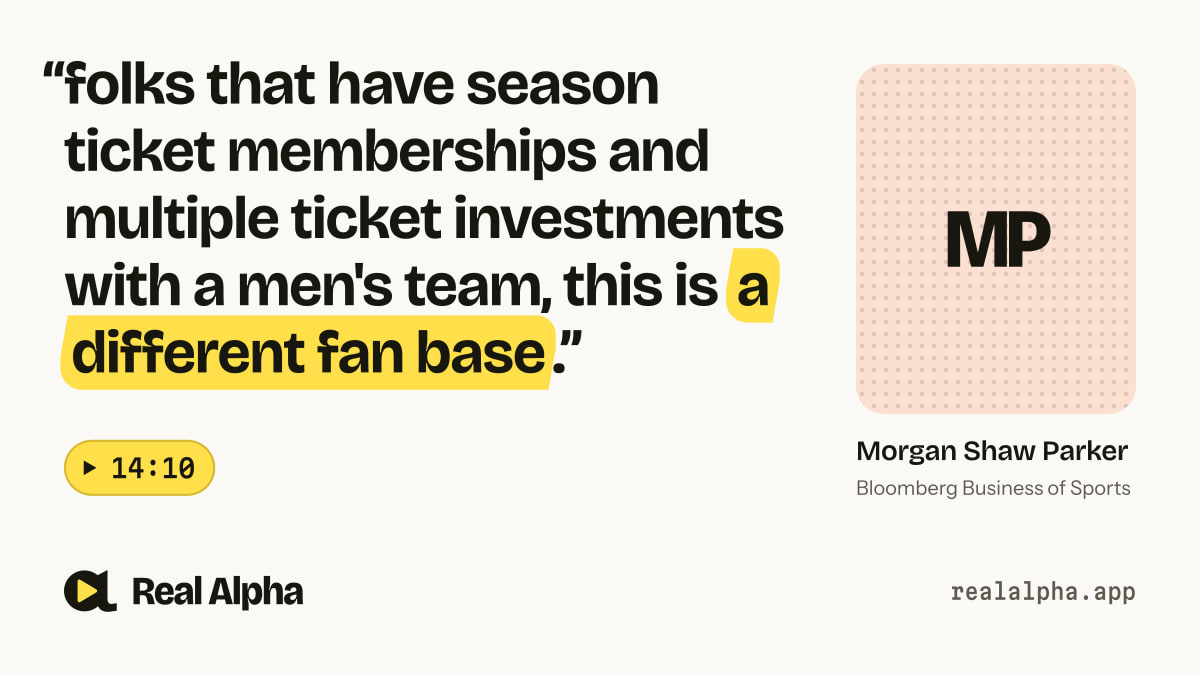
“folks that have season ticket memberships and multiple ticket investments with a men's team, this is a different fan base.”
Takeaways Pro pick
- Only 10% of the Dream’s fans overlap with men's professional sports.
- About 66% of fans bring a child to games.
- Parker says teams must adapt to this audience instead of copying men's sports.
One of Pro's picks, open to you here. Try Pro free for 7 days
One of Pro's picks. The rest of the summary and the 3 takeaways are in Real Alpha Pro; the video, the quote and the transcript stay free.
Read it with Pro, 7 days freeAbout this segment
Morgan Shaw Parker says women’s sports audiences differ sharply from traditional men’s sports audiences, citing low overlap and family attendance. Teams need to learn who these fans are rather than copy old models.
Morgan Shaw Parker is president and chief operating officer of the Atlanta Dream.
- VP
Vanessa Perdomo, Host
- MB
Michael Barr, Host
- RW
Randall Williams, Host
From “BONUS: Atlanta Dream President Morgan Shaw Parker on WNBA Finals Run | Bloomberg Business of Sports”, Oct 24, 2026. Watch the full episode
Thanks. We'll look at and fix what's off.
Transcript
From the transcript Bloomberg Business of Sports publishes with the episode.
- 12:31
The community part of the business or the corporate part of the corporate part of the business? Oh, my gosh, it's changed. I mean, every single year we grow, we add more people on our corporate partnerships team, we, we are assessing the market, you know, back in 2021, it was, you know, these amazing partners who had really been hanging on but weren't necessarily seeing the return on their investment.
- 12:55
And what I believe, and I think so many of our WNBA organizations have proved, is that women's sports is really an underdeveloped commercial opportunity. So these partners can come in and advertise with us, but they can also roll up their sleeves. And the money that they're placing into our organizations is going into supporting athletes, supporting communities, and Overall growth and infrastructure itself. And what we're finding is that our fans will give back that tenfold to those organizations.
- 13:29
And so it really is special. And there's so much data to prove that now. And I think we've seen such growth in women's sports over the last five years. I'm really excited to see where it goes from here.
- 13:41
Yeah, some of the points with women's sports fans is that they're more willing to engage with brands that support their women's sports teams. They engage at a higher point than fans of men's sports.
- 13:53
They do, and it's a fact, and we have proven it time and time and time again. I think one of the most interesting stats, and we're still learning about this evolving fan base as we go, is that there's only a 10% overlap with men's professional sports, meaning that folks that have season ticket memberships and multiple ticket investments with a men's team, this is a different fan base. Most of our fans have never been to these sporting events before. And so when you think about 90% new audience coming in time and time and time again, and 66% of them are bringing a child, we over-index on families, we over-index on new fans, And it's male and female.
- 14:40
It's all demographics. And so what excites me the most is there's so much more to learn, which then goes back to the core belief that I had at the beginning, which we are now proving out that these fans are so new in this environment. We cannot build the franchise like a traditional men's sports franchise. Yes, some of the infrastructure is the same. Do we need corporate partnerships? Do we need finance? Do we need accounting? Do we need HR? Absolutely, right?
- 15:10
But I think the approach is different. It needs to be different. And I think organizations and agencies are also splitting off these think tanks to really focus on what is this data telling us? What do we know about this quote unquote new market of fans and how do we serve them? Where do we go with them and how do we learn more? So to me, that's one of the most exciting places we are along this journey.
- 15:40
Was it something even you yourself had to learn with being in men's sports for so long, coming into this, knowing that it obviously wasn't going to be the same, but that the fans were as different as they are?
- 15:51
I didn't even know it. I suspected there was something like that, but I had to learn. At Nike, something that I learned for the 10 years that I was there is they're very intentional about moving people around every couple of years because they want you to have a very well-rounded understanding of different markets. So when I started there, my very first day, I had a background in men's professional sports, a lot of years in men's professional. Well, they wanted me to work on the women's sports for a minute. And I thought to myself, I'm like, man, do they think that I don't know my stuff? Because I'm really good in the men's sports space. And what I found out over time is they wanted a different perspective.
- 16:34
And so to come full circle, I worked at Nike in Olympics and World Cups and NBA, WNBA, running. Then come full circle, I was able to launch our NFL partnership in 2012. What was so interesting about that is I earned that opportunity there because I had perspective across all industries so I could think about it differently. I think for me, that has been so applicable at being able to learn about this new fan base that we are now uncovering and learning about them. I mean, we always talked about at Nike how it is so important to be a sponge. I'm loving being a sponge right now.