The alpha, twice a week
That was 3 min.
Get the best new moments in your inbox every Wednesday and Saturday. It's free.
Check your inbox
We sent a link to your address. Click it to finish signing up. Not there in a minute? Look in spam.
or
Founders · 3 min · Nov 18, 2026
Writing goals can keep useful opportunities top of mind
Brian Armstrong treats repetition as a way to keep a goal salient and spot chances to act.
In this episode
Full analysis- 17:09Agents work best when they own an area of responsibility6 min
- 29:49Agent commerce needs decentralized AI and payment rails4 min
- 53:44AI can move investing from orders to personalized advice3 min
- 0:23Writing goals can keep useful opportunities top of mind3 min
- 12:50Civilization offers a model for balancing strategic fronts3 min
- 44:37Generalizing internal AI tools can take 10–50 times more work4 min
- 49:29A small improvement rarely gets customers to switch providers4 min
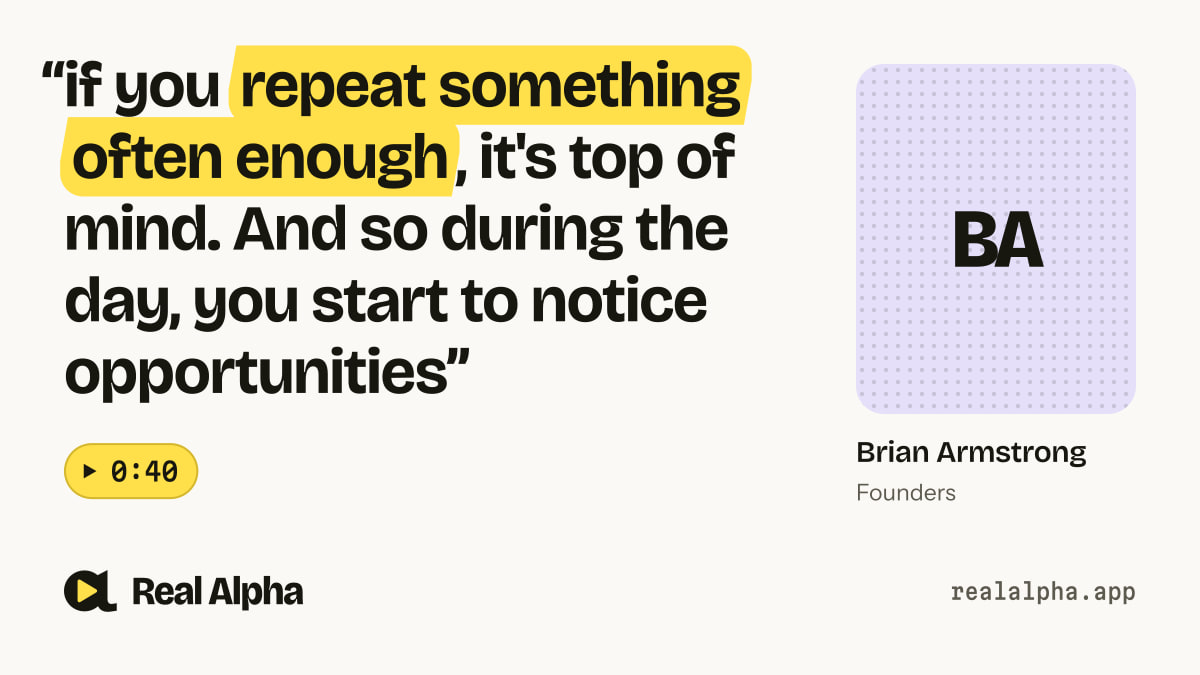
“if you repeat something often enough, it's top of mind. And so during the day, you start to notice opportunities”
Takeaways
- He treats repetition as a way to notice relevant opportunities.
- He wrote down a goal to start a billion-dollar tech company.
- He reframed CEO conflict as difficult, meaningful work.
About this segment
Brian Armstrong treats repetition as a way to keep a goal salient and spot chances to act. He used it to pursue a billion-dollar company and reframe hard CEO conversations.
Brian Armstrong is cofounder and CEO of Coinbase.

David Senra, Host · Host, Founders
Has read an entrepreneur's biography every week for Founders since 2016.
From “Why Now Is The Golden Age of Building | Brian Armstrong, Coinbase”, Nov 18, 2026. Watch the full episode
Thanks. We'll look at and fix what's off.
Transcript
Transcribed by machine (Whisper) from the episode’s audio, so a word may be off here and there.
- 0:29
I think he's right. I mean, I've definitely experienced this in my own life where, you know, I'll write down something that's like a goal or something I'm trying to work on. And I think some people have this like kind of woo-woo like thing about it. They're like, oh, you're manifesting something in the universe. I think it's actually much simpler than that, which is just if you repeat something often enough, it's top of mind. And so during the day, you start to notice opportunities that might help you move a little closer to that or practice it. And it's just a way of keeping things top of mind.
- 0:58
And I guess another mental model of this would be like, you know, your brain is like a neural network. And every time you reinforce something, it just updates the weights in your model, kind of like an AI model. And so literally just repetition. I mean, people have known this for thousands of years, right? Like prayer and meditation. And repetition just strengthens the neural pathway. I don't know if that's like accurate from a neuroscience point of view, but it's sort of a metaphor of how I think about it.
- 1:22
So some of the examples for me, I mean, in my 20s, I remember writing down like, I want to start a billion-dollar tech company. And I didn't even have any business writing that down because I'd never started a million dollar tech company or a hundred dollar tech company. But I wrote that down a lot. And I was like, OK, I was starting to look for ideas and opportunities and try things. Some of them work, some of them didn't.
- 1:40
And, you know, then I moved to Silicon Valley when I was maybe 29. And within six or seven years, I was the founder of a billion dollar tech company. Right. So that was interesting. And then early on as being a CEO, I think I was pretty conflict averse. right and sometimes being CEO you have to have just hard conversations with people all the time right it's like these two people aren't getting along you got to fire this one you've got to go make a hard call and so who do I want to disappoint today because only only the biggest problems come to you hopefully the rest are getting delegated and I started writing this down at one point I was like I need to reprogram my brain to not think of this as super stressful but think of it as it's me getting valuable things done to move forward towards the goal and so I
- 2:20
I remember writing this down a lot. It was like, I love conflict. I love conflict. I love conflict, right? And it doesn't mean I go out and like actively seek that and just to piss people off or whatever, but... If it does happen, I can get somewhat excited about it now. I'm like, okay, I'm about to do something difficult and meaningful and like, let's move it forward. Or if I'm in a meeting with the team and I'm like, the work is not good enough.
- 2:42
There's something wrong here. Like I'm feeling myself getting angry. I'm like, how can I use this as an empowered anger to actually help create change that will create a better outcome? So anyway, those are some things I've written down and practiced.