The alpha, twice a week
That was 4 min.
Get the best new moments in your inbox every Wednesday and Saturday. It's free.
Check your inbox
We sent a link to your address. Click it to finish signing up. Not there in a minute? Look in spam.
or
Bloomberg Businessweek · 4 min · Nov 20, 2026
Xi's succession dilemma is that sharing power requires trust
 Minxin Pei
 explains why Xi Jinping has little incentive to start grooming a successor, despite the risks of delaying.
The episode’s best minutes
Full analysis- 15:51AI fears are driving two kinds of stock sellingPro pick 2 min
- 28:21Anthropic's IPO leaves its business model's biggest questions open3 min
- 33:38Xi's succession dilemma is that sharing power requires trust4 min
- 3 more moments in the full episode
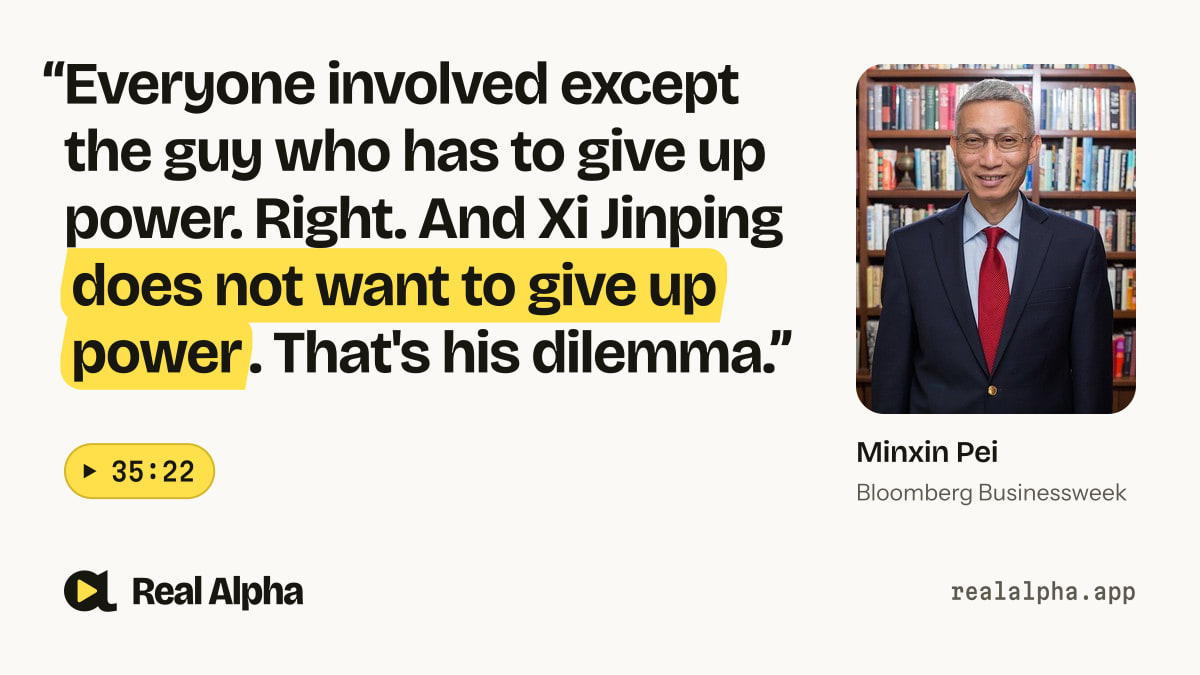
“Everyone involved except the guy who has to give up power. Right. And Xi Jinping does not want to give up power. That's his dilemma.”
 Minxin Peiat 35:22 · Bloomberg Businessweek
Takeaways
- A party congress next year is a key opportunity to begin succession planning.
- Xi has no legal obligation to step down.
- A successor cannot take over effectively without power beforehand.
About this segment
Minxin Pei explains why Xi Jinping has little incentive to start grooming a successor, despite the risks of delaying. A successor needs power before taking over, but granting it requires trust.

Professor of Government, Claremont Mckenna College
Studies Chinese politics and authoritarianism; authored The Broken China Dream and The Sentinel State.
- CM
Carol Massar, Host · Bloomberg

Tim Stenovec, Host · Co-host, Bloomberg
Interviewed leaders including Reed Hastings, Stephen Schwarzman and Mary Barra as a Bloomberg Businessweek co-host.
From “Anthropic Debuts on the Nasdaq in Record-Breaking IPO | Bloomberg Businessweek”, Nov 20, 2026. Watch the full episode
Thanks. We'll look at and fix what's off.
Transcript
From the transcript Bloomberg Businessweek publishes with the episode.
- 33:40
I want to start with the questions that he faces over the next decade or so. Let's start with the first one, whether to initiate a succession process. When does that decision have to be made?
- 33:53
Well, ideally, he should be making this decision next year. That is, there's a party congress sometime in October or November next year. And if he wants to hand over his power, he should start a process identifying one or two people and then promoting them to the Politburo. And the key thing is their age. They have to be under 55 so that he. Well, if they are 60, under 60, if she steps down, then they can take over. If they're 55, that shows she might want to step down in five years' time.
- 34:33
But we're not seeing any sign of this. And he can't delay, right? Well, he can delay. He's given every signal that he wants. To hold on. There's nothing in the law, in the Chinese constitution, in the party's constitution, that he has to step down.
- 34:54
But, I mean, you get into this in the article and noting on some other leaders, whether it was Joseph Stalin, the late Soviet dictator. I mean, it is important for a country, right, to really put in place– I think about this as kind of ironic when we're talking about NVIDIA and Jensen Wang and there really wasn't a succession. Plan in place. It is better– typically for everyone involved to have a succession plan in place.
- 35:23
Yes, but there's an exception. Everyone involved except the guy who has to give up power. Right. And Xi Jinping does not want to give up power. That's his dilemma. It's good for the country, but not good for Xi Jinping. So how has it worked in the past?
- 35:40
Because the title of your piece is the question, Make Like Mao or Play It Like Deng.
- 35:45
Mm-hmm. What's the historical precedent here? Well, China does not have a good record.
- 35:51
On the mall, he died without a clear successor. And the succession issue had to be resolved by a military-backed coup. Deng Xiaoping did it better, but still he had to purge two successors he picked. And then finally, he almost sort of abandoned Deng. the succession process. But eventually, I identified somebody who took over and followed his policy.
- 36:23
Dr. Pei, you know, I would think that President Xi, like he needs to think about, he thinks everybody who's been a leader for a long time, or even for a short time, they think about their legacy, right? And they want the programs that they put in place, the policies, you know, to stay in place. So picking a successor, you hopefully pick someone who is of, say, mind, if you will. But when you're living in.
- 36:49
A place like China, you're surrounded by probably a lot of yes people, right? So you don't really necessarily know how someone feels about something. And is that part of the predicament in terms of why President Xi is not so quick to step away?
- 37:04
Yeah, I think it's part of the equation. That is, how can you tell whether somebody who says long-lived Xi Jinping every day is actually sort of putting on a show. So that's a problem every strongman or every dictator faces. And Xi has the same problem. The other problem is that even if you genuinely trust somebody, you have to give him some power so that the guy can take over. You cannot keep your successor on ice most of the time.
- 37:41
And then on the day you're going to die, you say, okay, you take over because that guy cannot take over. So that's both the power and lack of trust.