The alpha, twice a week
That was 3 min.
Get the best new moments in your inbox every Wednesday and Saturday. It's free.
Check your inbox
We sent a link to your address. Click it to finish signing up. Not there in a minute? Look in spam.
or
Prof G Markets · 3 min · Nov 4, 2026
Zero-day options can make markets more short-term
Tom Lee says zero-day options compress investors’ horizons, while repeated shocks make each sell-off feel like a bubble warning.
In this episode
Full analysis- 5:27Lee says AI differs from past bubbles while innovation continues7 min
- 14:08Lee expects a post-midterm relief rally4 min
- 2:19Zero-day options can make markets more short-term3 min
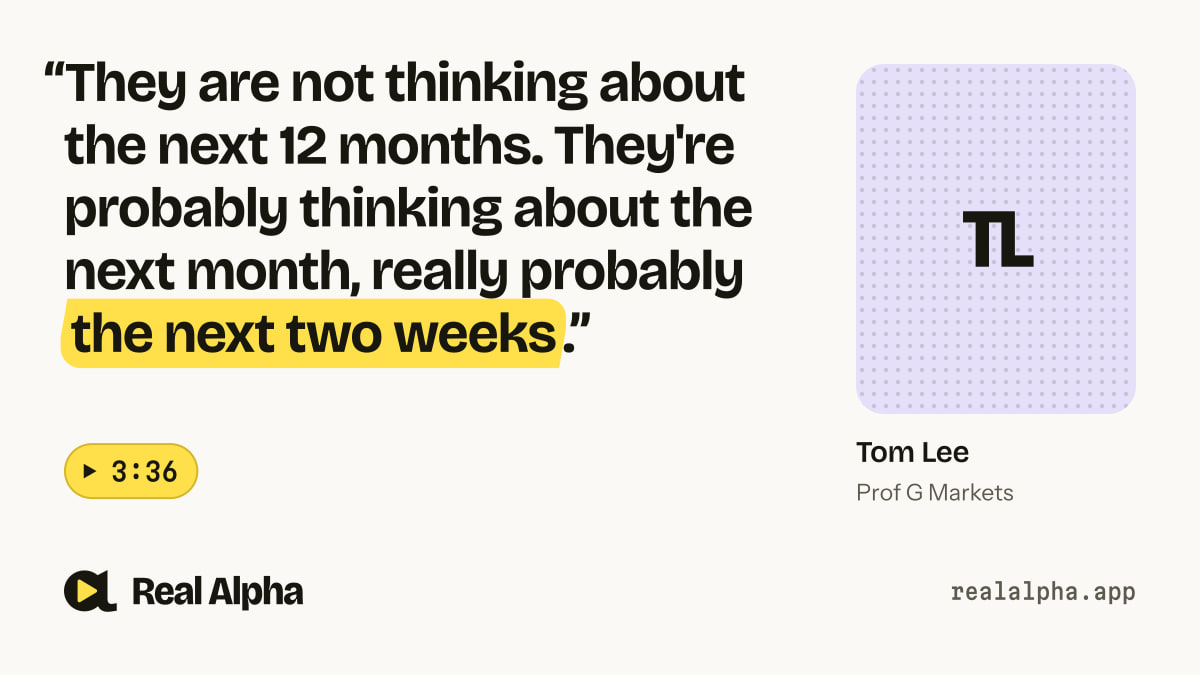
“They are not thinking about the next 12 months. They're probably thinking about the next month, really probably the next two weeks.”
Takeaways
- Zero-day options encourage highly leveraged, short-term positioning.
- Institutions respond to a market focused on the next few weeks.
- Recent shocks make investors pattern-match new downturns to past bubbles.
About this segment
Tom Lee says zero-day options compress investors’ horizons, while repeated shocks make each sell-off feel like a bubble warning. He explains how short-term trading can amplify market worries.

From “Tom Lee: The Correction Is Over — Stocks Are About To Surge”, Nov 4, 2026. Watch the full episode
Thanks. We'll look at and fix what's off.
Transcript
Transcribed by machine (Whisper) from the episode’s audio, so a word may be off here and there.
- 2:31
but why does this keep happening? I mean, it's true. Like, this does feel like deja vu. And then in the other sense that it feels like we're repeating history is, you know, you've got the NASDAQ down 10% in the past month. And then you've got this rotation into all of these non-AI stocks, which is why the equal weight is up more than 4%. And so you look at the overall stock market. And, you know, if you were to just look at the AI names, you'd think that it's chaos. But the S&P has not been hit that hard. We're still up, you know, more than 10% year to date.
- 3:06
So it almost feels like we keep on thinking. that a correction is about to occur. It does occur, but then it seems to be a lot less problematic than a lot of people expected. Why do you think this is happening? What are some of the dynamics that go into that? I think a lot of this is behavioral economics at work as well as mechanical. Let me just start with the mechanical. I think that there, as you know, has been an explosion of zero day trading options, so short-term uses of leverage. I mean, And that's basically the same as margin trading.
- 3:43
It's a highly levered bet. And therefore, investors are employing a very myopic time frame. They are not thinking about the next 12 months. They're probably thinking about the next month, really probably the next two weeks. And for the professional investor, the institutional investment world, which is still half of trading volumes, they have to respond to that. So I think the market has now become very short-term oriented. That's why quarterly earnings seem like long-term because someone's going to be like, whoa, that's not for another 90 days.
- 4:15
But the behavioral economics at work, I think, is that the world has faced seven black swans in just the last six years. COVID, the inflation cycle, the fastest Fed hikes in history, the U.S. bombing Iran, you know, declaring war on Iran, these tariff wars on top of the GFC, which wasn't that long ago, and the internet bubble. And so I think there's a lot of pattern matching that people say, oh, well, we have another bubble in the making. This time it's AI. And a lot of people miss the AI trade. The ones who've missed it are the ones that are most declarative that this is a bubble.
- 4:54
What do you make of the AI bubble concerns? Because, I mean, the way I look at it, there are some pretty clear signs of bubblicious behavior like circular financing.