The alpha, twice a week
That was 7 min.
Get the best new moments in your inbox every Wednesday and Saturday. It's free.
Check your inbox
We sent a link to your address. Click it to finish signing up. Not there in a minute? Look in spam.
or
The Pragmatic Engineer · 7 min · Oct 21, 2026
ZIRP pushed managers toward hiring and people-focused work
 Will Larson
 connects low interest rates and fierce hiring competition to management norms that prioritized retention and employee experience.
The episode’s best minutes
Full analysis- 19:39Digg launched a rewrite without load testing or rollback capacityPro pick 6 min
- 50:47ZIRP pushed managers toward hiring and people-focused workPro pick 7 min
- 1:33:30Middle managers may need to return to hands-on engineeringPro pick 6 min
- 4 more moments in the full episode
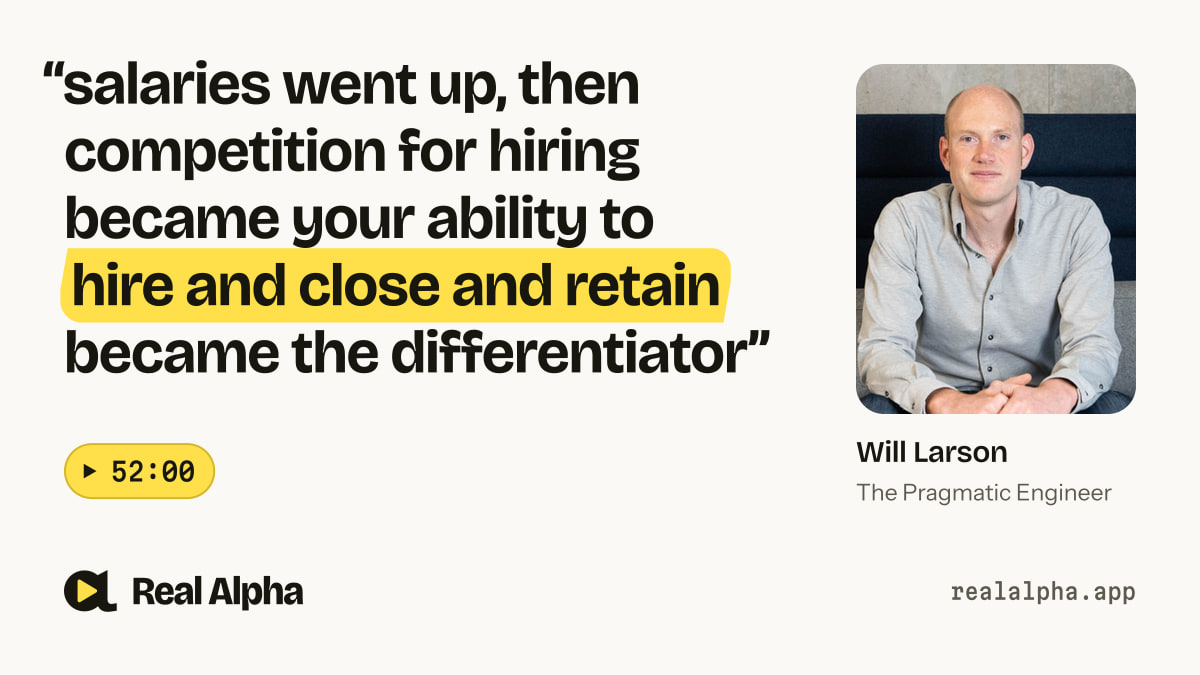
“salaries went up, then competition for hiring became your ability to hire and close and retain became the differentiator”
 Will Larsonat 52:00 · The Pragmatic Engineer
Takeaways Pro pick
- Hiring and retention became competitive advantages.
- Managers were encouraged to shield engineers from business pressures.
- Without technical decisions, managers leaned on headcount and process.
One of Pro's picks, open to you here. Try Pro free for 7 days
One of Pro's picks. The rest of the summary and the 3 takeaways are in Real Alpha Pro; the video, the quote and the transcript stay free.
Read it with Pro, 7 days freeAbout this segment
Will Larson connects low interest rates and fierce hiring competition to management norms that prioritized retention and employee experience. He argues that sidelining technical decisions left managers leaning on headcount and process.

Will Larson is CTO of Imprint and author on engineering leadership.
Led engineering at Stripe, Uber, Calm and Carta; author of Staff Engineer and The Engineering Executive's Primer.

Gergely Orosz, Host · Host, The Pragmatic Engineer
Spent four years at Uber heading mobile, web and backend teams; shipped part of its payments system.
From “The revised rules of engineering management with Will Larson”, Oct 21, 2026. Watch the full episode
Thanks. We'll look at and fix what's off.
Transcript
Transcribed by machine (Whisper) from the episode’s audio, so a word may be off here and there.
- 50:54
Was this something to do with zero interest rates? We often come back to this, which is so curious. I wrote about this as well, how an interest rate, which feels so abstract, and we sometimes hear about it, how it probably impacted funding in tech for a very long time, probably hiring startups, startups that were funded that maybe didn't have a business model, but they were still funded. and ultimately software engineering archetypes manager types management decisions and then the music stopped sometime around 2022 where efficiency became more important and now we're kind of seeing this and now i think a lot of us are asking and i'm also asking myself the question like everything that we did during that time was it right at the time did you ever read i i'm gonna get his name wrong but i think it was like ron john roy's like uh zerp explains everything
- 51:41
blog post from The Margins. Yes, The Margins. We'll also link that. I love his writing, yes. One of my colleagues at Digg, who then I hired at Uber, was John Durek, who's the other writer on The Margins, along with, I think it's Ron John Droy. So I read that piece, and it really resonated, right? I do think that Zurp has explained the entire 2010s in terms of how management styles changed, salaries went up, then competition for hiring became your ability to hire and close and retain became the differentiator between these like successful companies, the less successful because you simply couldn't retain great people.
- 52:19
And that like pulled kind of leverage back into the engineer's hands and created like a very different environment. And so part of the way companies were pitching themselves was like more relaxed, more focused on you, more career development. And I think in ways that I think were often like kind of self-defeating. So I think there's this kind of like broad judgment of like the Google perk culture. And I don't think any company that did incredibly well other than maybe Google and Meta had that level of perk orientation. But I do think ignoring the perks, there are many other ways that companies try to focus on rewarding work, interesting work. You know, companies like, oh, engineers maybe shouldn't be on call. That's right.
- 52:59
the second tier SREs to be on call, which was interesting because that was actually a place where every single person I've worked with knows engineers being on call for the work makes the software better. And yet companies were still kind of like, oh, maybe for the enjoyment of it, we should let folks not be on call for the work they're doing and instead page other people that aren't involved in the creation of this software. And that orientation really reveals, I think that the shift in priorities in those companies.
- 53:28
I also wonder if that was a time where managers were rewarded for having low attrition on team, meaning few people left, being able to hire on the team to fill headcount, because often there was a time, this might sound crazy, but filling headcount was difficult. you were given let's say you had a team of 30 as a director or senior engineering manager you had 10 headcount this year and if you couldn't fill that meaning you couldn't hire the right people and this was like let's say senior and above so it was like you couldn't just get new grass because that would be too easy then it kind of counted a little against you or if someone else would get that headcount which might help their promotion because it was kind of obvious if you have 40 plus people you're now you might be senior manager that's your director title and so
- 54:13
managers who did well in this environment became a bit of people pleasers and also they started to shield their engineers from the business for example and i wonder if this shielding from the business has bitten back a lot of people because now as engineers you're increasingly expected to be savvy about the business understand the business that's when you're going to be in demand that's when in a startup or other places you get to hit the ground running and i still hear stories from people who worked at this big company the let's say a big observability company at any of them and they want to start up seven person start up and they say it's terrible like i'm uh they're not letting me do things and uh i'm like hang on you're a seven person company like how is it and you're an experienced person how is it that you're not asking what does the business need to do let's
- 54:57
do it boom and they've been socialized in a different place for a while yeah i think i think that is like a huge part of it in terms of the incentives i do think the orientation around like headcount filling team kind of management, like the employee kind of survey results. These are really valuable tools. I get like a lot out of them. But I remember spending a lot of time at these faster growing companies, like analyzing the quality of manager based on the survey results. But survey results are like, you have to really interpret them, like high scores or low scores don't mean good or bad manager. There's like context that ask other questions about like, hey, why is your team all upset about this?
- 55:37
That doesn't mean you're a good manager or not, right? And I think these became a little bit a goal of their own rather than an interpretation mechanism, which, you know, in a lot of ways is just like lazy kind of middle management in terms of how these are deployed. But I definitely, definitely saw that. And I think, in general, I think I hate headcount conversations, right? I think they're almost never the most interesting conversation.
- 55:59
But I think in a world where managers are not allowed to make technology decisions, the only lever they have to actually execute faster is headcount or prioritization. Oh, so are you saying that at that time and during Zerp where managers were, the conventional wisdom was do not make technical decisions, this forced savvy and smart managers to put way more focus on the non-technical side, potentially under-investing in the technical things, maybe just not making decisions that should have been done and over-indexing on the soft side or maybe shielding their team from the business for all these things because they put their energy there?
- 56:36
Oh, 100%. I think that's very true. Like for most, like what I tell my teams that I work with now is like the hiring is the least interesting way to solve every problem. Like we almost always should never talk about hiring. But the corollary to that is like if you have open headcount and ask for more headcount, we shouldn't talk about headcount either because like what matters then is like the hiring throughput and you actually like can't use more headcount anyway.
- 56:58
But yeah, I think we basically told managers they couldn't think about technology solutions. And then what do they have? They have like process solutions, they have scheduling or they have people. And so I do think this was the natural consequence of the bifurcation of these two roles, which isn't to say we shouldn't bifurcate at all. But I do think we need effective leadership to have both or they over anchor on kind of hiring. And that drives a lot of the bloated orgs we saw in the past.
- 57:22
Let's talk about careers, career development. Let's start with individual contributors. How