Full episode · 1 h 26 m
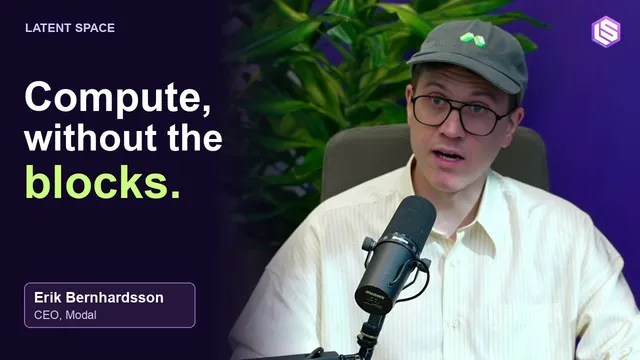
Why AI Compute Comes in Rectangles — Erik Bernhardsson, Modal
Erik Bernhardsson says Modal's edge is pooling compute so AI workloads can scale on demand instead of being locked into fixed GPU blocks.
 Latent Space · Shawn Wang (swyx) & Alessio Fanelli with Erik Bernhardsson
The best minutes
- 18:04GPU price drops can be riskier than continued scarcity4 min
- 43:35Fast sandbox snapshots could make parallel work practical4 min
- 52:58Good developer experience also helps coding agents5 min
Also worth watching
- 13:37Modal built a procurement team as GPU supply tightened4 min
- 28:28Neoclouds scale by pre-selling capacity to finance GPUs4 min
- 58:05Modal uses forward-deployed engineers to turn customer work into product4 min
- 39:14Small training is underserved, while fine-tuning is optional3 min
- 1:21:24Inference providers can shift capacity as model demand moves3 min
Skip the 13-minute opening career history and fundraising, the product catalog and integration tour, and the later hiring discussion.
Summary · 5 min read
Erik Bernhardsson spent seven years at Spotify, where he built the first version of its music recommendation system and helped launch features including Related Artists and Discover Weekly. He later served as CTO of Better.com for five years, then founded Modal, an AI infrastructure platform.
Bernhardsson says Modal combines a developer-focused platform with pooled compute capacity, which lets customers scale bursty AI workloads without buying fixed blocks of GPUs. He describes Modal's growth from serverless functions into sandboxes, now about one-third of revenue, and sees fast, snapshot-enabled sandboxes as a way to run agents and tests more efficiently. He is adding GPU capacity aggressively but warns that falling prices and utilization could put long-term commitments at risk. He also discusses security, developer experience, Modal's cloud-first model and possible new uses for AI.
Minute by minute
- 0:03
Modal packages AI compute. Bernhardsson describes Modal as a compute and storage platform with an SDK for deploying and scaling AI applications, including inference, sandboxes, training and batch jobs. He says revenue, users and usage had grown at least 50x since his previous Latent Space appearance. He traces Modal's roots to building Spotify's first music recommendation system and seeing how poorly the infrastructure supported AI work; he later spent five years as Better.com's CTO.
- 4:21
Stable Diffusion validated demand. Bernhardsson says he began building Modal in 2021, before the generative AI boom, after exploring ideas including web scraping and cloud workflow orchestration. He shifted his focus from scheduling code to executing compute in the cloud. Stable Diffusion brought early demand: monthly revenue rose from $100 in November 2022 to $2,000 the next month and $30,000 in January 2023, mostly from one customer, Mage.
- 10:39
GPU infrastructure demands global operations. Bernhardsson says conventional cloud tools were built for steady CPU workloads, so Modal built its own filesystem, snapshotting, scheduler and autoscaler for bursty GPU workloads. Modal treats capacity across regions as one global pool and expanded from hyperscaler spot capacity and one-year reservations to working with almost 25 clouds. He says Modal rents its capacity, often under three-year deals, and weighs the operational burden of owning hardware against the equity or debt needed to finance it.
- 20:08
Overbuying GPUs carries tail risk. Bernhardsson says rising GPU prices benefit capacity owners now, but he worries more about a price collapse that could hurt companies locked into expensive supply. He is adding capacity aggressively, but says utilization, prices and resale demand could weaken together, so he ties purchases to expected demand. He cites the Hunt brothers' failed attempt to corner the silver market and says hardware prices tend to fall over the long run.
- 26:23
Alternative accelerators are improving. Bernhardsson says AMD GPUs, Google TPUs, Cerebras and Groq are becoming more interesting, and he expects 2027 may be the year non-NVIDIA accelerators gain traction. He describes hybrid inference setups that use NVIDIA for prefill and Cerebras for decode. He says neoclouds can scale by preselling multi-year capacity to large buyers, then using those contracts to raise financing. GPU markets are less standardized than oil, he adds, so treating them as a fully tradable asset class remains uncertain.
- 32:13
Functions and sandboxes anchor Modal. Bernhardsson says Modal Functions, launched in 2021, became useful for inference and now account for about two-thirds of revenue. Modal launched Sandboxes in 2023 for running generated code; after a slow start, demand grew with vibe-coding products, background agents and reinforcement-learning workloads. Sandboxes now make up about one-third of revenue, and Bernhardsson says Modal is building a broader set of infrastructure products.
- 36:22
Smaller training workloads are underserved. Bernhardsson sees an underserved market in smaller and mid-sized training workloads, including research, speech models, biotech and recommendation systems that may use 64 GPUs rather than 100,000. He also sees opportunity in batch jobs and post-training, including supervised fine-tuning and reinforcement learning. He says open-source models have improved enough that fine-tuning is now optional for many users.
- 41:27
Ephemeral sandboxes could speed parallel work. Modal added full virtual machines alongside its earlier gVisor-based sandboxes for workloads that need full Linux compatibility. Bernhardsson sees snapshots, forks and fast resumes as key to starting a sandbox for a command and shutting it down immediately afterward. For CI, he imagines snapshotting setup once and running every test in its own sandbox, reducing the overhead of parallel work.
- 46:51
Security needs safer defaults. Bernhardsson says Modal can provide a sandbox for Anthropic's managed agents. He clarifies that the Hugging Face incident involved a vulnerable app running on Modal, not a breach of Modal itself, and says Modal is considering more restrictive defaults. Separately, Modal has started using agents to probe its systems for vulnerabilities and sandbox escapes; Bernhardsson sees that as a potential defensive use of AI.
- 52:49
Developer experience still matters to agents. Bernhardsson says good documentation, clear error messages and fast feedback loops help both developers and agents, though agents can make difficult configuration tasks easier. Modal has become more cautious about deprecating features because agents often reproduce old syntax found in training data. The team also tests whether agents recommend Modal for different workloads and works to make its product and pricing information clearer to them.
- 57:47
Customer engineers turn gaps into products. Modal grew its forward-deployed engineering team from four people at the start of the year to about 24, using them to tune inference, troubleshoot, support migrations and identify product gaps. Bernhardsson says the long-term aim is to turn that work into self-serve features, and that product managers need deep strategic understanding of infrastructure. He says Modal treats code review as optional for low-risk changes, relying on strong tests and deployment systems, and encourages technical staff to keep building.
- 1:03:58
Cloud remains Modal's preferred model. Bernhardsson says he remains a cloud maximalist and sees multi-tenant cloud as the stronger default than on-prem deployment. He views on-prem and bring-your-own-cloud as increasingly outdated security approaches, though Modal might offer BYOC at a high price or use it to access partner capacity. He says the most important near-term use of cash is prepayments for GPU capacity.
- 1:10:19
Growth strains culture and capacity. Bernhardsson lists capacity procurement, pricing, product strategy and company culture among Modal's main priorities. The company had recently crossed 200 employees; he says it may reach 250 by year-end and possibly 700 the following year, while aiming to slow from its recent fourfold annualized growth. Modal is hiring systems and GPU-performance engineers, expanding sales and building research capabilities in areas such as post-training, distillation and quantization.
- 1:17:30
Flexible capacity fits bursty demand. Bernhardsson says many GPU contracts sell fixed three-year blocks, while customer workloads rise and fall; Modal can often provide 100 GPUs on demand by aggregating demand across customers. He says sandboxes are becoming more ephemeral, with the median Modal sandbox lasting about eight seconds. He also argues that inference providers can shift capacity as model demand changes, and points to computational biology and materials science as areas where AI may advance.
Published Oct 22, 2026.
Transcript · 1 h 16 m read
Latent Space, hosted by Shawn Wang (swyx) and Alessio Fanelli, with Erik Bernhardsson.
Transcribed by machine (Whisper) from the episode’s audio, so a word may be off here and there.
- 0:16
Thanks for coming on. Eric Byrne Hartson from Modal. Could you explain the business a little bit and maybe how you got here? Yeah, so we build, the easiest way to put it is we build AI infrastructure. So we offer a bunch of compute, a compute platform and a storage platform that enables a lot of customers like Decagon and Suno and Runway and Cognition and many others to essentially build AI applications. So what that means in practice is a lot of inference, a lot of sandboxes, sometimes training and fine-tuning, sometimes batch jobs and other things. So we have basically built a software SDK that enables customers to move really fast and build this.
- 1:00
We manage all the capacity underneath, make it easy to deploy and scale and run these things in production. So you were on Latent Space like two years ago. A lot has happened since then. like how big were you back then? Like whatever numbers you can share and comparatively, yeah, how big are you now? I actually don't remember where we were, but it's like, it's probably like at least like 50X in terms of like revenue and users and usage. Yeah, yeah, yeah. I use it actually for like a side project that I have where... Nice. Yeah, it's like, yeah, turn like 2D images into 3D models. Yeah. So yeah, just hosting like a couple of models here.
- 1:33
What do you think? Any feedback? I mean, I love it. Nice, good. I mean, yeah, that's why I use it over like any competitors or anything. Good. So before you started Modal, you were at Spotify and also like Better.com, I think. That's right. Yeah. Yeah. What were you doing at Spotify? I actually did a lot of different things at Spotify. But my main contribution was I built a music recommendation system, the first version. I joined after school in 2008, 2009 maybe, and spent seven years at Spotify. And most of that time was building basically from scratch a music recommendation system and built up a small team and we launched a bunch of features like Related Artists and Discover Weekly and a bunch of other stuff.
Read the whole transcript
- 2:11
So a lot of matrix factorization, a lot of compute intensive stuff. And arguably, a lot of what sort of later became the genesis of modal was just building AI applications and realizing the infrastructure fucking sucks. There's got to be a better way to do that. So a lot of the rationale for modal was kind of building a tool I always wanted to have throughout my years at Spotify. Yeah. So, Modal was more of an offshoot of the stuff you learn at Spotify, not much from Better.com? Better.com was a little bit of a side tour. It was kind of a roller coaster, a long story about the company. Talk about it separately. But I was a CTO for five years of Better and grew to tech team from, I think, you know, two to three, four hundred.
- 2:57
So, I learned a lot about management and building teams and hiring and also learned a lot about developer productivity. thought a lot about tools and things like that, did a lot more like full stack stuff. But yeah, I kind of came back to my, was close to my heart, which is infrastructure and AI and machine learning after that. What was Better.com doing again? Mortgages. Okay. Yeah. How did you get into that? I mean, we don't have to spend too much time on that. Yeah, no, it's fine. Like this guy, Zach Frankel, who I didn't know at that time, ended up recruiting me to Better as a CTO and the company was 10 people.
- 3:27
And, you know, for whatever reason, you know, the founder of Vishal, very interesting guy, very, very smart, a little crazy in mostly positive ways. We got very well along. So we, yeah, we started building it in 2015 and I spent five years growing that company. And then, you know, eventually turned out that doing mortgage is pretty hard. And, you know, interest rates went up very quickly after the pandemic and that caused a lot of issues at the company. But by then I had already left. That was like 2020, 2021 when you left? Yeah, something like that, yeah. So, okay, you left before you had the idea for Modal?
- 4:03
Or you left and then you started? It's hard to say. I had a lot of random ideas when I left better. And I actually wasn't sure if I wanted to start a company. I was kind of just, you know, during the pandemic, I sort of almost took like a sabbatical. I had two kids. I mean, I still have two kids. But I mean, at that time, there were, I think, two and four. And so I decided to hang out and took some time off and was kind of working like part time, like hacking on certain things and wasn't sure maybe I should do some consulting. And I started building stuff and I just got like super pumped about this idea that eventually became modal.
- 4:40
But actually I built, you know, modal was like, I think the third thing I built that I got, you know, that so there were like a few attempts before then that went nowhere. But modal was like the first idea. I was like, this is kind of cool. Like I should do this. This is like, this could be a really cool platform. Were the other ideas like also in a similar vein, like developer tools? The first thing was like some sort of web scraping thing, which went nowhere. But actually, you know, in hindsight, maybe could have gone somewhere. And was this before the ChatGPT launch? Yeah, yeah, 2021. Oh, okay.
- 5:07
So ChatGPT was late 2022, right? Then I started building, so maybe actually to rewind a little bit context, like when I worked at Spotify, I released an open source framework called Luigi, which is like workflow orchestrations. It's sort of the same category as Airflow and Prefect and Daxter. sort of dated category to some extent, like people don't talk about it as much, but for a while it was like, you know, got a lot of attention. Anyway, I never turned it into a business. But a couple of years later in 2021, when I was thinking about business ideas or things to work on, I kind of came back to workflow orchestration and I started hacking on a bunch of ideas of, you know, running code in the, you know, like basically orchestrating code running in the cloud.
- 5:45
And what I realized was like, you know, at the end of the day, like a core puzzle piece is not just like orchestrating the computer, It's like executing the compute. And I was like, that's kind of a bigger problem actually to solve. So in a way, I actually left it on the shelf and then said, actually, I'm going to go to this other thing over here. And I'll get back to the workflow scheduling a little bit. But I never got back to it, long story short, and ended up building modal, which is like the focus is more like, let's just figure out a way to make it easy to run code in the cloud. And the focus was initially fairly general purpose.
- 6:18
And actually, in a way, it's always We've kind of gone full circle more recently. But we focused on so many different applications. It's kind of the idea was like, let's just make it super easy to run code in the cloud. Could be GPU code, AI, machine learning. It could also be like data stuff. And focused a lot on, you know, how do we scale it up? How do we make the developer experience awesome? Realized super early that like in order to do that, we'd have to go very deep in a stack and built on file system, built on container runtime, and did a lot of, you know, solved a lot of hard engineering challenges.
- 6:49
And then you mentioned ChatGPT. That was actually not quite the killer app, but if you remember that fall, another thing came out around the same time, which was Stable Diffusion. And Stable Diffusion turned out to be a killer app for what we were building at that time. We were only four or five people at that time. So we started seeing a lot of people coming to us and wanting to run a Stable Diffusion model. And then that made us realize maybe Gen.AI inference is actually a really good use case for us. How were they finding it? I'm this compulsive tweeter. I was even more. Now I'm too distracted by building a company.
- 7:24
But I always tweeted a lot. I always blogged a lot. I think I had a little bit of a following. And so in the early days, a lot of what drove the growth is just me just compulsively tweeting about modal and what I was building, getting people excited and writing long blog posts about where the cloud is going and all these things. I call it a bit like founder-led marketing. I always feel like you have to lean into what you're good at. And like what I'm good at is like, I guess, like just shit posting and being terminally online. And so, you know, like work, it's still like, you know, I think a lot of our growth is we're just kind of good at social media and just like being, you know, online a lot.
- 7:59
Nice. How long until you had your first customer? It took a while. Also, did you raise like early on? We didn't raise for a while. I actually self-funded it for a while, even with up until the first few employees, which in a way was like kind of nice. because it may be really frugal about money and wanting to see ROI. I wasn't taking out a salary for a while, for a long time, actually. At some point, it became a problem because I needed the money. But we didn't race for a while until early 2022, we raised the seed round. So at that point, I'd already been working on it for about a year. Aksha joined us as the CTO and co-founder about five years ago, about now, August, maybe 2021.
- 8:40
But then it took until basically late 2022 for us to see any meaningful revenue. I guess that's when Chagubity came out. Yeah, and Stable Diffusion, in our case, was the main thing. So we went from like, you know, $100 a month in like, I think like November 2022. In the next month, we did like $2,000 a month. And then like January 2023, we did like $30,000 all of a sudden. And, you know, so finally I felt this like massive, just like anxiety thing off my chest. I'm like, maybe this is actually like we're onto something. It feels like we're onto something. And then 2023, we grew very fast. And I guess we've been growing very fast since then, basically.
- 9:20
That 30K a month moment, was that just like a couple of big customers or was it like very diverse? It's just one. And I don't know if I ever talked about like who that was and if they even know it, but I think they suspected. It was a company in New York called Mage. They're doing like a stable diffusion company. So at some point, you know, in the first, I think, first quarter of 2023, I think there were like 80, 90% of our revenue. But then after that, you know, it started diversifying a little bit. And late 2023, we got Suno as a big customer. They were a big chunk of our revenue for a while, too.
- 9:54
But then, you know, it's over time, like we actually have really good revenue diversification now. Yeah. For the stable diffusion stuff, I remember using it for like Comfy UI. I'm assuming a lot of people were using Comfy UI, like running Comfy UI workflows on it? Some people were, but I think the people that were using modal, they tended to be more like low-level stuff. Like they did like complicated stuff. What they like with modal is like it's always been pretty hackable. So they deployed their own custom workflows with adapters and custom inference and a lot of optimizations. And all the stuff we had done in order to get the developer experience to be really good turned out to be really good for also running production workloads because autoscaling turns out to be actually a very similar problem.
- 10:34
You want to scale up containers up and down very fast. So we just happened to be very well positioned to capture a lot of those workloads in the early days. Did tools for autoscaling not exist? Why did you have to build those yourself? In general, my thesis is every new era of technology runs up against limitations of tools. Whether that's, you look back, the web or the cloud or, you know, mobile or PCs or, you know, AI or whatever. So I think, you know, it's often the case that tools exist, but they're often not like particularly good. And often you kind of need to rethink a lot of those tools in order to reap the benefits of, you know, and really, you know, turbocharge and start building for this new world.
- 11:18
And you saw this with cloud, you know, we have to invent things like Kubernetes and Docker and things like that. And in a similar way, you know, like with Gen.AI, you could build these things on the sort of prior generation of tools. You can build these things on top of Kubernetes and Docker and these things. But those technologies are built for a very different type of workload. They're built for a very sort of steady backend workloads. They have an even steady number of requests. Like running a pretty low utilization because CPUs are normally pretty cheap and so people don't really worry so much about cost.
- 11:50
But now you're entering this new world and you have very expensive GPUs. you want to manage capacity and utilization. You have very large models that you need to load over network into CPU, into GPU. And it turns out a lot of these tools, they were just not built for that. So we felt that we had to rebuild a lot of that, building our own, I mentioned the file system, but we also spent a lot of time over the last few years building some really cool stuff around CPU snapshotting, GPU snapshotting, and we built our own autoscaler and scheduler and all kinds of capacity management tools. And we kind of feel like you have to do that because you can't build, you know, for this new generation of software on top of, you can't build like a wrapper on top of the old stuff in order to do the new stuff.
- 12:35
You kind of need to start over a little bit from scratch. So I guess like the auto scaling stuff, like did you see any like weird behaviors on the platform? Like was there anything that like broke while you guys were scaling? I mean, capacity has always from time to time been a challenge. How do you get hundreds and thousands and tens of thousands of GPUs? So that's always challenging. We had to go multi-region very early. So I think that was kind of a fateful decision in hindsight, doing that and kind of just biting the bullet and building it. We always thought of our capacity management as one big pool.
- 13:08
It's like one big pool over the entire world. We don't think of it as separate clusters running in each region. And so that was one of the very consequential decisions we made earlier to kind of think about it that way. So I don't know if there's been specific issues. I mean, we've obviously had bugs and outages. And as much as I would love for modal to be 100% uptime, and I think recently we've basically hit four or five nines. But throughout the history of modal, of course, we've had run up against scaling issues and things like that. The GPU market, well, actually before that. So you guys use AWS, GCP, all these cloud providers underneath.
- 13:46
Do you also buy any infrastructure or no? Let's talk a bit about cloud capacity because I think it's actually changed a lot. In the first few years, we got almost all the capacity pretty much from the hyperscalers, spot and on-demand capacity, mostly spot capacity, running in all the different regions using initially AWS, but also GCP and over time Azure. We started renting some capacity from Oracle pretty early because we wanted A10s and A200s and we got really good rates on those. And over time, we added a couple more clouds, like doing reservations. But still up until actually end of last year, like most of our capacity was either spot or one-year reservations.
- 14:29
Spot means you're just like renting it right there and then that's it. Exactly, yeah. And it's also preemptible, which we had to deal with. But it sort of works in aggregate because you can sort of just aggregate capacity from many hundreds of regions, basically. So that model worked really well until we started running up again. I mean, first of all, like, modal started growing, like, very fast, and so we needed more capacity. But fundamentally, also, like, the cloud market started changing a lot. So in the last year, basically, now, in order to get the capacity we need, we have to work with a much larger set of clouds.
- 15:00
We actually work with almost 25 clouds at this point. And in many cases, in order to get the capacity we want, like, we have to go and do, you know, three-plus-year deals, and you have to pay a meaningful amount of money up front. and you're locking in pricing on a three-year term, right? And so we had to spend the entire last six to nine months kind of rethinking how we get capacity.
- 15:25
Erik BernhardssonWe had to build a whole procurement desk. We have four guys working full-time, basically.
- 15:29
All they're doing is procuring capacity, calling neoclouts, doing deals, vetting the capacity. We've had to build a whole engineering team, basically 10 people just managing bare metal capacity from all over the world and dealing with network issues and bad drives and GPUs falling off the bus and all these things. We don't own capacity. We rent all the capacity so far, you know, on typically these three-year deals. And that's like a big decision. Like, should we buy? Should we, you know, or should we keep renting? I'm actually like not like mega dogmatic about it. I think renting is nice because there's a certain amount of capital efficiency to it.
- 16:07
If you're buying, you know, like, I mean, first of all, there's an obvious like operational complexity of it. Like you have to deal with vendors and suppliers and power and cables and all kinds of stuff. But there's also financial complexity to it. Like how do you fund it? Like should you raise equity? And you can raise a billion dollars and go buy hardware for it. That's a very diluted way to do it. You can raise debt. But if you raise debt, you typically want to have like locked in long-term revenue to pay the interest rates. That's also not trivial. all. But, you know, like we look at the economics, we look at the operational complexity, we look at the risks. It's a complex trade-off and we're open to buying. We're sort of, there's other constructs too. Like we're, it's, to get the capacity we need for 2027, it's going to take a lot of work on, you know, going a lot of different avenues to lock it up.
- 17:03
So do you have to hire a lot of like finance people to do all this stuff or not really? You know, I've had to spend a lot of time on this and we've had to spend a lot of time on this. And I do think over time, I mean, there is a lot of, you know, these are very expensive assets, the hardware. And, you know, I think, I mean, it's kind of staggering. You're starting to see like AI investments starting to become like several percentage points of GDP of the US and, you know, starting to see like interest rates in America shooting up in the last few weeks. And I mean, like at this stage, like, you know, and you go and look at the neoclots, like these are very, very sophisticated financial engineering companies.
- 17:40
And so, yeah, we look at that and, you know, we look at all the options and it's possible we might have to do similar things ourselves. I wouldn't want to, like, I would rather focus on being, you know, like a very lean software company, like doing the things we're good at. I don't think it's good in general for software companies to own hard assets, you know, in the same way as like, should you own your office? Like, I don't think that's necessarily the right solution for most companies. But of course, like in order to get the capacity we want, like, you know, everything's on the table. Yeah. And I guess the supply is going to be constrained for a while. So you kind of have to do that. Like, do you agree with that? Or do you think this is just like a moment in time? I don't necessarily agree with that. I mean, And like NVIDIA is delivering, you know, several hundred thousand black walls, you know, a month.
- 18:27
Right. And I don't want to say like the market is like 100 percent efficient. But like, you know, in general, like if you're willing to pay a high price, you can get GPU capacity. Right. Like if you're willing to pay more than everyone else. And of course, Anthropic and OpenAI is buying up as much as they can. And but fundamentally, like there's constantly supply coming on the market. And so I don't necessarily think it's like a fully cornered resource. prices are going up and i do think it's worth kind of reflecting on that it's like the normal state of hardware is like it's like kind of like gravity like eventually hardware prices always go down so we're a little bit in like a weird sort of period of time where like hardware prices are going up and you know it's hard to say you know how long is this going to last you know could be another six months could be another 36 months like it's really hard to know how long and but but i i fundamentally don't know if like it's true to say like you know you need to buy capacity in order to me that's a little bit sort of almost like the great toilet paper shortage of you know the pandemic or whatever right like you know at least this like you know run on the bank type situations
- 19:33
and but that being said like you know capacity is going to be tight for a while and and you know prices are going up and you know luckily i think you know it's not even necessarily bad for us if prices go up because because you know scarcity it also means like we can charge more from our customers and you know and the fact that we have a lot of reservations locked in at a rate means like to some extent we're effectively like long gpu prices already um so um i i don't necessarily
- 19:59
Erik Bernhardssonworry too much about prices going up i do worry more about actually prices collapsing i don't think that's going to happen anytime soon but i think that would be a quite bad thing for a lot
- 20:09
of the players in the market why would that be bad i think it would be bad for if for anyone who's locked in a lot of supply. Yeah, because they paid way too much. They paid too much. So there's a risk of buying at the top, right? And again, I don't worry about that that much. I don't think it's going to happen anytime soon. But like I said, hardware prices in the very long run, they tend to go down. And so it's worth reflecting on that. Right now, I think your capacity is constrained and that leads to sort of, in economic terms, there's a scarcity rant, right? Like who captured the scarcity rant?
- 20:46
I think that primarily goes to two places, mostly NVIDIA, but of course, but also to some extent, NeoClouds. Like NeoClouds, and in general, like anyone owning capacity has better economics. Like that's undeniably true today with capacity being constrained. Long-term, in the very long run, I don't think that's necessarily entirely true, right? Like there's always going to be a little bit of a premium you can get from owning GPUs, but is it worth the risk? Is it worth the risk holding these very expensive assets on your balance sheet? I'm not so sure. But we're going to see. It's going to take a few years to get through this.
- 21:22
And in the long run, we might own some. We might rent some. Maybe a combination. Maybe do some other crazy stuff. Joint ventures. Who knows? Maybe some complex SPDs or whatever. Everything is on the table. How do you compete with OpenAI and Anthropic in buying GPUs capacity? I'm assuming they'd want to buy out literally everything that's available. They are. And I think what you're seeing is, you know, a lot of the prices going up is a reflection of that. That being said, you know, NVIDIA is shipping a lot of stuff. I think also, like, to some extent, like, NVIDIA is, like, kind of prefer a little bit of a diversification.
- 21:57
Like, they don't want, like, you know, small amount of large buyers. Much in the same way as you see, you know, hyperscalers getting a little bit of a constrained allocation. I think, you know, also NVIDIA prefers to see, you know, a lot of neoclouts and a lot of alternative clouds, like, getting more allocation. And I think a little bit what we see in the market is also, this is more speculation, but I think we see, you know, smaller clouds that are a little bit more sort of risky to work with being more of an opportunity for us. Like where, you know, maybe Anthropic and OpenAI, my feeling is like they prefer to buy from like the tried and true.
- 22:36
Part of it is also because they do a lot of training runs, so they need to have like very large blocks. but there's plenty of capacity out there you know you can get 32 nodes in armenia you can get 128 nodes in indonesia like you know like we love that kind of shit like you know so we can go out there and like get a lot of you know smaller capacity all over the world pretty good prices is it pretty much just like if someone offers you like a certain number of gpus like that's all you care about is there nothing like oh you care about like how reliable it is you know is it just some like janky warehouse that someone has these in?
- 23:08
I mean, sometimes it's kind of a janky warehouse, it feels like, you know. But, like, we do have, like, a spec sheet, basically. Like, when we talk to vendors, the first thing we do is we send them a spec sheet. We say, we need this number of IOPS, we need, you know, like, the CPU needs to be at least, you know, have this many, you know, whatever, the pass mark scores or whatever it is. We need to see, like, you know, minimum, you know, north-south bandwidth egress and ingress. So we do have a list of requirements. Often we try to do like an acceptance testing period where we get like one node and run some tests.
- 23:43
Over time, you know, like to some extent, it also involves a little bit of a leap of faith. You know, sometimes we sign very big commitments, you know, tens or hundreds of millions of dollars, and we start working with the vendor that we still don't fully know. And, you know, over time, like, you know, we'll see. You know, and I think over like in a little bit of like, there's a little bit of sort of just, you know, Our own sort of, you know how Semi-Analysis has a cluster max? I kind of feel like we almost have our own modal max score internally. I know which vendors I like more than others, and we sort of prefer to do additional deals with the vendors that we've seen very good reliability.
- 24:21
Not just that also, it's not just reliability, it's also are they very responsive when we have support issues, do they fix the issues we ask for, the turnaround time? if things go down, you know, how quickly do they fix it? Like things like that. Do you agree that the demand for intelligence is basically infinite? And if so, like why wouldn't you just buy up as much capacity as possible? And then like, if you overbuy, you can just like sell it to somebody else. I think it's very easy to say when there's like a scarce resource, like let's just buy as much as you can. But I think, you know, first of all, like if we bought it today, we couldn't utilize all of it.
- 24:57
Like we could utilize a lot of it, right? But you can sell it off to somebody else who wants to use it, right? I think the challenge is if there was something in the market that happens, there are a lot of correlations that happen at the same time. If prices going down and utilization going down and the market for reselling capacity vanishes at the same time. I'm sitting here and I'm extremely aggressive buying capacity every day and raising money to buy. So overall, I'm very bullish. But I do want to point out, there are tail risks here. And when those tail risks happen, it could get very bad.
- 25:35
Part of it is maybe I'm just old and I've seen this in the past. I actually had my first job in 1999. So I saw the dot-com crisis and I've seen the great financial crisis and things like that. And I want to build a company that is around for 20, 30, 50 more years. And so I think we can certainly go out and buy an insane amount of capacity right now trying to just corner the market. But, you know, do you know about the Hunt brothers? It's like a legendary story in trading. They try to corner the silver market. It failed spectacularly. So, cornering the market, I think, in general, can be not a good idea.
- 26:14
But we are, in general, very, very aggressive. But we're ramping up, you know, at an aggressive plan that basically matches our demand growth and matches where we want to try to get to at the end of next year in terms of run rate. Are you only buying up NVIDIA stuff or also maybe a capacity from other types of companies? I guess like Trinium and... We're looking at it. I think the alternative accelerators are starting to get very interesting. Ironically, every year in the last five, maybe even 10 years, I've been saying, next year, it's going to be the year of non-NVIDIA accelerators. And then I'm always wrong.
- 26:52
But I do think 2027 might be the year of non-NVIDIA accelerators, finally. So we'll see if I'm wrong this year, too. But so, you know, AMDs are starting to get, like, really good scores on certain things. I think, you know, TPUs are obviously used very, you know, widely internally at Google. They seem to work really well. I don't know much about Tranium. I don't feel like I see quite as... But, you know, the team is very good. I know they're working on a lot of the software stuff. You know, hardware is hard in a certain way. Like, software is, like, easier. And that makes me feel like, you know, if we just fix the sort of software layer for these accelerators, like, I think there's going to be a lot in the man for them.
- 27:25
And I think fundamentally, you know, with NVIDIA being such a bottleneck, like we'll probably see, you know, more alternative accelerators. That being said, you know, there's bottlenecks further down the pipe. I mean, you know, there's like TSMC and ASML, maybe like a deeper bottleneck to all of this anyway. But, you know, long term, I think monopolies don't always last. And so I think you'd be healthy for the market to have more alternative. As much as I love NVIDIA, like to make that clear, I mean, they're obviously an amazing company with an amazing product. I do expect to see a little bit more diversity in the market as well.
- 27:58
Also things like Cerebras and Grok and these things. Yeah, what are your thoughts on some of those providers? I think they're pretty exciting. And you see them doing really well on certain workloads. And there's some interesting people doing these hybrid disaggregated inference where they run NVIDIA for the pre-fill and Cerebras for the decode and things like that. Oh, I haven't heard of that, actually. Yeah, and, you know, Grok too, because a lot of these things, you know, certain things are compute bound, certain things are memory bound. So you can sort of mix and match. And I think that's quite exciting.
- 28:29
It starts to get very complex when you're deploying these things in practice. But I do think there's a lot of, you know, opportunity in these sort of, you know, more complex hardware setups. Are there any learnings that you get from some of these NeoClouds? Like, I don't know, like Nebius or whatever, and like the way that they're doing things versus like what you're doing? I think one of the things that, you know, is very interesting with neoclouds is like, how can they expand so quickly? I think actually the most crazy example is like Nscale, which went from like nowhere to like, you know, having like, you know, whatever, hundreds of billions of dollars in the pipeline, despite barely having any capacity.
- 29:07
How can neoclouds grow so fast? I mean, there's like, you know, and basically the answer is like, you know, and this might be obvious, but like what they do is like they go out to like, you know, Anthropic or OpenAI, some big buyer or whatever.
- 29:21
Erik BernhardssonAnd basically say like, hey, do you want to buy like five years of chips? You know, sign this contract. We give you a good rate.
- 29:27
And then they take that contract and then they go to, you know, Wall Street and say, look, we got this like, you know, big buyer. You know, they committed to $10 billion worth of chips. We just need the money right now. and then they go and raise the money and then they like you know go to like super micro and dell or whatever NVIDIA and like get the hardware and then they install it and then you know now they have like you know deliver it to the customer right so you have this like very nice sort of financial construct where you can basically sort of pre-sell things that you haven't even bought and that means you know you can scale up extremely fast and so that's what we've seen with these neoclouts is is they can scale very very well i think modal because we've always had a little bit more of a PLG focus and not the sort of, you know, ability to lock in long-term contracts in the same way.
- 30:12
It's a little bit more challenging from a financial perspective to scale that fast, even though I think, you know, in the long run, like we'll get to the same point. But I think that's been kind of a fascinating thing to see with these NeoClouds and especially like CoreWeave and those big ones. Very, very savvy with, you know, how they raise money and how to, you know, think about GPU as collateral for loans and all these things. What's the relevance of, like, I forget who it was, but like some like financial company was like, oh, we're going to make, oh, I think it was NVIDIA. Actually, they were like, we are going to turn GPUs into an asset class.
- 30:46
Is that just because like they need to raise money and they're like trying to figure out where to get the money from? Like, what's the relevance of that? I mean, there's a bunch of startups. I don't know if you're thinking about that. There's like Silicon Data and Compute Exchange and like Orn and a few other ones that are like, basically like trying to get to like, creating price indices and indexes and trading derivatives and things like that. I think it's interesting. I think with compute, there are a number of challenges with compute as an asset class. It's definitely not as homogenous as other asset classes.
- 31:19
You have different network and different locations and different disks and CPUs and all kinds of stuff and reliability. That being said, you can say the same thing about oil. We kind of created relatively commoditized tradable assets out of oil. It remains to be seen. I do think at the scale where we are with the AI data center GPU deployments, we do need to be a little bit smarter with risk hedging and how we share risks and having more insurance and things like that. So I'm very happy that people are thinking a lot about this. That being said, I'm not entirely sure if we're going to see, you know, GPUs becoming sort of, you know, whatever it is, sort of Henry Hub, like, you know, Brent crude type, like, you know, super commoditized, like, tradable asset.
- 32:10
Yeah. I want to shift the conversation to modal sandboxes. Yeah. I guess, like, before we do that, what are the different products that modal has? It's, I guess, like, the main product, obviously, is, like, the GPUs. Then you have modal sandboxes. Is there anything else? I think of the two big products that we have as basically, number one is modal functions, and number two is modal sandboxes. So with modal functions, we launched that back in 2021. It was the idea of serverless functions that are very easy to deploy and very easy to scale, and we manage all the capacity. That turned out to be really, really good for inference, and it turned out to be really good for managing GPUs and running on things like that.
- 32:49
But we actually never had a dedicated inference product or a GPU product per se. Like we never thought of modal as like a NeoCloud. And I think there's like a risk of like getting sucked in that direction and becoming a NeoCloud, like just selling, you know, sort of what I think was like rectangular, like here's like a three year, you get this many GPUs. Modal has always been very good at like, you deploy something, you can kind of scale it up. You have this like very cyclical or like bursty stuff. Like we manage all the capacity. And the beautiful thing is like, cause we have many, many thousands of customers.
- 33:17
We can sort of aggregate that capacity and get very smooth workloads, you know, very smooth aggregate demand, which we can manage very, very efficiently. So modal functions was the core. We launched that in 2021. Like I mentioned, we started seeing product market fit in 2023. And now, you know, it's about two thirds of our avenue and empowering a lot of, you know, in practice it's mostly inference, but you can use it for all kinds of other stuff. Modal sandboxes, we launched that in 2023. And it's actually kind of, you know, took a while to see product market fit similar to functions. Why did we launch it?
- 33:48
We realized a lot of people we talked to were using LMs to output code. This is like me and Akshat talking over lunch one day. We're like, maybe they need a place to run that code. And we realized, actually, we kind of have a lot of the infrastructure already to just take code and run it because we've already built the primitives for managing containers and isolation. We already had G-Visors and isolation primitive and things like that. So we got kind of excited about that idea and Akshat wrote a prototype and launched it in basically one day or two days or something like that. zero, like we saw like very little like growth.
- 34:23
I don't want to like trivialize it. We did see some growth. Like there were like some sort of, you know. And it was 2023. Yeah, it was 2023. And like, you know, like some people picked it up. Like we had some early users who kind of enjoyed it for certain things. But like overall, like it was like a pretty insignificant source of revenue going into the summer of 2023. So two years later, we even discussed like, do we even need this product? Like should we shut it down? then it just started exploding. So 2023, and I think what really happened in 2023 was like, LMS got really good at generating code.
- 34:57
In 2023? 2023. I mean, it was like around that time. Like, I feel like that was like when they went from like being able to like refactor functions and like write snippets. So like generating like full apps, right? And so we started seeing a lot of growth coming from like Vibe Coding, you know, companies like Lovable and other ones. and then companies like Ramp started using Modal for background agents and then we started seeing tremendous growth coming from a number of Neo Labs doing things like reinforcement learning on Modal sandboxes so sandboxes is now about a third of our revenue we consider it basically our second product and to me it's really exciting because even back in the early days of Modal I always knew that Modal is about creating a whole toolkit of products we always wanted to be almost like a cloud you know you have the storage and the compute and a bunch of different ways to work with it we always wanted to be a multi-product vendor but that wasn't necessarily true in practice until like now where like i think now it's like kind of clear we have functions we have sandboxes we're working on a bunch of other stuff too working on training working on batch we're working on a bunch
- 36:01
of other stuff so to me that sort of evolution into becoming like a multi-product company i think it's been amazing because that was that was always so core to the vision even in the very early decks I had a bunch of slides on this, but it wasn't necessarily true to the external world until recently. Do you have anything in the works that you think is going to be like that next product? Any predictions maybe about the market? Anything like that? I mean, I'm very bullish on training. I think training is kind of an underserved market. Obviously, there's a lot of focus on very large training runs, but we actually see a lot of demand in the smaller and mid-sized training segment.
- 36:39
So I'll be talking a little bit about that later this week. We're organizing a conference. Batch is, I think, a really interesting market. I think we see a lot of demand for customers that need a... We had a customer the other day that needed to transcribe 5,000 years of audio. They had millions and millions of audio files. And we had a lot of capacity, so we let them do that. It took a few days. I think there's some really interesting use cases there. Very bullish on low-latency stuff. I think there's going to be a lot of, you know, once we sort of get the audio, like the speech to speech models working, like the voice models, I sort of expect that to be very interesting market.
- 37:16
Then, of course, like all this like agentic stuff, right? In a way, like I have like mixed feelings about like the word agentic because I feel like in certain ways, like I think all software will become agentic. So it's almost like to me, like, what does it mean to be agentic? Like, I think all software in a certain way, like will become like AI powered over time. But clearly there's a set of building blocks of doing more LM-powered software that seems to be common across all the different use cases. The way I think about models, we're in the business of building building blocks. We want to give you amazing, generalizable, battle-tested, general-purpose, composable building blocks.
- 37:59
And I think there's some really interesting stuff also with the agent use cases. that's interesting you bring up training because i think in another podcast maybe like a year ago maybe like two years ago you said like training you were not focused on like specifically like what changed in the market i mean we've been building a training product for multiple years so you know on and off so so we i wouldn't say we're like we've never been focused on it but it's like it's like one of those things we're like i mean now we're like 150 engineers but you know a year or two ago we were a much smaller number of engineers and so but just virtue of you know, being smaller, we had to focus a little bit more.
- 38:34
And so inference became like our sole focus and was our sole focus for many years, but we're bigger now. Like we do have opportunities to also place bets in other markets. I'm also really interested in, you know, kind of continuing the list of things. Post-training, reinforcement learning. I think there's some really exciting stuff around that. I think there's also many other like stuff around like storage and building data warehousing and feature stores and real-time streaming pipelines and all kinds of like, I don't know. I think the long-term view of Modal is like, basically like, you want to build some cool AI shit?
- 39:09
Like, you know, we got you covered. Like, you know, we got all the building blocks. Like, come to us and like, we'll help you, you know, take all these building blocks and compose them. And that's the beauty of software. It's like, you can, you know, build almost anything if you have the right building blocks. So that's very much the sort of company and the product they want to build. When you say training, are you focused on more of like the bigger enterprises doing huge training runs? No. Okay. No, they're going to go and do these big hyperscale or rather NeoCloud mega deals and get 100,000 GPUs or whatever.
- 39:41
But there's a little bit of an underserved market of, in my opinion, researchers iterating or people training smaller models. There's text-to-speech and speech-to-text models. Competition and biotech is actually a market that we see a lot of demand from. We have a lot of customers in that space. Training relatively modest models. You can train on 64 GPUs or whatever. Recommendation system. A lot of sort of traditional machine learning. There's a lot of things where you don't need 100,000 GPUs. That market, I think, we're not going to focus on that for a while. But I think there's a lot of stuff in the slightly smaller markets that are relatively underserved.
- 40:18
It's very hard to set up training clusters. Yeah. Have you noticed since, I don't know, GLM 5.2 or maybe like Kami 2.5 that a lot of people are using those and fine-tuning them? If anything, I've actually seen the other direction. I feel like fine-tuning the value prop a couple of years ago was like, yeah, open source models, they're not quite as good. But if you take a small model and you fine-tune it on your specific domain, you can actually reach the frontier in terms of, you know, quality and cost.
- 40:55
Erik BernhardssonToday, I would say, like, the open source models are so good that, like, you can basically just, like, swap them out
- 41:00
and just run, you know, instead of, you know, the frontier ones, you can run, you know, Kimi K3 or whatever, DeepSeek 4.1 or GLM 5.3. And they're, like, basically almost as good as, like, the frontier model at a much lower cost. So we still see a lot of demand for post-training. And I do think it's a really interesting space. and we're working on some products in that space, both sort of SFT but also reinforcement learning and things like that. I would also say fine-tuning is no longer the thing that you kind of have to do. It's very optional. Open source models work really well just off the shelf too.
- 41:37
Back to sandboxes, actually, I forgot to ask you. So what did you have to update about the sandboxes that you guys were offering that existing sandboxes did not allow for? Not a whole lot. I think the thing we've always been very, very good at, I mean, we're infra geeks, right? We're very good at scaling and reliability and doing a lot of stuff. And I think that's why that explains to a large extent why we have, in my opinion, I don't have numbers, but I think we have by far the largest market share in this space. We're just very good at running hundreds of thousands or even millions of sandboxes.
- 42:12
I will say, we've had to rewrite our systems a bunch of times in order to handle that scale. But we were always very good at it. There are other things over time. I mean, the sandbox space in general, it's not the most differentiated space, but we're working on some really cool stuff. Over time, we've had to add support for VMs, like virtual machines. So we previously built our sandbox product on GVisor, but now we offer full virtualized machines as well. Turns out a lot of, for certain use cases, you kind of need full Linux compatibility. There are other things we've had to build, you know, better primitives for like more interactive, you know, piping data back and forth between sandboxes, working with file system.
- 42:54
We've had to spend a lot of time on snapshotting. I think a lot of the things that over in the long run will differentiate will be like, you know, really cool things like, you know, forking sandboxes, snapshotting, resuming snaps, like live migrations. In general, like I think sandboxes, the novelty of sandboxes was always, you know, this sort of ephemerality. Like you can spin up sandboxes for a few seconds. And that's something I, like that's a string I want to pull more in. I think there's a lot of really cool stuff you can do, you know, kind of decoupling the agent and the harness decoupling it from sandboxes, having agents control many sandboxes, forking sandboxes, you know, snapshotting things, like, you know, like running basically like very short lived, maybe one per command, like things like that.
- 43:36
So I think there's a lot of cool stuff there. We've already spent a lot of time doing that, you know, around snapshots. But I think there's a lot of cool stuff to be built there as well. You brought up snapshotting a couple of times. What do you see as the use case for snapshotting? What would that give us that we don't get right now? I think the big thing for me is today, a lot of sandbox workloads are kind of like lift and shift. People think a lot about sandboxes, almost like I have my dev box, now I'm going to shove it in the cloud, I'm going to have an agent control it, maybe I'll run the harness inside the sandbox.
- 44:09
I don't know if like long term that's like the right way to think about, you know, on like compute for agents. I think a much better model would be you're going to have this like very long running agents, which almost like to me are like kind of durable execution workflows. Like they're going to run, you know, 24-7.
- 44:29
Erik BernhardssonYou know, every once in a while they're going to run commands and, you know, having the ability to like spin up a sandbox in, you know, 100 millisecond, run a few commands and then like shut it down.
- 44:39
and like snapshot it, I think the faster you can get that like, you know, wake up, you know, go to sleep cycle, the more you can sort of create sandboxes that only run for like a very brief period. And that will make compute much more efficient. And it will also enable you to do some really cool things, you know, like forking and moving things around and, you know, having, like imagine, you know, like clawed code instead of, you know, having sort of a very linear flow, like sequential flow, like kind of branching and, you know, running hundreds of agents at the same time. I think a lot about CI is another illustrative example. For most of the history of CI, talk about GitHub actions and things like that, you've had a very sequential flow.
- 45:20
You slowly install a bunch of stuff, then you run the test suite, and then generate some reports or whatever. And it's like, you can break it up into shards, but it's kind of annoying. What I would love to do is take your entire test suite and just run every single test in its own sandbox, right? and just paralyze the shit out of that. Run like a thousand sandboxes. Why can't that be done? I mean, the problem is like there's too much overhead around like, you know, starting and stopping sandboxes. So I think the more like you create like, you know, frictionless like starting and stopping, the more you can enter a world where like you can do this like extremely bursty, like large scale, like run as much as you want in parallel.
- 46:00
So, you know, I'm an infra geek, like I said. Like I get very excited about these things. once we figure out all these primitives and the right building blocks, I think it's going to unlock a lot of really cool stuff that we previously could not do with software. Why hasn't that already been built? I would assume even previously people would want to parallelize as much of their CI as possible. You can't, but the overhead, it's like Amdahl's law or whatever. The overhead of parallelization right now is very high. In GitHub Actions, for instance, we parallelize in the modal test suite. But what that basically means is now if you take your test suite and you split it up in two, now each of those shards both need to do all the installs and the test setup.
- 46:43
And that takes a long time. It can take minutes. But let's say you can do the test setup once, and then you snapshot the container, and now you clone it, and now you can run the test suites independently. I think a lot of the benefits cannot be, you can't materialize those benefits until you get the friction and the overhead down, the transaction cost. I think you guys have a partnership with Anthropic and they're using sandboxes for something, like modal sandboxes. Yeah, I mean, the managed agents with Anthropic, there's a sort of bring your own sandbox integration. So you can use modal for those, yeah.
- 47:19
Oh, cool. How did that come to be? I think Anthropic is like trying to create, you know, like a thriving ecosystem and community. And so I think, you know, they make money from inference, right? Like, so I think it's very much in their interest to promote, you know, like for everything else, you know, as much of, you know, of an ecosystem as possible. And they want to have the largest possible surface area as long as you use Anthropic for inference. So I think it makes like very rational sense for them to partner with us as a sandbox provider. Also, I feel like we have to bring up the hugging face incident.
- 47:50
Are you okay talking about that? Yeah, yeah. It's all there. Yeah, yeah. So, yeah, could you just briefly describe what happened? And I think they were using the modal sandbox, but it wasn't your, you know, it wasn't like a fault of the sandbox. Yeah, exactly. I forget all the details of the exploit, but I mean, you know, I think what you're referring to is the fact that like modal was involved. Yeah. And so, you know, just to comment on that, like basically the agents running inside, you know, that exploited hugging face, they discovered a vulnerability in an app that was deployed on modal. And they used that to sort of, it's almost like a springboard for getting access, getting full internet access is my understanding.
- 48:32
I don't remember the full details. To be clear, this is an app running a modal that was hacked. Like it was not modal that was hacked. So it's like AWS, a lot of people run stuff on AWS, occasionally those apps get hacked. Does that mean AWS got hacked? Like, no, of course not, right? And so there's a lot of people running apps on modal. and one of those apps got hacked. But there are some lessons we can learn. And I think one of the things we've been reflecting on is could we have more sensible security restrictions by default? I think to use the AWS analogy, just as another analogy, S3 used to be very easy to accidentally make an S3 bucket public and AWS realized it doesn't necessarily pose a security problem for AWS per se, but a lot of their customers accidentally would leak data.
- 49:25
And so S3, it's much harder now to make S3 buckets public. And so in similar ways, we're exploring, can we make security a little bit more restrictive by default without necessarily destroying the magic that makes modal good? And I think there's also, it's kind of a separate sidetrack is like, agents are getting really good at cybersecurity. So we've actually also, as a sort of separate learning from this incident, We started using agents internally quite a lot to try to find vulnerabilities. Software hasn't found anything, but they're very good at probing into very deep parts of the system and trying to exploit things and trying to escalate and get out of sandboxes.
- 50:05
So it's something we're exploring very actively right now. How exactly do you get the agents to run through the code base? You're just like, hey, find security vulnerabilities? Well, no, you just put them in a sandbox and tell them, can you try to explain? Just run through the entire table. Can you just try to escape from the sandbox? It's like escape the room, but for agents. Cool. When did you start doing that? We started doing it a few months ago. And it's pretty exciting. Like when Fable, I guess, came out? Yeah, roughly around the same time. Okay. I mean, my view on cybersecurity is that I actually think they're very good at finding vulnerabilities, but I think you can also use them defensively very well.
- 50:43
So I think, you know, companies like Modal and many other companies right now, like I think, you know, if you go to talk to like pretty much every citizen, I'm sure they're all thinking about the same thing. Like how do we use agents defensively to, you know, fix all our vulnerabilities? So over time, actually, in a way, like I'm not that nervous. I think if anything, like agents and cybersecurity, all the breakthroughs in cybersecurity will make the world safer, if anything. Do you think that like all of the cybersecurity, the big cybersecurity companies are just cooked? I don't know if that's true because, I mean, you're asking something that's like very far outside of my core expertise.
- 51:20
But when I think about like cybersecurity, a lot of what you're selling is effectively fear. And that's almost like a branding and like marketing strategy as much as, you know, obviously the core products. But I think, you know, brand and things like that are actually like arguably like more valuable in the era of AI. So I wouldn't necessarily jump to the conclusion that they're cooked. I think they have, you know, deep relationships with the enterprise customers. And they have, you know, big sales teams who are very good at telling, you know, spooky stories and things like that. And I think they're going to continue to be very good at that.
- 51:55
I just ask because, like, yeah, you're doing it yourself. You're not going to one of, like, the Palo Alto networks or whatever. But I guess, like, it's only, like, giant enterprises that care about that. Also, they can blame somebody if something goes wrong. That is true. Yeah, yeah. you kind of want to hire in many cases, just like an established vendor in order to blame them. I mean, to some extent, it does reduce a little bit the need for us to bring in pen testers, like human pen testers, which most startups like do on a regular cycle. So maybe previously, you know, we would do it. I actually don't know what the cycle was, but I think we used to do it like once every six months, roughly. Maybe now we only need to do it once every year. I don't know.
- 52:32
But I think with all of these things, humans can also use them to get more efficiently. So I don't know. I'm kind of a believer also that humans with AI is even more powerful now. So maybe there's an argument that we can bring in pen testers who are really good at using agents and find vulnerabilities even faster. I don't know. I'm not that, you know, I'm an optimist. I started a company, so I'm generally optimistic about everything. But I certainly don't think humans are cooked or companies are cooked. I think in the era of AI, a lot of companies are going to figure out how to use AI to be even more efficient.
- 53:07
I want to transition a little bit to developer experience. Because early on, I mean, even now, you guys focus a lot on that. You've talked a lot about that. Does developer experience even matter anymore? I think it still matters. And I think you're sort of, you know, like the context, I think the thing you're talking about is like now with agents, right? Yeah. Like the docs are already there. The agents are going to look at the docs, like all that stuff.
- 53:33
Erik BernhardssonTo that point, though, like almost all the things that make developer experience good also makes the agent experience good.
- 53:40
It's kind of what we've seen in practice, which is like things like having good docs, having descriptive error messages, having fast feedback loops. Right. Like I do think there's certain things have changed. The other day I was like setting something up with Cloudflare and it's like I found Cloudflare like notoriously annoying to work with sometimes. And I threw an agent at it, and it was able to just configure a bunch of things in Pulumi for me. And so I will say agents, they do make it a little bit easier to work with things that are harder to work with in the past. Like the sort of human toll of dealing with YAML has arguably gone down a little bit, because you can just tell your agent to deal with it.
- 54:22
But for the most part, I think the things that make developer experience good also make agent experience good. I think to some extent also like infrastructure over time anyway becomes and needs to be more programmatic. I think that's always been a thesis about sandboxes is that, you know, like things that you previously had to configure using YAML, that should just be an SDK. That should be more like imperative, like launch a sandbox, like do stuff with it, tear the sandbox down, right? Like rather than sort of declarative using, you know, some sort of DSL. It also pushes like a little bit of a different interface that maybe previously didn't exist.
- 54:56
I think in either way, like SDKs are as relevant as they always were, if not more. Is there anything you changed in your product just because like, you know, most people are just running agents on it? We do. I mean, we also, we actually do run a lot of internal tests where we have agents, we tell agents to like build a mobile app and run it. And I mean, a very concrete thing that is kind of funny is that we've actually seen that because of agent training data, it's very hard to deprecate things now. We see that agents often love using old versions of modal syntax, and it's kind of hard to nudge them away from that.
- 55:37
So we've actually had to be a little bit more conservative going forward over the last year or so with how we deprecate and remove features. We have to be very careful to update every single example that's out there online. You have skills, right? Yeah, there's stuff like that. But there's also an insane amount of modal code that's now online too that goes into the training data. I've seen that to be a little bit of an interesting example. Another thing, by the way, too, is obviously similar to search engine optimization. There's agent engine, whatever people call it, agent optimization. we often like run internal benchmarks we're like ask an agent like hey like can you deploy a stable diffusion for us use whatever tool you want and we see if it recommends modal or not and those things are very useful for us to sort of track over time or like hey spin up some sandboxes or like hey like rank all the sandbox vendors so we spend a lot of time like doing those things to make sure what do you do about that yeah you say hey like you know build a stable diffusion thing does it recommend modal or not like Yeah, what do you do about that?
- 56:41
Yeah, I think that's harder. I think, you know, it's like search engine optimization. I think it's primarily through content. It's like you just have to put out a lot of content. You can also, to some extent, like sort of see the perception, I think, a little bit more. Like you can ask an agent, like, you know, how does, you know, rank all the sandbox vendors by reliability or rank all the sandbox vendors by price and sort of see. and it does feel like agents are a little bit more prone to like mis-understanding pricing and, you know, things like that. So we also spend a lot of time like just making content more clear and more like, you know, understandable for agents because we know they're all indexing, like everything that's out there and that's talking about modal.
- 57:25
Have you thought about just like making a bunch of GitHub repos and having the agents like write a bunch of modal code in there? Have you tried that? Slop cannon. I think the truth is like that is probably something you can do. My guess is like LM training data today is probably quite insensitive to like what's like AI output in the first place. And you can probably like create a lot of slop. Like we thought about it. Like I don't love that idea. But like in theory, like much like, you know, SEO in the early days and still to some extent, like auto-generated content is like a very effective strategy.
- 58:00
I think it's possible like, you know, you can do those things too. Yeah. I want to switch to FDEs. Apparently you guys hire forward deployed engineers. A lot of them. We're in a new era of building applications and things that we couldn't build just a few years ago. And we see a lot of companies that need a little bit of help. And so we started investing in FDEs a couple years ago, but it's really been this year. We've kind of scaled it up a lot.
- 58:31
Erik BernhardssonI think we started this year having like four FDs. Now I think we have like 24 or something like that.
- 58:36
So we've grown a lot. And they do, you know, it's more, it's not exactly the Palantir model, but they do a lot of like heavy, you know, sort of customer engagement. Like they work with a lot of customers on performance tuning, especially with LMs. We see that there's so much benefit from like, you know, sitting down with customers and training draft models and tweaking, you know, parameters and DLM and SGLang. They often, you know, fix bugs or not fixed bugs, but like, you know, when customers run into issues, like they often work with customers trying to figure out like, how do we work around that?
- 59:07
Or another thing we've used FDs a lot for is like just kind of proactively, you know, if we see certain customers, you know, over provisioning with modal, like customers requesting too much CPU or too much memory, for instance, like that's kind of expensive. And like, we try to catch those things and we try to sit down with those customers like, yo, like you're spending a lot of money on modal right now. We can actually help you save money. And then of course, like with sort of active deals. We help them migrate code from other platforms, things like that. I think we never have the intention of becoming a service-heavy business.
- 59:43
I think that the goal for FDs is A, is to be part of the sales process and closing deals. B, is to serve customers and do some customer support. But I actually think the most important thing is C, is bridging gaps in the product. that we later want to turn into like real features. So I think to a large extent, you know, anything an FTE does, you know, my question is always like long-term, how do we turn this into products so that we don't need an FTE for this? Yeah. Do you guys hire PMs? Product managers? Yeah. No. Would you say these FTEs are kind of like pseudo-ish PMs? It's a little bit of a different function.
- 1:00:24
Like I think certainly on the more like, you know, customer facing side they are, But there's like, you know, on the more like inward, you know, internal side, like this is a sort of separate part of like product management, which is more like, what are the next building blocks Modo should invest in? And like, you know, and then there's like something in between, like, you know, looking at like maybe 10, 20 different customers, they're all asking for like slightly different things, but maybe what are the patterns? Like, how do we turn this into product? We do have people doing product with us and it's sort of evolved.
- 1:00:51
We've had people basically become product managers after previously being either DevRel or engineers and just showing strong aptitude on doing, thinking very strategically about what we have to build. So I'm actually not anti-product management. I do think that a lot of companies in the past hired product managers too eagerly. And I think there's a risk that you kind of, I can sort of see it in a lot of products, like certain products, like you can tell, like, there's just like eager product managers that just thought of like kind of like widgety things and just ship them. I think doing product management at an infra company really well is very, very hard because I think it takes like a very deep level of strategic thinking, thinking about like, what are the foundational building blocks?
- 1:01:39
Where do we want to be in one to two years? Because the truth is building infrastructure is very hard. and how do we make sure we don't end up with like 35 features that are like kind of similar looking but all do like a little bit slightly different things. That sort of level of thinking is something that, you know, is very rare to find. And for that reason, we haven't aggressively tried to build up a product management team yet. Yeah, that makes sense. How would you say your teams have been evolving maybe like since Genialite? Because I would assume, yeah, I mean, you obviously worked at like Spotify.
- 1:02:10
You had like a certain team structure. have your team structures like evolved a lot now that you know we have coding agents? In a funny way like yes I do think team structures have changed a lot but I'm actually not convinced it was like Gen AI driving that I think in particular like one thing I've seen a lot is that there's been sort of a focus like a swing back towards being in IC that I actually think is very very positive for the space as a whole I think you know if you look back at the space like 10 years ago, 20 years ago, everyone wanted to be in management because that was the way you would get more money and more, you know, more recognition and more prestige. I think that shift actually started even before Gen AI, but I do think it's like heavily accelerated with AI. Like, you know, we make it very clear to everyone at Modal that like manager IRC, it's like, there's no difference in prestige. Like everyone is just a member of technical staff. You know, it's about ultimately your contributions.
- 1:03:05
And we see a lot of ex-managers, you know, becoming ICs because they want to go back and build code. And so, you know, there's been sort of shift away from like, you know, non-technical managers. Everyone, including me, I still write a lot of code at Modal and Akshat too. And pretty much everyone in the tech team and a lot of people who are not in the tech team still write code. So that to me is like, you know, a recent phenomenon. But I actually don't know if it's like necessarily caused by Gen.AI. But I think Gen.AI has greatly accelerated it because it made it even lower. The cost of writing code is even easier.
- 1:03:41
So if you have non-technical people committing code, how do you review that? How do you guys do code reviews? We do code reviews, but we think of it as optional. I mean, for most, my view is code reviews in large part is people, in many cases, trying to just escape the accountability of merging things into production. And if you have that culture, then to me, that's a sign that you need to invest way more in CD and CI and things like that, CI in particular, but also CD, continuous integration, continuous deployment. We do code reviews. I mean, when I write code occasionally, I'm asking authors, is this in line with how you think about things?
- 1:04:26
I hope I'm not changing the architecture fundamentally. But we also make it clear internally that code reviews are quite optional. and if you're just changing docs, if you're just doing some basic stuff, don't wait for a human to look at it, especially in the era of AI. Why do you need a human to look at every piece of code? You don't have to. But that does require you to have very good controls internally around testing things. Especially at an infra company. Yeah, exactly. Like, you know, infra companies, we need one more nine than the average startup, right? Yeah. In terms of uptime. But like, you know, these are investments you just have to make.
- 1:05:00
Like you have to build systems that are very resilient to like, you know, you have to have rate limits everywhere. You have to decouple systems. You have to make sure that like nothing is a single point of failure. You have to have extremely good test coverage. Agents are actually really good at writing tests these days, which was like, you know, a few years ago, I thought like one of the major things missing in agents. Now they're actually quite good at like, because I think it takes a little bit of like sort of kind of like need a step out of what you're trying to do for a second and be almost a little bit like devil's advocate to write good tests.
- 1:05:30
But now they're actually quite good at writing tests too. So I think all these things help. Do you guys use like frontier models for coding or have you guys experimented with like token source ones? We experiment with everything. But yeah, I mean, you know, initially there was a lot of cursor then, you know, of course, Claude and Codex and now a lot of people are using, you know, Nightshift and all these open source stuff or other stacks. So I don't necessarily have like a strong point of view. Like I want people to experiment and try different things. Like we, you know, use frontier models, use open source models.
- 1:05:58
We're trying to do a little bit more dog floating internally now that we're actually running inference for a lot of the open source models, like a very large scale. I think it's also helpful to like use our internal endpoints for a lot of agentic development. So we try to promote that a little bit. Something I read maybe like, I don't know, a year ago, maybe like two years ago, you were saying that you didn't think that there was going to be like a big on-prem business for you guys. Have you maybe like changed your opinion on that? No, I have not changed my opinion. I think modal to me, I'm a cloud maximalist.
- 1:06:32
And maybe to take a step back, like when the cloud came in 2008, 2009 or whatever, my first reaction was like, that's crazy. Like, why would I want to take my code and run it on someone else's computer? That's like insane. And then like six months later, I was doing it. And I think, you know, like it took me six months to change my mind. It took probably enterprises like another 15 to 20 years. But like you look at, you know, vendors like Snowflake or I mean AWS and like, you know, I think there's many examples of Datadog, et cetera. Like the cloud is clearly winning, right? Like, and the multi-tenant systems are clearly winning.
- 1:07:08
And, you know, to me, on-prem looks increasingly like sort of a legacy business model. And I actually think, you know, BYOC, you know, sort of VPC peering, like all of these things, you know, like to me, they reflect sort of an outdated security model of like, we need to protect everything inside our own network, right? Like using the network as a moat. And that I don't think is true anymore, right? Like we've sort of moved on to more like actually robust security paradigms, like, you know, zero trust and things like that. And so to me, BYOC and those things, like they look increasingly as like outdated, at least from a security perspective.
- 1:07:50
From our perspective also, like the fact that we have full control over our entire infrastructure stack, we rent all the hardware, we deploy, we manage all the infrastructure, we deploy and manage health and observe all the metrics and all the hosts, it means we can iterate very fast and build a greater product. And I think that's very, very valuable versus customers in the past who had enterprise additions that they had to deploy on customers' environment. They have to think very carefully about release management. If we want to introduce a new database, we can introduce a new database because we have control over it.
- 1:08:25
we don't need to think about what customers have access to. So to me, multi-tenancy has so many different benefits. I mean, that being said, if we were to work with some very large Fortune 500 customer in the future, and they ask for BYOC, we've done this in the past, we'll give them a number. That number is very high, and no one said yes to it so far, but who knows? At the right price, I would still build it. And I think there's maybe separately another thing which I think is interesting, which is in theory, BYOC might also be a way to work with and get capacity in certain ways. We sometimes work with NeoLabs, and those NeoLabs already have very large capacity reservations.
- 1:09:11
And the question is, how do we get them to run modal when they already have capacity? And BYOC might be a solution. We can still keep the control plane in our environment. and the other flip side of that is like we could maybe even run like other people's stuff on that capacity so there's some like kind of fun stuff you could do in theory where like you can sort of you know like kind of aggregate all that capacity into one big pool so we're excited about some of those ideas but in general like i feel like on-prem i don't know if we're ever gonna do but bylc like maybe bring your own cloud i keep saying bylc i should explain acronyms um let's say hypothetically you are going to raise i should tend more money like soon what would you use that money for? I mean, like I mentioned, like in this capacity situation, a lot of the money, a lot of the cash flow, I should say, that's required is capacity prepayments, right? And so that to me represents the best use of cash today. We're ramping up capacity very aggressively. Maybe we move into other types of deployment models in the future, ownership or whatever. But I think there's always going to be a cash component of that, like some sort of down payment or prepayment or some sort of that.
- 1:10:20
So that to me is the greatest use of cash right now. There's, of course, other things like, you know, salaries and office spaces and stuff like that. But that actually, in the grand scheme of like our financials, like it's basically a rounding error, right? Yeah, interesting. Do you think that's going to change? No, I think, you know, the sort of operating leverage that we have in this business is kind of insane. Like, you know, we have 200 employees, you know, they cost a lot of money, but, you know, the GPUs cost a lot more money. If you had to say, what are the top, I don't know, three things that are your biggest focus or the business's biggest focus right now, what would you say those are?
- 1:10:58
Capacity and the sort of financial complexity and in general, how do we think about that space? How do we think about pricing and packaging? How do we think about the sort of tension between ownership and renting? Should we go in a more NeoCloud direction? Should we go in the opposite direction, the sort of counter-precision? Like, that's probably the biggest thing that I think a lot about. The second biggest thing I think a lot about is probably around like more like product strategy. Like I think a lot about like what is the next building blocks? Like if we, you know, do more like agentic stuff, like what are the things we need?
- 1:11:29
You know, are there certain storage primitives or compute primitives or in general, like what is the thing that the world is going to wake up and realize they need over the next few years? And ideally we have that at that point. we've been pretty good in general at like you know anticipating demand and building products in advance of it with the serverless functions in the sandboxes so what's the next thing then i would say like actually the third thing i think a lot about is like more on like culture and company building and stuff like that i mean we recently crossed 200 people we're growing extremely fast we'll probably hit 250 by the end of the year like when you're growing very fast you have 250 people that are all trying to figure out how they can add the most value to modal and you know making sure that they have the right context, that they have the right motivation, that they're excited to come into work every day because they get to build something incredibly cool and they know, you know, what makes Modal successful, what they can do, aligning the incentives and making sure that, you know, we, we, people have like a very positive culture where they have the sort of implicit trust to do a lot of stuff, but also the accountability
- 1:12:33
to like, you know, deliver the best things and, you know, and be held accountable to like if they're not doing it to me those are like you know super critical things around this scale like when it's like 10 20 30 people you can all just like kind of sit in a room and like it's all kind of implicit and you kind of just like feel it people can sort of read read me like they can tell me when i get a little bit annoyed they can tell when i'm happy but like now we're 250 people and like people don't necessarily see it and you know of course there's like a lot of new people they're like maybe a little bit nervous to like talk to ceo and like all this stuff so like, you know, how do I remain approachable? And how do I like it's, it's, there's like the Dunbar number, which I think is like more sort of, you know, fake than, than anything, like, at least like the story behind it. But like, it is actually kind of real still, like there's something around like 150, 200, we're like laying the foundation of the culture is very, very important. How many people are you guys trying to hire over the next year? We've grown about 4x on an annualized basis in the last 12 months. I think that's like an unsustainable growth rate
- 1:13:32
on a relative basis. I've seen that, you know, you can double the team every year and that's not super hard to do. But 4X, what you start to see is, you know, cultural drift. You start to see islands of different working styles. You start to see people doing like very speculative things. Like that's something I always watch out for in the engineering team. You go and talk to an engineer and I'm like, what are you working on? And it turns out they're like building something like kind of like fringe and like, is this really what you should spend time on? And so growing very fast has that cost and, you know, it has the cost of ramping people up.
- 1:14:05
So I don't know. I think by the end of the year, maybe 250, by the end of the next year, you know. But like, you know, we're going to keep growing, like maybe two and a half, three XO. So it's very likely we'll end up like next year, like 700 people or something like that. I'm going to assume most of those are engineers. Mostly engineers. We're ramping up sales a lot too. Okay. What kinds of engineers? It's primarily systems engineers. I mean, we've always been like very deep in the sort of, you know, Linux and file systems and scalable systems and networking and cloud and stuff like that. So that's the core of what we're looking for.
- 1:14:37
Like people are really good at those things. We're also looking a lot at like, you know, more like, because we moved up in the stack a little bit. Like we're doing a lot of work in the LM inference space. so now we're dealing with a separate set of concerns around you know cuda and like gpus and and and mfu you know like maxing out the tokens that you can get per gpu and and a lot of that things and you know even though i actually like will say a lot of the work in that space in my opinion turns out it's like more systems driven still because it turns out like kv caching and routing is actually like, it's still like very like systems-like.
- 1:15:14
These are very like systems-heavy problems. But yeah, a little bit more like sort of GPU performance, that kind of stuff. We're starting to build up a research team. We're very excited about, you know, moving into stuff around like, you know, post-training and distillation and better methods for quantization. For your customers or for internally? Both. I think it's like a little bit like with the FTEs. Like I think we initially will do a lot of stuff with our customers to optimize their models, but over time figure out how do we turn those into products? I think we'll sort of arguably fail in a certain way if every time a customer needs to optimize a model, we have to go and work with them and long-term it has to be turned into products.
- 1:15:59
And so with the FDs and with the research team, initially you're going to have to do a lot of work with the customers and we are that, but over time we're also building a lot of internal tooling and a lot of overtime internal products that are fully self-serve. So we're working on a lot of stuff right now in the post-training space, but also in the GPU performance space. So a lot of cool stuff, a lot of cool stuff. Back to the product strategy stuff that you were talking about. Yeah. Yeah, like what are your thoughts? Like what do we need over the next year, two years? I think it's incredibly hard to say.
- 1:16:29
And if I said like, I know exactly what we need to build, like I think I would be like delusional. I think what we've seen so far, you know, and what I kind of believe in on a more general level is like, we need better building blocks. Like this is a new era of software and we're unlocking a whole new type of applications that could not be built a few years ago. doing all the JNI stuff, code that, you know, LMs that output code that, you know, it needs to run like in an isolated way. Like there's so many like new primitives that are needed to work with GPUs and work with LMs. And, you know, we built some building blocks so far and, you know, that's unlocked, you know, a bunch of applications that the world, you know, has seen over the last few years, not just us, of course.
- 1:17:14
But I think over the next few years, like there's going to be so many more cool things. And so I mentioned some stuff, like I'm very bullish on training. I'm very bullish on bass jobs. I'm very bullish on certain things around agents and low latency and things like that. But in the end, we consider ourselves like an infrastructure shop, right? We're not trying to build very narrow things. We try to build very general purpose building blocks and put them in front of customers. And then those customers will combine those building blocks and build some incredible applications that we could have never anticipated.
- 1:17:46
I want to go through some of your tweets. This will be the last part of it. Okay. And we can just like, maybe you want to double click on anything. A lot of long running persistent sandbox stuff right now. Today feels lift and shift. I suspect sandboxes will evolve from dev box in the cloud to something more ephemeral. One environment for every command and snapshotting in between. So you can pause, resume clone. Yeah, I mean, we talked about this a lot. Yeah, we talked a bit about it, right? Like I'm fully, I think the median sandbox in modal today is like eight seconds long or something like that.
- 1:18:17
Like, which is kind of incredible when you think about it. And over time, I think it might get even shorter. We want to support long-running sandboxes too. I think there are some very valid use cases around long-running sandboxes. But my vision is the world needs also, we need to figure out this. How can we just massively paralyze things and reducing the overhead of starting and stopping sandboxes? I don't know if I ran an IPO-ready startup engaged in CapEx arms race with a competitor. It would be nice to coordinate and pace the arms race a bit. No comment. The biggest downside of GPU scarcity is not that it's hard to get GPUs, but that almost all capacity is sold as a three-year rectangle starting three to six months in the future.
- 1:18:57
That's not what demand looks like for most users. I think we talked about that a little bit as well. Yeah, and maybe just to go a little bit deeper now. One thing I think Model has always been very, very good at is fully on-demand capacity. If a customer comes to us and needs 100 GPUs, we can typically give them that immediately. You don't even have to talk to a salesperson. And a lot of workloads in real life, they don't look like these flat rectangular workloads. They scale up and down throughout the 24-hour cycle. They maybe grow over time. They maybe have certain burst periods. And to me, that is a challenge with a lot of customers today.
- 1:19:29
And I do think it's a legit problem for this space. It's like the prime way to get capacity is to buy these rectangular blocks. It's not great. I think the world needs to evolve. And that's fundamentally, I mean, I'm very biased, But that's why I think modal can play a very large role in that sort of, you know, whatever you want to call it, sort of duration transformation of offering more flexible capacity. And we can do that because we can aggregate many, many thousands of customers and the demand gets very smooth in aggregate. So that's a lot of the value prop of modal is exactly that. Would you say that's a differentiator?
- 1:20:01
I think so. Oh, really? Okay. Yeah, massive differentiator. Actually, in fact, I think Modal's, if you want to be very sort of reductive, you can break down Modal's value prop into two things. One is the developer experience, the ability to iterate and build things and not have to think about infrastructure. The other thing is the capacity stuff. The more and more I think about Modal and where we're going in the long run, it's like we're aggregating the world's compute capacity and we're very good at slicing it out very granularly because we built all this work around scaling up and down extremely fast, all this stuff around GPU snapshotting, working some ways to make it much, much faster.
- 1:20:36
And that model works at very large scale, like really, really well, because you can aggregate lots of customers. Every month I keep saying our sandbox revenue might apply to it, but it keeps going up 30% every month. It's kind of nuts. Like, I don't understand, you know, like every month I'm like, well, you know, sandboxes grew a lot, but like clearly they kind of plateaued. And then they keep growing even more. So I don't know. And a lot of VCs, like they're like, how did you know sandboxes was going to be big? Like, and the truth is like, I didn't. Like, I thought it was going to be bigger than it was in 2023, for sure.
- 1:21:08
But like the fact that sandboxes is a third of our revenue today, it's insane. And, you know, we're obviously very happy about it. We have like a very large team investing in sandboxes. You know, I don't want to like trivialize it. Like we obviously, I do want to give ourselves like a lot of credit for seeing sandboxes for what it is today, a little bit back in even 2023. But I think, you know, like, I probably would have never, you know, taken a bet that revenue would be this large from sandboxes and the market demand would be so much. There's an interesting structural reason why inference providers should exist separately from model builders.
- 1:21:41
The best model keeps changing a lot.
- 1:21:42
Erik BernhardssonInference providers keep, can easily reallocate resources between models since overall demand is quite smooth.
- 1:21:48
So, I mean, if you think about all the Chinese labs and, you know, in the future, hopefully more U.S. labs too. every time a new lab releases, you know, the latest and greatest open source models, like you see big shifts in demand, you know, for these models. And so I think a challenge with, you know, if all these labs independently like held capacity, they would see when they launch a new model, demand would go up a lot. And then another lab launches a better model and then the demand goes down, you know, but of course, like in the background, they're working on the next version. So like, I think, you know, there's like a structural reason, like I said, like why you're going to start, you're seeing demand kind of shifting to like the latest and greatest Chinese lab. I mean, not like, it's not like, you know, this is like everything just moves overnight because, because a lot of models and prompts and stuff like, like a lot of things that get sort of, there's like a certain stickiness to it. But I do think, you know, there's an argument that it's very easy for modal to like, you know, right today we're running, you know, X number of thousand GPUs for one model tomorrow. We need to shift like, you
- 1:22:48
50% of that to another model, sure. That's just like, that's what the system is built to handle. No one even needs to tell us to do that. It just magically does that. So you agree that basically the LLMs are commodities? And if you agree, then where do you think the business for the big labs is going to be? I'm not sure if that's necessarily true, right? Like, is Taylor Swift the commodity? Like, she releases a big album and goes on a tour and makes a lot of money. And then, you know, then there's like a down year when she goes and like records, I don't know if this is the best analogy. And then she releases a new album, you know.
- 1:23:20
So I don't know, like she still has like a lot of brand and there's a lot of, you know, power and like makes a lot of margin. So like, as long as the labs like repeatedly can launch new models, and as long as the margin that they have on those models are such that they can sort of pay off, amortize like the cost of training those models, it could still be like a decent business, I think. So you don't think that the intelligence is like plateauing? No, I don't think so. I mean, I think it remains to be seen, right? Like models today are like very good at like doing things that can be trained very efficiently, you know, using reinforcement learning.
- 1:23:56
So we've seen that initially with, you know, coding and writing simple snippets. Over time, it's gotten really good at also writing production level code. It's gotten really good at math. It's gotten really good at cybersecurity. Like these are all like very quite verifiable things. I still think it remains to be seen, you know, are models going to be really good at whatever, cooking food or, I don't know, like things that have like more like diffused targets and maybe longer feedback loops or whatever. I think humans probably like, my feeling is like will be quite good and quite competitive with models for a long time in those domains.
- 1:24:32
But, you know, certainly, you know, AI models, they're getting very, very good. Cool. As I'm sure everyone can agree with. Yeah. So obviously like the models are getting really good at coding. They're already really good at coding. what other applications do you think maybe that aren't as big right now are going to become huge over the next few years for the LLMs? I don't know, but I think anything that has kind of a verifiable... A computational bio, I think you mentioned. Yeah, a computational bio. I think those are not exactly verifiable, but there's certain ways you can sort of run... You can use an LLM to output predictions.
- 1:25:05
Then you can do computational methods to simulate the molecular dynamics and get kind of feedback loops. I mean, I think like material science is like maybe another area where like you have a little bit of that loop where you can sort of, you know, synthetically manufacture certain materials and measure the properties and you just kind of put an agent in the loop and like, you know, do things. So, you know, I have a physics background. I'm pretty excited about that. So drugs, materials, what else? I'm drawing a blank, but I'm sure there's many other things. Cool. I mean, those are all the questions that I had.
- 1:25:34
Is there anything you wanted to talk about that I haven't? I'm good. This is great. This is a lot of fun. Awesome. Thank you. Thank you.