News· The long read
Barg says scoring 40 million companies could cost $1,500
Cheap classification could change prospecting budgets, but model cost is only part of a useful sales workflow.
 Jeff BargHead of AI, Clay
From How Clay Builds GTM Agents — Jeff Barg, Head of AI, on Latent Space
The short version
Jeff Barg estimates that scoring 40 million companies for customer fit could cost about $1,500.
His token assumptions and stated rate produce $2,520, and Clay has not tested the model in production.
Separate high-volume classification from harder research, then measure the cost of results your team accepts.
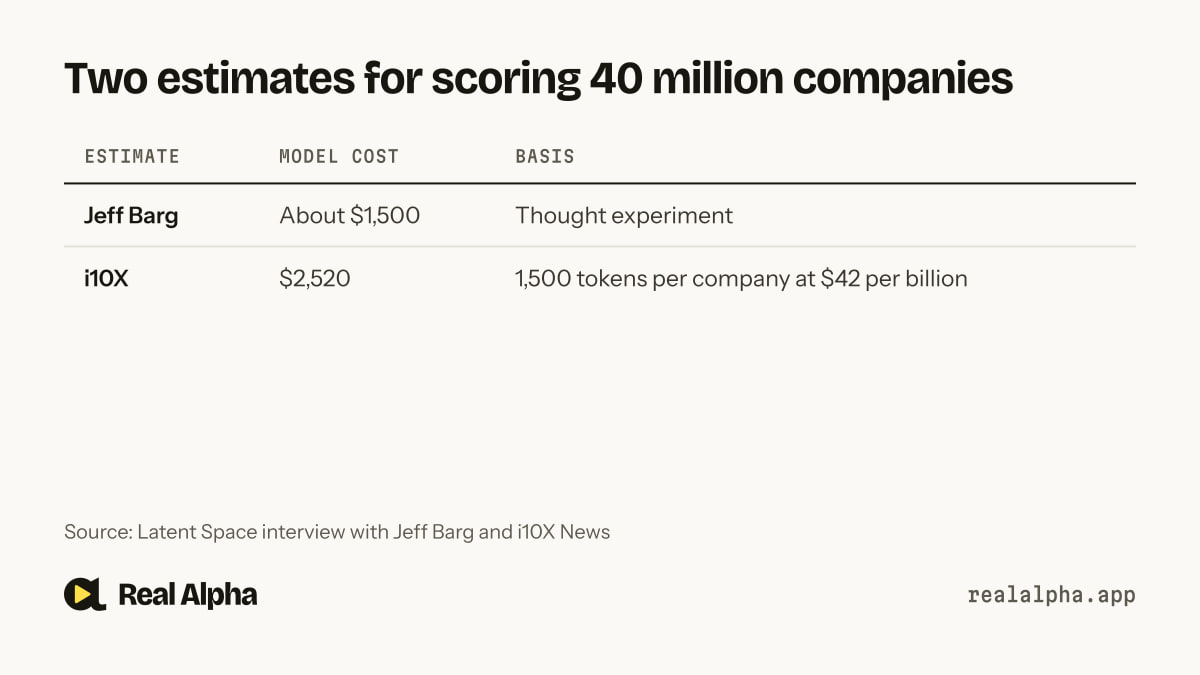
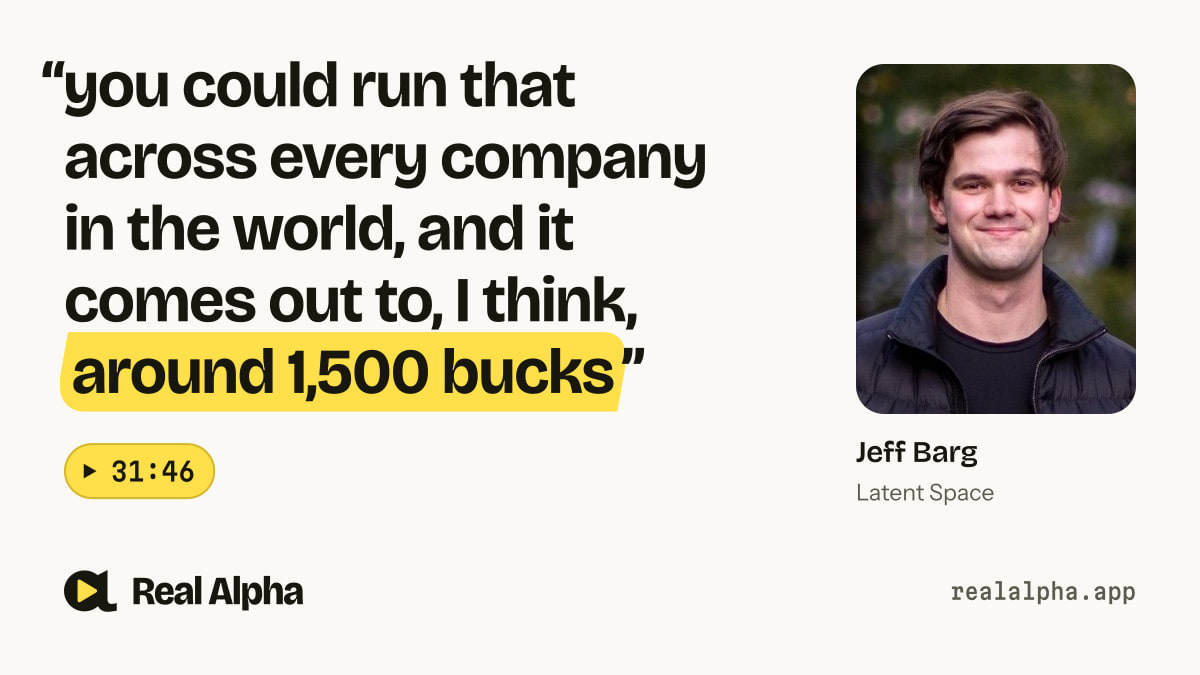
A scan of Clay’s 40 million-company dataset could cost around $1,500, Jeff Barg said on Latent Space 31:46. Barg, Clay’s head of AI, described a thought experiment rather than a customer price. Clay sells prospecting software and stands to benefit if customers find that experiment useful.
For sales and finance teams, the decision is where to spend on models and where to check results. The calculation below shows why Barg’s estimate needs another look. It also separates a cheap score from a working sales campaign.
The stated inputs produce a higher bill
Barg imagined using Jev, a classifier from TypeSafe, to check each company against an ideal customer profile. A classifier assigns a category or score to an input. He said Clay had not used Jev in production.
His example allowed roughly 1,000 tokens for a company’s LinkedIn page and 500 for the customer profile. He also gave a rate of $42 per billion tokens. But those inputs do not produce his estimate.
- Multiply 40 million companies by 1,500 tokens to get 60 billion tokens.
- Multiply 60 billion tokens by $42 per billion and the result is $2,520.
i10X reached the same $2,520 result, using a listed Jev 1.14 input rate. Its report cites TypeSafe’s model documentation for that price. But the TypeSafe documentation was not opened here, so its current rate remains unchecked.
Barg’s calculation assumes a company page and customer profile are available for each assessment. Missing or outdated records could change which prospects the classifier can assess. The estimate gives no measured accuracy for Jev on Clay’s data.
Neither figure establishes what Clay would charge a customer. And neither includes a demonstrated cost for acquiring fresh data, reviewing errors or running outreach. The inputs are useful for sizing a model bill, but they leave out campaign expenses.
Clay’s lead tests favor cheaper task models
Barg said Clay’s lead-qualification tests have had little room for improvement for about a year. Newer models can still improve harder tasks, he said. But on Clay’s tests, routine qualification has stopped distinguishing them much.
“our evals have probably been saturated there for about a year”
Jeff Barg, on Clay’s lead-qualification tests 33:30
That is a result from Clay’s own tests, not proof that every company’s scoring problem is solved. Yet a customer profile may depend on facts absent from a public page. A model can also apply a clear instruction consistently while the instruction itself selects poor prospects.
For instance, Barg contrasted finding a company’s latest funding announcement with deeper prospecting research. He said recent models can handle the former effectively, while stronger models help with the latter. The distinction turns on the task and its requirements.
Hayden Field described companies building their own benchmarks to route tasks. That supports testing the same split on your own records. It does not establish that Clay’s results will transfer to them.
Post-training needs enough spend to matter
Barg put the inference-spend threshold for considering post-training somewhere from $10 million to $100 million. Post-training means additional training that adapts a model after its initial development. He did not specify a yearly basis for that range.
His point was economic. Savings must be large enough to justify the work of producing and maintaining a specialized model. Clay was still exploring post-training, and Barg did not present a measured saving from its own effort.
So the $1,500 scoring example is not evidence that Clay post-trained Jev. Barg discussed an existing classifier separately from Clay’s post-training plans. A company can test an available cheaper model before committing to training its own.
The research supplied for this story includes no independent study establishing Barg’s spending threshold. It is a judgment about when savings become material, not a rule for every budget. So the size and repeatability of the workload still decide whether the investment pays.
“cost savings are great, but you have to kind of do that on a substantial enough base”
Jeff Barg, on the economics of post-training 30:08
Harder workflows still call for stronger models
Clay’s original Sculptor agent could add a column, Barg said. Building an outbound campaign with qualified meetings was harder. The earlier system lacked context that sales staff might have, including campaign results.
I think that distinction matters more than the price of a single token. A cheap classifier can narrow a list. The work of deciding what to do next may need different information and a more capable model.
Take Clay’s own analysis of Y Combinator companies using its product. Barg said its agent found the answer in about 60 seconds 1:02:01. He contrasted that with gathering a company list and checking internal systems himself.
That single internal example gives no measured saving across customers. Still, it shows why a useful agent needs access to more than a company description. It must combine the list with customer records.
Now the interface matters too. Barg said usage through Clay’s agent and outside systems was closer to evenly split than he expected. He did not recall the exact breakdown.
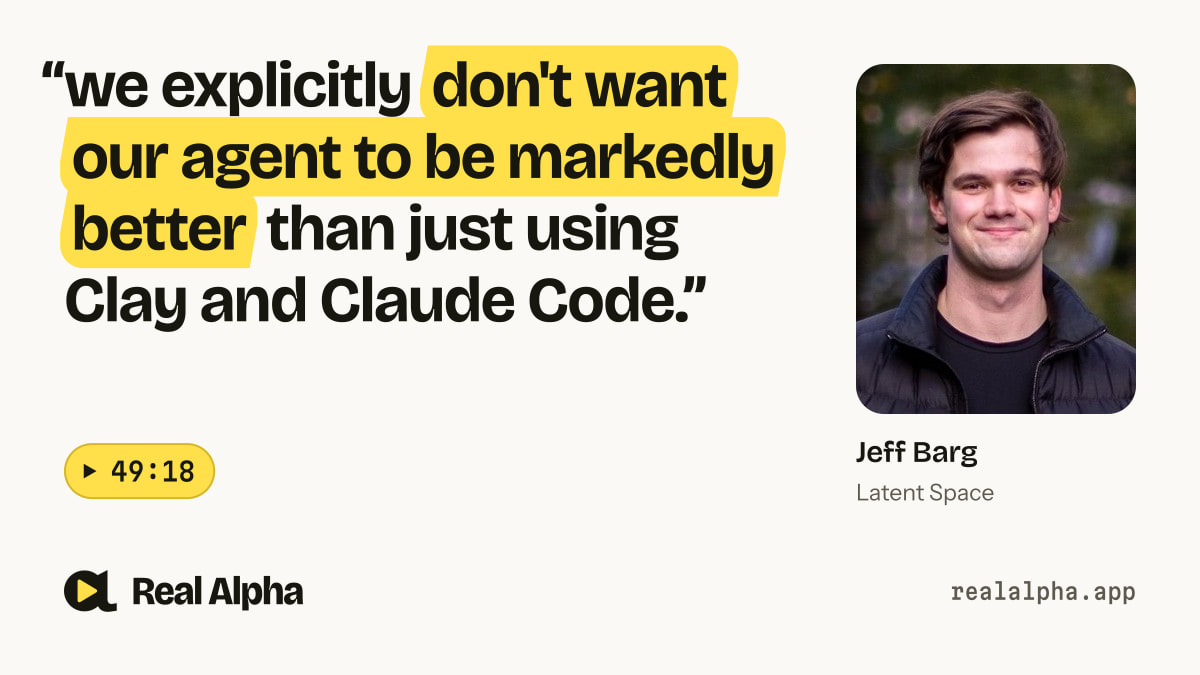
Clay wants both routes to use its platform, which it sells to those customers.
A built workflow is not a booked call
Clay tests whether its agent builds the requested workflow and gives it the expected properties. Barg wants to measure whether recipients actually respond to an outbound campaign. Those are different tests.
“if something can’t be expressed in our internal evals, it’s probably, like, a product feature to be built around it.”
Jeff Barg, on gaps in Clay’s internal tests 40:01
A completed workflow can still target the wrong people or send a weak message. And a poor response rate does not identify which part failed. The product, the offer and the list can all affect the outcome.
Daniel Saedi described judging model economics by cost per completed task. For a sales team, an accepted score is one useful checkpoint. A meeting is another, but it depends on more than the scoring model.
Cheaper agents still need human checks
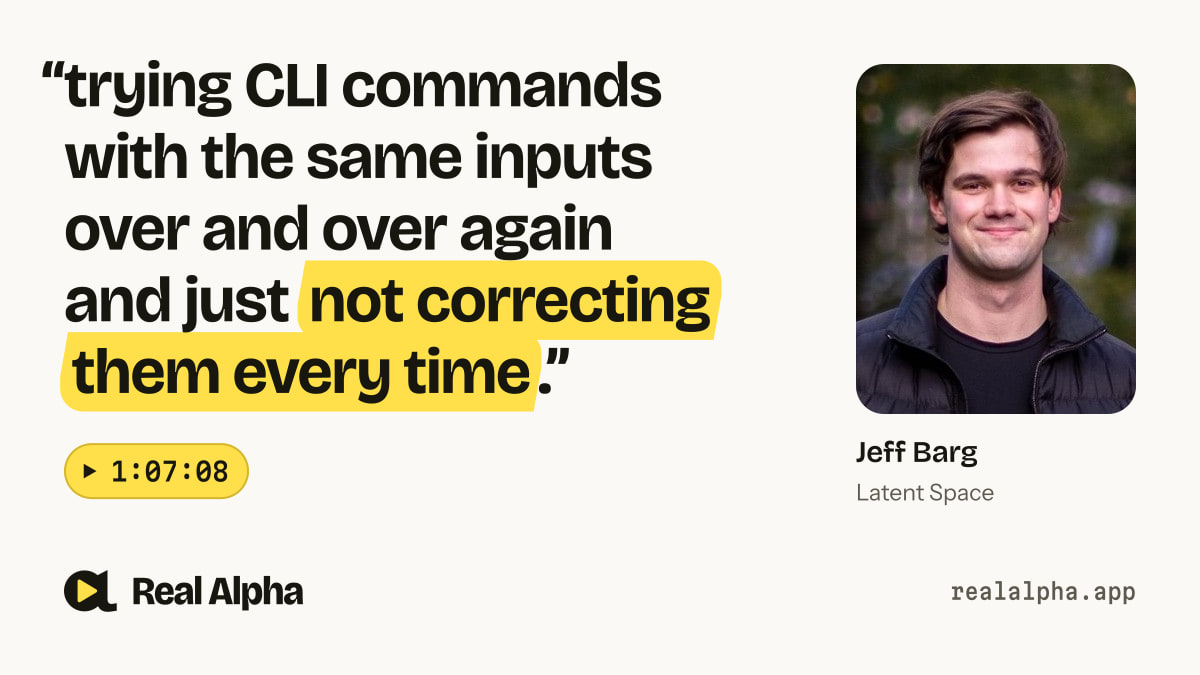
Barg said agents still struggle to diagnose their own traces, the records of what they did 1:10:10. An agent may blame a long run even when the time was justified. Clay still writes many of its agent skills by hand.
Model routing has its own costs too. Researchers Zhou, Sviridov, Ustiugov and Javaid tested 36 open-weight models on a coding benchmark. Their small-model-first approach reduced reported GPU-hour costs by 16.4% across all benchmark tasks without sacrificing benchmark accuracy.
But some tasks had to restart on a larger model, increasing elapsed time. Some authors work for AMD, which sells computing hardware. The paper tested coding tasks, not Clay’s lead scoring or a customer sales workflow.
If you run an agent product, keep failed runs for human review. Barg’s experience suggests an agent’s diagnosis may point to the wrong cause. Check its suggested fix against the original run before changing the workflow.
Buyers can test cost per accepted result
If you run sales operations, start with a sample your team can review. Barg’s calculation makes broad scoring worth testing, but it does not validate the scores. Compare models against the same records and the same definition of a useful prospect.
- Check the inputs Record which company facts and customer criteria each model receives.
- Review the misses Have a sales operator inspect prospects the model rejects as well as those it accepts.
- Count full costs Include data, model calls, retries and human review in the comparison.
- Separate the tasks Test qualification apart from research, campaign building and outreach results.
If you buy an agent platform, ask which models it selects and what its bill covers. Barg said Clay planned automatic model selection while keeping manual choice available 36:12. Ask for enough detail to compare the cost and quality of each route.
Copy this line into your team’s next evaluation plan.
- Task = ___, model = ___, accepted results = ___, full cost = ___.
Forward this to your sales operations lead before the next prospecting budget review.
Watch the moment where Barg gives the scoring estimate. 31:46
By email
The best moments, twice a week
Wednesday and Saturday at 7:00 in New York.
Check your inbox
We sent a link to your address. Click it to finish signing up. Not there in a minute? Look in spam.
Long reads also go out by email. Get them at read.realalpha.app