The alpha, twice a week
That was 2 min.
Get the best new moments in your inbox every Wednesday and Saturday. It's free.
Check your inbox
We sent a link to your address. Click it to finish signing up. Not there in a minute? Look in spam.
or
TBPN · 2 min · Feb 20, 2026
A bank charter keeps key decisions under the company’s control
 Palmer Luckey
 explains why Erebor sought its own charter rather than relying on partner banks.
The episode’s best minutes
Full analysis- 0:45Erebor is built for deep tech and always-on dollar settlement3 min
- 7:20A bank charter keeps key decisions under the company’s control2 min
- 19:04Vision Pro brought future display economics into the present3 min
- 3 more moments in the full episode
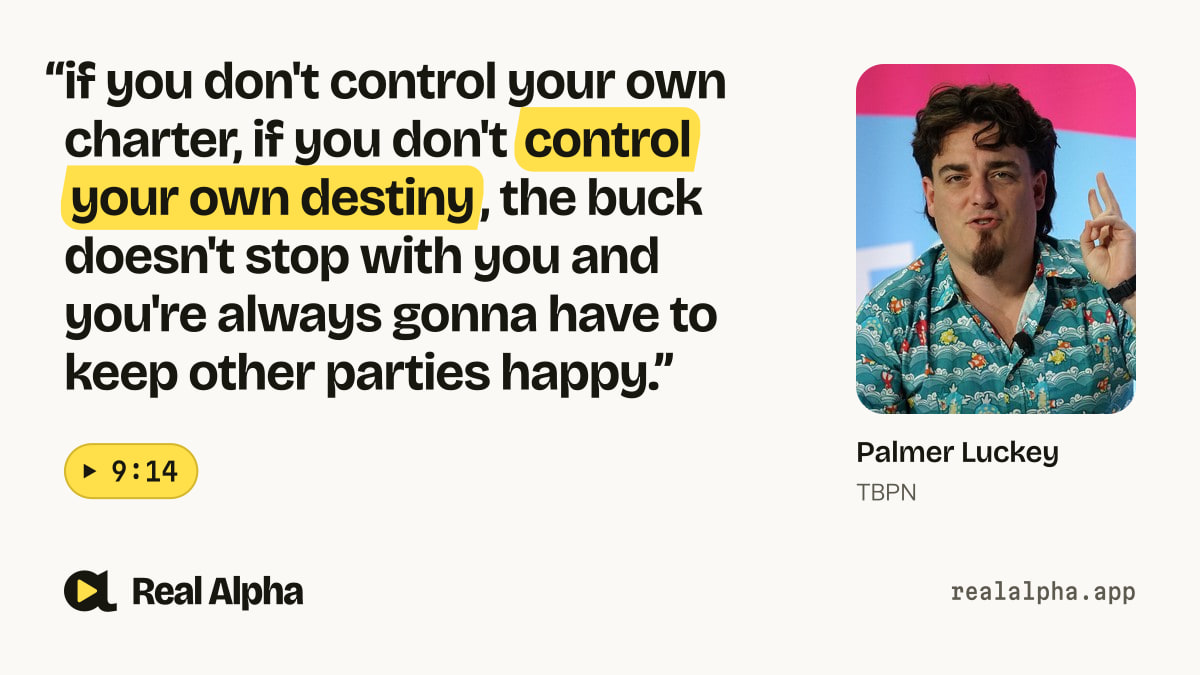
“if you don't control your own charter, if you don't control your own destiny, the buck doesn't stop with you and you're always gonna have to keep other parties happy.”
 Palmer Luckeyat 9:14 · TBPN
Takeaways
- Partner banks can cut off access to essential infrastructure.
- Payment intermediaries can pressure companies to censor users.
- Owning the charter means taking responsibility for debanking decisions.
About this segment
Palmer Luckey explains why Erebor sought its own charter rather than relying on partner banks. Owning the infrastructure and risk decisions, he argues, means the bank must answer for who it serves.

Palmer Luckey is founder of Oculus and ModRetro, launching Erebor.
Co-founded Anduril, which builds autonomous defense systems, and designed the Oculus Rift that revived VR.

John Coogan, Host · Co-host, TBPN
Co-founded Soylent and Lucy; OpenAI bought his show TBPN in April 2026.

Jordi Hays, Host · Co-host, TBPN
Founded Branded Native; co-founded fintech Capital, which Rho bought.
From “Palmer Luckey: Why I Started My Own Bank”, Feb 20, 2026. Watch the full episode
Thanks. We'll look at and fix what's off.
Transcript
From the transcript TBPN publishes with the episode.
- 7:22
Talk about the trade offs of going the charter route. You know, the last ten years, most of the banking products that founders have used were built on top of existing charters or or Sure. Spreading deposits across multiple
- 7:39
avoid getting a charter at all. You know, they wanna be a fintech company and they basically will dance around the fact that realistically what they're doing is basically being a bank. Look, there's a lot of things that you can do without having your own charter. There's things you can do partner with other companies. There's a lot of things you cannot do without having your own
- 7:57
anti anti hyper growth. Like, you can't just to 50,000,000,000 of deposits tomorrow even if there's the demand. Right? So maybe
- 8:08
we we decided that we needed to get our own charter because of the type of bank we were gonna try to run and the ability to have the buck stop with us. The moment that you're dependent on somebody else for the key infrastructure, the key risk management, the key licensure questions, they can kick you off the platform. They can be forced to kick you off the platform. They might and maybe they're doing it for good reasons. Maybe they're doing it for bad reasons.
- 8:32
I mean, you've seen this play out, for example, with Steam and their payment processors and their banks and their payment processors' banks where they're basically censoring games because there's some circle of people who all claim it's not them pointing down the chain. It's that guy, it's that guy, it's that guy, But they all agree, even if they can't agree, who's causing the censorship, that if you don't censor, they're going to drop you, they're going to drop your account, they're going to debank you, they're going to depayment you. And so one of the things that you have to ask yourself when you're making yourself dependent on another bank or another payment company is, am I setting this up where they get to make my decisions for me? And are they making their decisions for me or is the Chinese Communist Party making those decisions? Is some political party that is extremely hostile to some business on our network the one actually making that decision.
- 9:16
So if you don't control your own charter, if you don't control your own destiny, the buck doesn't stop with you and you're always gonna have to keep other parties happy. And I I think that was not something that we're interested in. We wanted to be able to run the bank the way that we think it needs to be run. And if we are debanking somebody, we are gonna have to take responsibility for that. And I think that that actually leads to much better behavior.
- 9:36
I would love to see that type of behavior across the industry.