The alpha, twice a week
That was 4 min.
Get the best new moments in your inbox every Wednesday and Saturday. It's free.
Check your inbox
We sent a link to your address. Click it to finish signing up. Not there in a minute? Look in spam.
or
Silicon Valley Girl · 4 min · Nov 24, 2026
A CEO can reverse course without defending past decisions
 Vlad Tenev
After Robinhood’s stock fell 90%, Vlad Tenev imagined a new CEO taking over to reconsider decisions—including remote work.
The episode’s best minutes
Full analysis- 15:15Generic AI trading prompts are unlikely to produce alphaPro pick 5 min
- 40:00Measure AI productivity by output, quality, and speed4 min
- 43:28A CEO can reverse course without defending past decisions4 min
- 4 more moments in the full episode
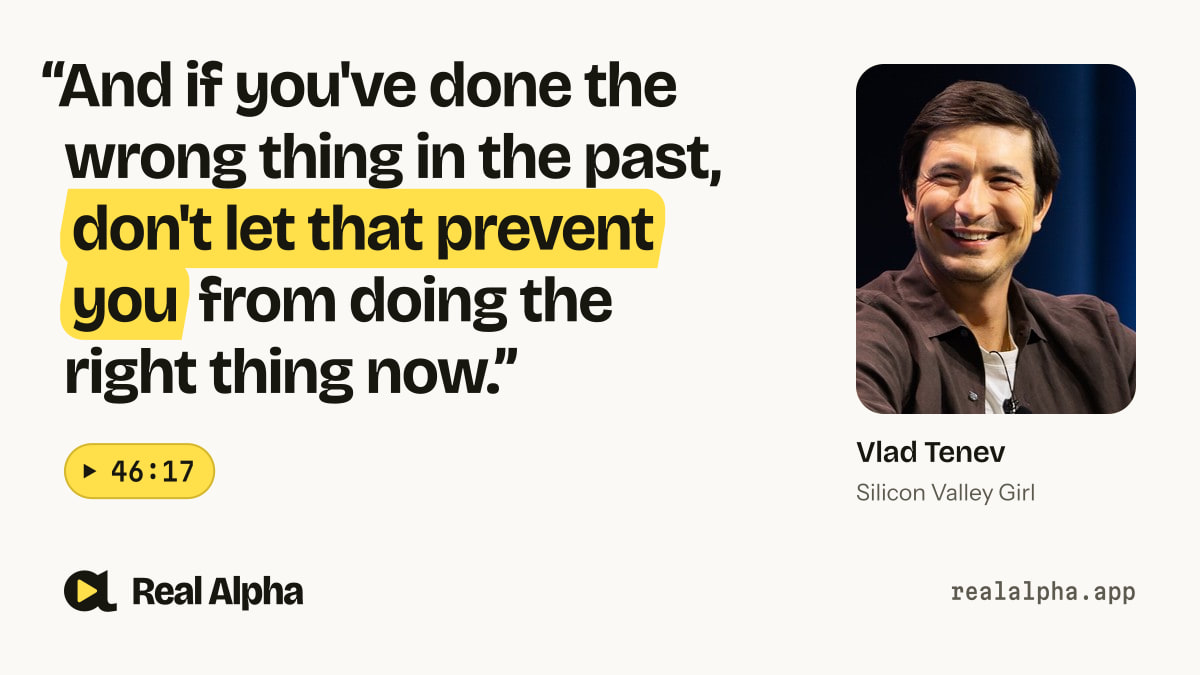
“And if you've done the wrong thing in the past, don't let that prevent you from doing the right thing now.”
 Vlad Tenevat 46:17 · Silicon Valley Girl
Takeaways
- Revisit past decisions without treating them as untouchable.
- Imagine what a new leader would change.
- Reverse course when it’s the right thing to do.
About this segment
After Robinhood’s stock fell 90%, Vlad Tenev imagined a new CEO taking over to reconsider decisions—including remote work. He says fear of seeming inconsistent can stop leaders from doing what’s right.

Vlad Tenev is cofounder and CEO of Robinhood.
Co-founded Robinhood in 2013, then steered it from a $500M loss in 2023 to a $1.1B profit.

Marina Mogilko, Host · Host, Silicon Valley Girl
Co-founded LinguaTrip and built Linguamarina, an English-learning YouTube channel with almost 9M subscribers.
From “Robinhood CEO: How to Build Wealth in the AI Era (Before It's Too Late)”, Nov 24, 2026. Watch the full episode
Thanks. We'll look at and fix what's off.
Transcript
Transcribed by machine (Whisper) from the episode’s audio, so a word may be off here and there.
- 43:40
this transition and when it happened and why? Yeah. Back when things were a little bit more of a struggle for Robinhood, I remember the year 2022, we had gone public about a year prior. We had just done a couple of rounds of layoffs. Our stock was on a downward slide. It had gone from $75 a share a month after IPO, a valuation of something like $65 to $70 billion, all the way down to below $7 a share. So, we lost 90% of the market value in less than a year. So, that was very rough. An exercise that I found very useful to me was imagining that a really good, stereotypically good CEO was just brought into the company by the board of directors, and they had to make a decision about what to clean up. And I think the value of this exercise was in letting go of decisions that I'd made in the past that I was still holding onto. I think for a lot of people, it can be
- 44:49
difficult to reverse decisions that you've made in the past because they have this innate fear of being inconsistent with themselves, which can make it hard to reverse policies, for instance. It's like remote work is probably a good example. You know, I announced that we were a remote first company, I think in February of 2022. It became pretty clear that that was not a positive change pretty quickly.
- 45:18
But, you know, a lot of people at that time, at least, were telling me it's really hard to reverse this, you know, because people move to places once you once you say this and make this change. It's a one way door. You can't go back. All the other companies are hiring remotely. And so we're going to lose out in the war for the best talent, you know, all of these excuses. But then I thought to myself, well, let's say I was gone and some new person came in, someone that's like really tough CEO.
- 45:48
Probably one of the first things they'll do is bring everyone back into the office. And nobody's going to bat an eye about that because there's a new person coming in. You expect them to make changes, make fundamental changes in everything. I think that why do people that are already in power avoid making fundamental changes? It's this desire to not contradict your past self or to seem inconsistent.
- 46:14
So I think the value of that exercise is in letting go of that. And what I found is like the fear of appearing inconsistent is like a false fear. It doesn't matter. I think I always try to remind myself, do the right thing. And if you've done the wrong thing in the past, don't let that prevent you from doing the right thing now. Obviously, if you're just like flip-flopping all the time, then there's probably some issue there.
- 46:40
But I think most people, you know, they dwell on one to two reversals. And I think the occasional reversal is... Totally. Is necessary.