The alpha, twice a week
That was 4 min.
Get the best new moments in your inbox every Wednesday and Saturday. It's free.
Check your inbox
We sent a link to your address. Click it to finish signing up. Not there in a minute? Look in spam.
or
Silicon Valley Girl · 4 min · Nov 24, 2026
Measure AI productivity by output, quality, and speed
 Vlad Tenev
 says AI usage alone can’t show whether a team is more productive.
The episode’s best minutes
Full analysis- 15:15Generic AI trading prompts are unlikely to produce alphaPro pick 5 min
- 40:00Measure AI productivity by output, quality, and speed4 min
- 43:28A CEO can reverse course without defending past decisions4 min
- 4 more moments in the full episode
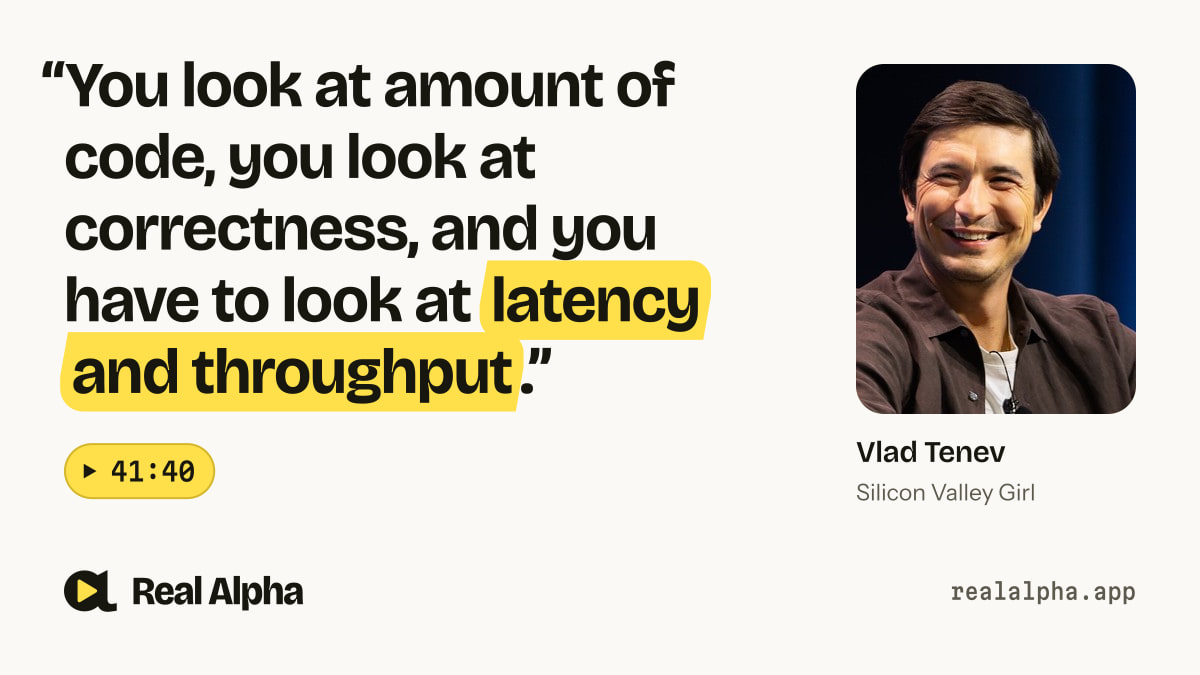
“You look at amount of code, you look at correctness, and you have to look at latency and throughput.”
 Vlad Tenevat 41:40 · Silicon Valley Girl
Takeaways
- Don’t use token spend as a proxy for productivity.
- Track code output alongside defect rates.
- Measure throughput and the size of changes, too.
About this segment
Vlad Tenev says AI usage alone can’t show whether a team is more productive. He recommends tracking code output, defects, and how quickly changes move through the pipeline.

Vlad Tenev is cofounder and CEO of Robinhood.
Co-founded Robinhood in 2013, then steered it from a $500M loss in 2023 to a $1.1B profit.

Marina Mogilko, Host · Host, Silicon Valley Girl
Co-founded LinguaTrip and built Linguamarina, an English-learning YouTube channel with almost 9M subscribers.
From “Robinhood CEO: How to Build Wealth in the AI Era (Before It's Too Late)”, Nov 24, 2026. Watch the full episode
Thanks. We'll look at and fix what's off.
Transcript
Transcribed by machine (Whisper) from the episode’s audio, so a word may be off here and there.
- 40:13
It's fascinating with this 24-7 agent. How can you tell if it's making your employees more productive versus just spending tokens 24-7? Yeah, I mean, you have to look at the output metrics and not just cost, which we try to do ourselves. Now, for coding, so every team has certain output metrics that you track to make sure that you're actually making progress, right? Before token spend was a huge input, it was headcount. How do I know that this team is actually being efficient with the additional headcount that I'm giving? And you don't want to get into the trap of just giving teams that aren't doing well more and more headcount, even though that's what a lot of people do. You want to reward people for being as lean and efficient as possible.
- 40:59
So for coding, I think it's pretty straightforward. You, of course, track your AI usage, but you also have to track how much code is being outputted. PR is generated by engineer. But of course, you don't want to just count that because what if it's crappy, bug-ridden PRs? So you have to have some knowledge, some, some measurement of the defect rate. So you can look at, you know, number of production incidents per PR or commit or, or some variant of this. And then you also don't want to incentivize people to just generate a whole bunch of tiny little code changes so that they fluff the metrics up. Right.
- 41:44
So there has to be some measurement of throughput. So I think that's really the holy trinity in a sense. You look at amount of code, you look at correctness, and you have to look at latency and throughput. Like how quickly is it going through the pipeline and how big each change is. I think it's a really fun task, thinking about what tasks can you do 24-7? Because I'm thinking about maybe my AI agent that my team can talk to all the time to get my feedback, because I'm the bottleneck in our company with all the reviews. That could be a really fun task to execute on.
- 42:23
Yeah, and you can have your agent. The thing is, you don't have to get rid of the human review. I think human review is still important. Like a first read from the agent. But the human review can be more meaningful. Like you can review bigger and bigger chunks and your agents can actually help you process what would have otherwise been a large amount of information and kind of. dissect the things that are most salient. You mentioned marketing. Marketing has metrics too.
- 42:55
I mean, you're looking at your payback periods, your lifetime values, your cost of customer acquisition. So, you know, you can run a really easy experiment to make sure that, you know, AI-driven marketing is outperforming the non-AI driven. You can almost have like two sets of campaigns, some that are AI enabled and others that aren't. And if the ROI isn't higher in the AI enabled one, particularly to justify your token spend, I think that that's an indication that maybe it's not having as much value for you and something needs to be tweaked or changed.
- 43:35
Going back to your founder mode, you mentioned that you fired your old self. Can you talk about