The alpha, twice a week
That was 3 min.
Get the best new moments in your inbox every Wednesday and Saturday. It's free.
Check your inbox
We sent a link to your address. Click it to finish signing up. Not there in a minute? Look in spam.
or
Training Data · 3 min · Nov 18, 2026
A CEO’s job is strategy, people, and the conditions to succeed
 Dev Ittycheria
 defines the CEO’s three core responsibilities and explains how he spots executives who have stopped scaling.
The episode’s best minutes
Full analysis- 14:49A CEO’s job is strategy, people, and the conditions to succeedPro pick 3 min
- 33:15A strong CRO builds a sales playbook for the businessPro pick 8 min
- 41:18AI makes speed, unit economics, and talent more important3 min
- 5 more moments in the full episode
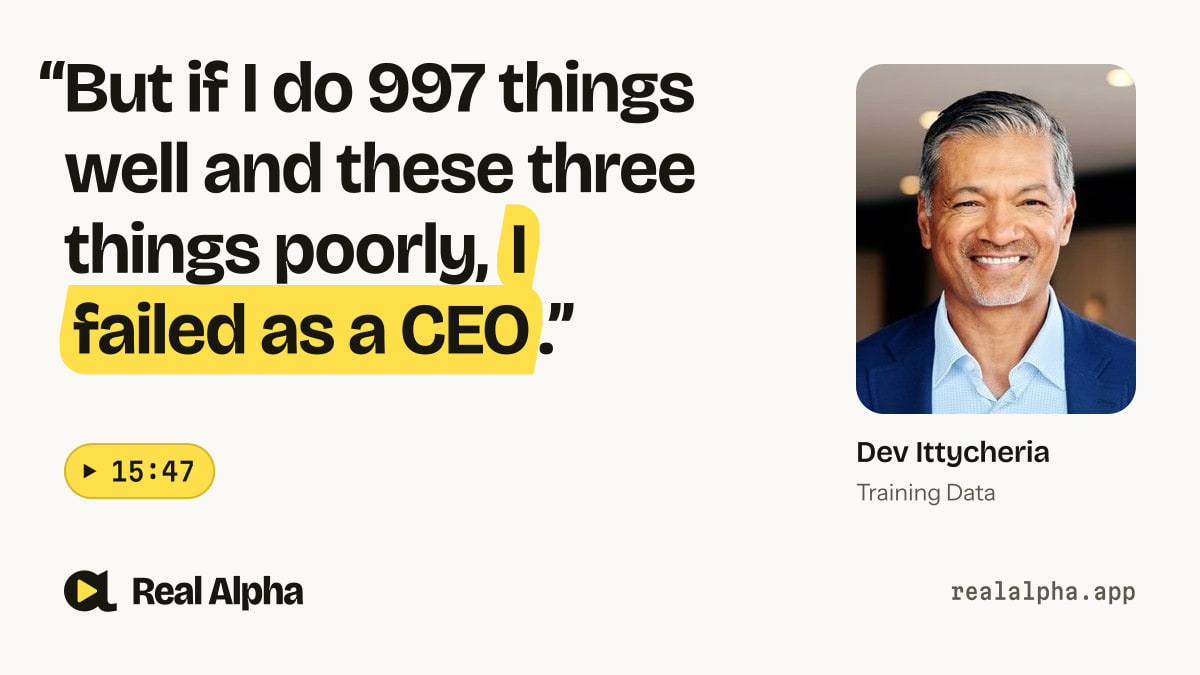
“But if I do 997 things well and these three things poorly, I failed as a CEO.”
 Dev Ittycheriaat 15:47 · Training Data
Takeaways Pro pick
- Focus on strategy, the leadership team, and an environment for success.
- Watch for leaders losing their teams or hiring weaker people.
- Put the company ahead of a longtime executive who no longer scales.
One of Pro's picks, open to you here. Try Pro free for 7 days
One of Pro's picks. The rest of the summary and the 3 takeaways are in Real Alpha Pro; the video, the quote and the transcript stay free.
Read it with Pro, 7 days freeAbout this segment
Dev Ittycheria defines the CEO’s three core responsibilities and explains how he spots executives who have stopped scaling. The hardest calls, he says, take courage more than intelligence.

Dev Ittycheria is CEO of MongoDB.
Led MongoDB through 11 years of exceptional growth, helping establish it as an intelligent data platform for AI.

Sonya Huang, Host · Partner, Sequoia Capital
Works with OpenAI and Anthropic; co-wrote Sequoia's essay on generative AI.

Pat Grady, Host · Co-steward, Sequoia Capital
Joined Sequoia in 2007; backed Snowflake, Zoom, ServiceNow and OpenAI.
From “The Boomerang CEO(s): With MongoDB’s Dev Ittycheria”, Nov 18, 2026. Watch the full episode
Thanks. We'll look at and fix what's off.
Transcript
Transcribed by machine (Whisper) from the episode’s audio, so a word may be off here and there.
- 14:55
And then what does that mean? So it does mean do you have the right team around you? And one of the things like a lot of people ask me is, what does the CEO actually do? What does the CEO do? In my mind, and actually I have to give Mark McLaughlin, the old Palo Alto CEO, credit for this because he really crystallized this for me. I kind of knew it, but the way he said it really framed it well was, one is, I think the CEO is in charge of strategy.
- 15:18
What is the company's strategy? Where are we going? What do we aspire to be? Blah, blah, blah. The second job is, do you have the right people in the bus to go execute on that strategy? And that's really the core leadership team. And then the third job is, are you creating an environment where people are set up for success? That could be the right capital allocation decisions, the culture you create.
- 15:38
You've talked a lot about culture as a product that can attract and retain great people in an environment where people really want to stay for the long term. I can do a thousand things. I can do this podcast. I can go visit customers. But if I do 997 things well and these three things poorly, I failed as a CEO. at least that's my definition so those three things are like linchpins for the success of co and that people think so you don't change strategy that often but you're constantly assessing your team right and a world that's moving so fast i mean i went through well when i left had gone through 23 c levels and i would say just to be clear some of them left because they had kind of retired and made a lot of money and said you know i'm done but a lot of them just were very effective at a certain stage of the company, but just couldn't scale to the next
- 16:29
stage of the company. And the tell for me was a couple of things. One, they weren't very self-aware. They couldn't see where they were being ineffective. Two, they were losing their team. That's another tell because good people, you can always fool the people above you. You can sometimes fool the people around you. You can never fool the people below you. I love that, by the way. They're losing their team. And the quality of the people they were hiring was also not as good as before, right? So this is where a lot of people think like, you know, being CEO, you need to be this amazingly brilliant person. I think the toughest decisions I faced were not the ones that tested my intelligence, they were testing my courage. And like, I'll give you an example, someone's worked with you from the early days, maybe you know their spouse or partner, you've
- 17:10
had dinner with them, you know, you've bonded over crucible moments, you know, baptism by fire, but at some point you realize that person's not scaling. And now the decision is, do you put the company ahead you know with this person head of the company or the company head of the person and the job of CEO the founder is the company always comes first And that's where a lot of people, you know, when they have to make that hard decision, double clutch and don't.