The alpha, twice a week
That was 5 min.
Get the best new moments in your inbox every Wednesday and Saturday. It's free.
Check your inbox
We sent a link to your address. Click it to finish signing up. Not there in a minute? Look in spam.
or
MTS · 5 min · Oct 24, 2026
A China AI deal would separate stacks and require safeguards
 Chris McGuire
 proposes a deal in which each country builds on its own compute, adopts deployment safeguards and pledges not to interfere with the other.
The episode’s best minutes
Full analysis- 9:29Enforcing chip controls could preserve a two-year AI leadPro pick 5 min
- 14:45Chip controls need to cover access, smuggling and security3 min
- 18:42A China AI deal would separate stacks and require safeguards5 min
- 3 more moments in the full episode
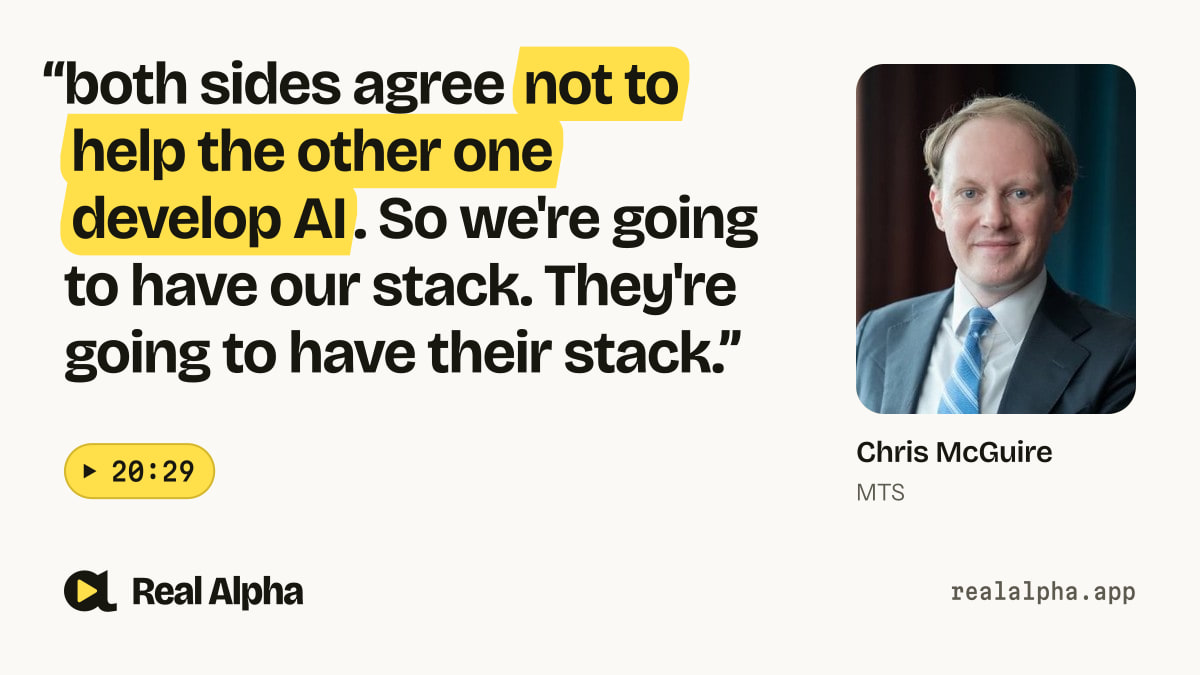
“both sides agree not to help the other one develop AI. So we're going to have our stack. They're going to have their stack.”
 Chris McGuireat 20:29 · MTS
Takeaways
- Both countries would commit to safeguards on AI deployment.
- A deal could include a pledge not to help the other side develop AI.
- The US should pace development only when safety allows without losing its lead.
About this segment
Chris McGuire proposes a deal in which each country builds on its own compute, adopts deployment safeguards and pledges not to interfere with the other. He says the US needs a strong lead to make such an agreement viable.

Chris McGuire is a Senior Fellow for China and Emerging Technologies at the Council on Foreign Relations.
Crafted U.S. technology-protection strategy covering semiconductors, AI, and export controls at the National Security Council.

Theo Jaffee, Host · Co-founder & host, MTS
One of the first members of a16z's new media team; earlier hosted the Emergent Ventures-backed Theo Jaffee Podcast.

Sophia Dew, Host · Host, MTS
From “US AI Holds a 25-to-1 Compute Lead Over China | Chris McGuire”, Oct 24, 2026. Watch the full episode
Answers “Should AI be regulated?” See all 145 answers
Thanks. We'll look at and fix what's off.
Transcript
Transcribed by machine (Whisper) from the episode’s audio, so a word may be off here and there.
- 18:49
ai era charge b.com and what do you think a deal with china should entail yeah i mean this is a big question specifically yeah i mean look what what you wanted to do ultimately is like you want we would want to we we should have our own regime that has some combination of kind of pre-deployment auditing, pre-release testing, incident reporting, and some kind of authority to stop companies from releasing certain things and a bunch of details therein. But you need to have the visibility into what is happening both while companies are testing models before they release and then also post-release and have a bunch of standards. I think We need to set those standards and we need to set those requirements for companies.
- 19:38
And then we're going to need to basically get, you know, we should have the Chinese do more or less the same thing. The hard thing there is, look, the U.S. has two objectives. I said at the start, right? Like one is maintain leadership in AI and two is, you know, make sure AI is safe. And the Chinese probably broadly have those objectives as well. At the same time. both countries can't get leadership in AI, right?
- 20:03
There's only going to be one leader. So as long as the Chinese are behind, I think it is very hard for them to agree to anything that would restrict their capabilities. So I think the U.S. is probably going to have to either accept that the Chinese are at parity, which I think is unacceptable from a national security standpoint, or build such a large lead that the Chinese are willing to take a deal that they otherwise wouldn't because they don't want the U.S. to keep racing further ahead.
- 20:29
And I think it's possible to get there. And if you did, I think the deal is something like both sides agree not to help the other one develop AI. So we're going to have our stack. They're going to have their stack. Both sides agree to implement pretty robust safeguards on deployment. And then also there's some kind of non-interference pledge. So in exchange for those commitments, both sides will let the other one develop AI and not use their own systems to counter the other one as long as the other side complies.
- 21:03
I think that's the basic framework of a deal, and I think that actually could really lock in U.S. interest because of the first one, which is saying basically we're going to be relying on our compute ecosystem. They're going to be relying on theirs, but we have big structural advantages. But I think unfortunately we're probably a long way off from that. To what extent should the U.S. slow down or pace domestically before we know that we have buy-in on such a thing from China?
- 21:29
I think we should to the degree that we don't compromise leadership and we think is necessary for safety. So I think it does have to be a bright line that we can't fall behind China. And if we pace ourselves so much that actually China develops the frontier models, that is catastrophic for national security, right? Then it's not the NSA tweeting about the PHP exploit. It's not our company is developing mythos.
- 21:54
It's the MSS, and they're not going to be alerting the world. They're going to be using it to infiltrate all of our systems. So starting from the premise that that is unacceptable, we have to stay at the frontier. I think the thinking behind the controls from the start was always, we need this to build the lead over China, but also it gives us the lead to spend on safety at the right time. And we didn't think that 2022, when we started to do the controls, was the right time.
- 22:20
But I think it probably is now. So I think we probably should start to spend down that capital. But I think an important thing to keep in mind is the larger our lead is, the more flexibility we have to spend. So I think we probably should be doing that now. I think just claiming, well, we can't do anything because of China is, first of all, wrong. I think we have some ability to slow some now while maintaining our lead.
- 22:41
But second of all, it's really not credible to make that claim while we are actively supporting China's AI development. If we were, you know, putting a bunch of barriers up and doing everything we could to make sure that China wasn't using our tech, it would be one thing. And I think that's where we should be. And if China was right there, then it would make sense that we couldn't do anything. But that's not where we are.
- 23:00
And we're kind of actively, you know, fueling their tank, which means I think we probably have more flexibility if we kind of recalibrate both sides to do more on both control and on safety. Totally. Well, you know, very topical.