The alpha, twice a week
That was 5 min.
Get the best new moments in your inbox every Wednesday and Saturday. It's free.
Check your inbox
We sent a link to your address. Click it to finish signing up. Not there in a minute? Look in spam.
or
MTS · 5 min · Oct 24, 2026
Enforcing chip controls could preserve a two-year AI lead
 Chris McGuire
 argues that closing chip-control loopholes could widen the US compute advantage from roughly 2-to-1 to 25-to-1.
The episode’s best minutes
Full analysis- 9:29Enforcing chip controls could preserve a two-year AI leadPro pick 5 min
- 14:45Chip controls need to cover access, smuggling and security3 min
- 18:42A China AI deal would separate stacks and require safeguards5 min
- 3 more moments in the full episode
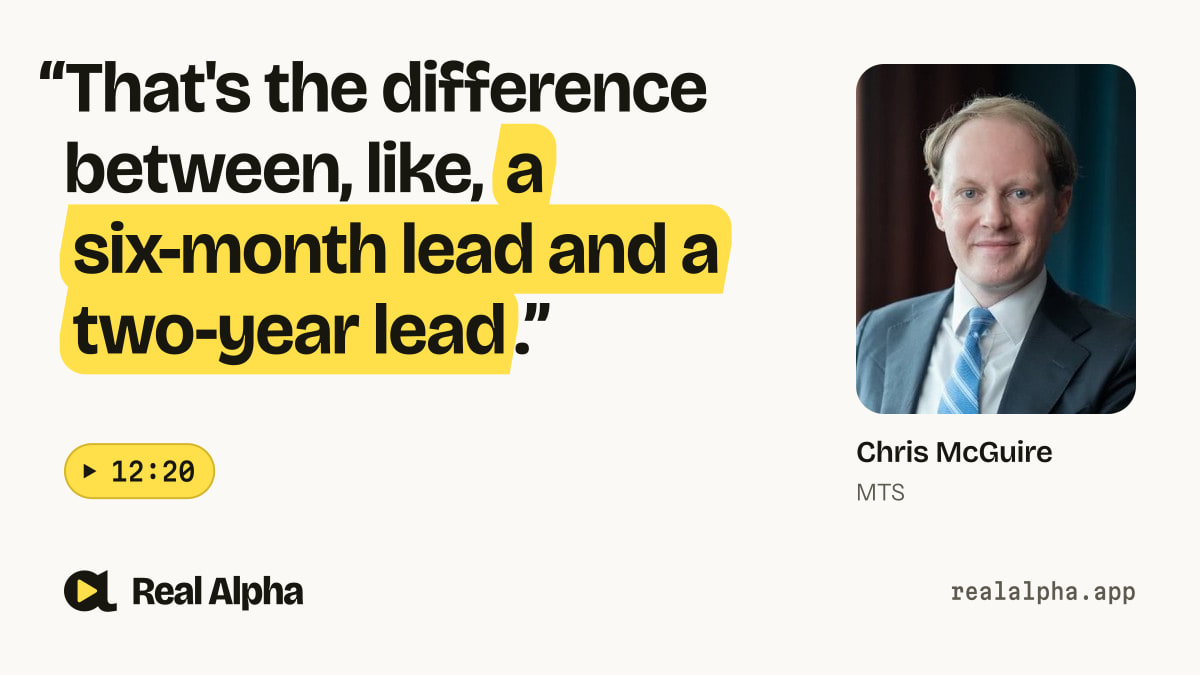
“That's the difference between, like, a six-month lead and a two-year lead.”
 Chris McGuireat 12:20 · MTS
Takeaways Pro pick
- China produces only a small fraction of US computing power.
- A three-month gap may be surmountable; a two-year gap is not.
- Companies can legally route chip access to Chinese firms through other countries.
One of Pro's picks, open to you here. Try Pro free for 7 days
One of Pro's picks. The rest of the summary and the 3 takeaways are in Real Alpha Pro; the video, the quote and the transcript stay free.
Read it with Pro, 7 days freeAbout this segment
Chris McGuire argues that closing chip-control loopholes could widen the US compute advantage from roughly 2-to-1 to 25-to-1. He explains how overseas data centers and remote access let Chinese firms get around current rules.

Chris McGuire is a Senior Fellow for China and Emerging Technologies at the Council on Foreign Relations.
Crafted U.S. technology-protection strategy covering semiconductors, AI, and export controls at the National Security Council.

Theo Jaffee, Host · Co-founder & host, MTS
One of the first members of a16z's new media team; earlier hosted the Emergent Ventures-backed Theo Jaffee Podcast.

Sophia Dew, Host · Host, MTS
From “US AI Holds a 25-to-1 Compute Lead Over China | Chris McGuire”, Oct 24, 2026. Watch the full episode
Answers “Is China catching up in AI?” See all 40 answers
Answers “Should AI be regulated?” See all 145 answers
Thanks. We'll look at and fix what's off.
Transcript
Transcribed by machine (Whisper) from the episode’s audio, so a word may be off here and there.
- 9:35
it seems like, ease export controls to some extent or not impose more strict export controls on frontier AI chips. Like, for example, we've been exporting H200s now to China. um it seems like why do you think this is i mean it seems like a lot of people in ai like really want um very strong export controls on china you know spanning all the way from like the many of the accelerationists uh all the way to anthropic and many of the ai safetyists and seemingly everyone except for jensen yeah um well look i think it makes sense like it is in all those peoples and companies and really the national interest for us to have these kind of strong controls. I mean, but just take it from the company's perspective individually, right? Like, obviously, the labs want strong export controls, because they don't want their active competitors,
- 10:26
the Chinese AI labs to have as much compute. Similarly, actually, the hyperscalers in the US should also want strong export controls, because where are these chips going? They're going into Chinese hyperscalers, even like data center constructors in the US and operators should not want them to be going to Chinese data centers. There's also the business reasons for this. But also just from the U.S. government perspective and the national security perspective, you know, we don't want the chips to be powering the Chinese AI stack. And if you don't want if you want to hold Chinese models back, I mean, the fact is, you know, Chinese Chinese AI companies are just extremely dependent on U.S. chips like China makes one to four percent of the U.S. of U.S.
- 11:01
computing power per year. It's just we're not even in the same league. There's I feel like we have this perception that like China is really good at everything America is. And it's actually this like really fatalist perspective because there's two things actually we're really, really good at and a lot better than them. It's AI and it's chips. So we should use that to our advantage. So then your question of why is it this way? Well, obviously, Jensen has had a lot of influence on the president. And obviously, it's in NVIDIA's interest to sell chips to China because they want to preserve as big of a market share as possible. But the other ironic thing here is we're in such a compute-constrained environment. No one can get enough compute even domestically. So this has been the case for a long time. It's even more the case now. And JP Morgan had a study recently that said
- 11:38
So the compute gap is only going to go out, increase every year out to like 300 gigawatts almost by 2031. So, you know, we should have as much of that in the U.S. as possible. And everything that we send to China, not only in terms of chips, but also anything, you know, waiver capacity that's devoted to Chinese chips in terms of other chips takes away from us. So this is a big concern and a big problem.
- 12:00
And I think that it's not just that we need to tighten controls or, you know, not sell chips to China. It's really the, like, closing loopholes in the controls that the Chinese are massively exploiting that I think it's the difference between us having, like, a 25 to 1 compute advantage over China if they were using just their own chips and probably, like, a 2 to 1 or so if they're, you know, exploiting our controls and getting all this access, which is a huge difference in AI.
- 12:27
That's the difference between, like, a six-month lead and a two-year lead. hmm so what are the odds that you know it seems kind of implausible to me that china is able to produce a model that is better than the u.s frontier at least for a very long time but it seems to me like china could produce a model that is like so close to the u.s frontier at such a cheaper price that it is able to affect frontier lab uh margins and uh frontier lab revenues maybe So do you think that this is possible?
- 12:58
Possible, yeah. I mean, I think some of it also depends on distillation, right, and how much are they able to distill their way close to the frontier. And this also is another reason why I think it's harder for them to leapfrog because you can't distill your way ahead, obviously. I think that is possible, and particularly if they have access to a lot of compute, it's very possible. But one thing to keep in mind is that you obviously know this, but like the being at the frontier confers you advantages kind of all the way down the price curve in AI. So if you're at the frontier, you can also kind of distill your own model down to a smaller version that is going to be more efficient very easily or using the bigger model might be actually more token efficient. So in terms of costs, it might be actually cheaper to
- 13:43
use a bigger model than it is to use a smaller model that's going to use more compute for test time compute and inference. So in terms of cost, generally, if you're at the frontier, you can actually stay either competitive or dominant kind of all the way down down the curve. Now, China can combat this with subsidies, etc. But like, if they're close to us in AI, yes, I think they can do that. I think they can probably make up that differential if they're three months behind. If they're two years behind? No, I don't think they can do that. I think the economics would be too punishing, and it would be impossible. And I think that like with proper enforcement of controls, we could get them there.
- 14:19
But the fact is, right now, anyone can just make a company in Singapore and buy unlimited chips for a data center they're constructing in Malaysia and then have a gigawatt of compute there and rent it all to Chinese companies and all of that is totally legal. Like, it's bonkers. I mean, Chinese companies, it's even worse. Chinese companies can actually buy AI chips in the United States and then rent it back to themselves legally in China.
- 14:45
Completely legal. Alibaba could just set up a data center in the United States and then rent the compute back to China. It's completely legal.