The alpha, twice a week
That was 3 min.
Get the best new moments in your inbox every Wednesday and Saturday. It's free.
Check your inbox
We sent a link to your address. Click it to finish signing up. Not there in a minute? Look in spam.
or
Bloomberg Law · 3 min · Nov 13, 2026
A DOJ appeal rule can keep immigrants detained after bond is granted
 Leon Fresco
 explains how an automatic administrative stay can nullify an immigration judge’s bond release while an appeal is pending.
In this episode
Full analysis- 7:21A ruling could weaken immigration enforcement and worker protections4 min
- 16:15Federal tort claims offer weaker remedies than BivensPro pick 3 min
- 27:53Texas gives blue-state AGs a major boost in legal firepower3 min
- 13:07The Court has kept Bivens claims to three fact patterns3 min
- 21:26A DOJ appeal rule can keep immigrants detained after bond is granted3 min
- 30:38Partisan fights take up a small share of AG office work3 min
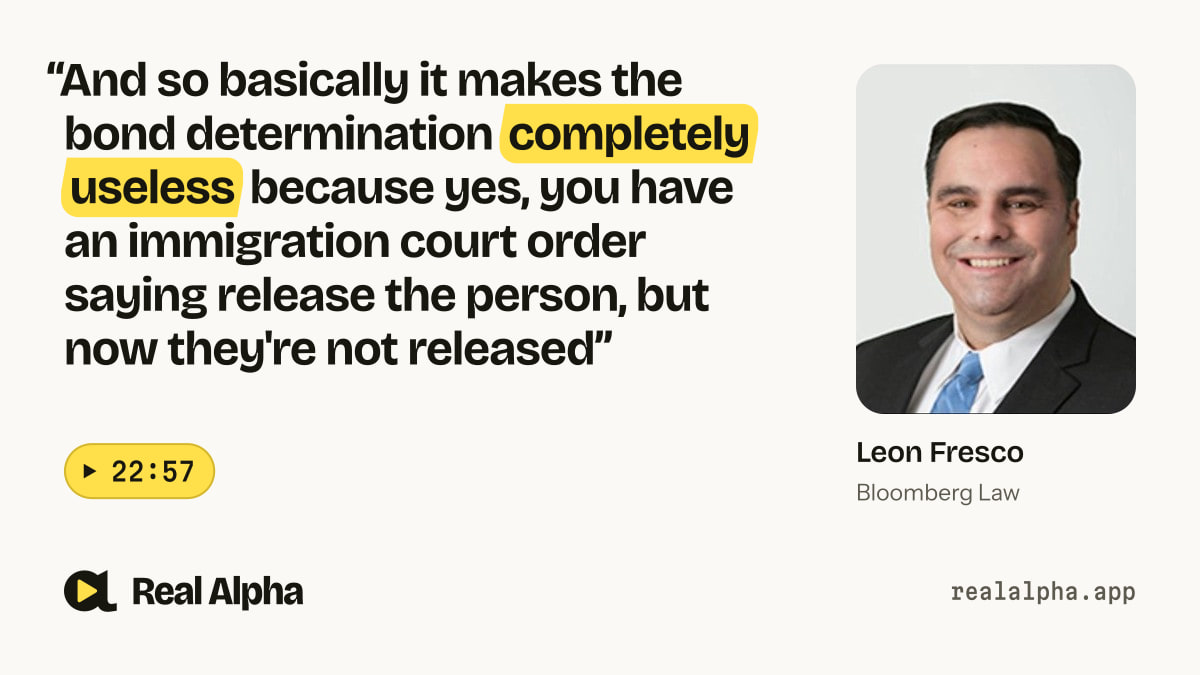
“And so basically it makes the bond determination completely useless because yes, you have an immigration court order saying release the person, but now they're not released”
 Leon Frescoat 22:57 · Bloomberg Law
Takeaways
- ICE can seek a stay while appealing a bond decision.
- The DOJ regulation dates to the post-9/11 period.
- Judges have responded with fees and contempt orders.
About this segment
Leon Fresco explains how an automatic administrative stay can nullify an immigration judge’s bond release while an appeal is pending. The result can prolong detention and trigger a cycle of court orders and re-arrests.

Partner, Holland & Knight
Drafted the Senate’s 2013 immigration reform bill and oversaw federal civil immigration litigation at DOJ.
- JG
June Grasso, Host
From “SCOTUS Takes On Administrative State & Blue AGs To Take Control | Bloomberg Law”, Nov 13, 2026. Watch the full episode
Thanks. We'll look at and fix what's off.
Transcript
From the transcript Bloomberg Law publishes with the episode.
- 21:28
doesn't make much sense, at least to me. The government is using an obscure 9-11 era rule aimed at suspected terrorists to overrule bond orders of federal judges. So the judge issues a bond order and the government says no?
- 21:45
So here's what happens. Whenever the government tries to put someone in deportation proceedings, the first step that is determined is whether the government wants to have that person detained or not while the proceeding is happening. If the government says, yes, I want that person detained, then that person can ask the Department of Justice Immigration Court for a bond hearing. And At that point, the immigration court decides, do we have jurisdiction? And then if we do, do we think this person is dangerous or a flight risk? And if they say they have jurisdiction, and if they say the person is not a flight risk and is not dangerous, they can release the person on bond. At that point, the federal government or ICE can appeal this Department of Justice decision to a different person in the Department of
- 22:30
Justice called the Board of Immigration Appeals. And they have the ability to decide, are they okay with the fact that the person is free or not while this appeal is pending? And so what happened after 9-11 is the Department of Justice issued its own regulation without notice and comment that said, If ICE thinks the case is a sufficient emergency, we will limit our own authority to release people and say that we will issue a stay that's automatic for the time that that appeal is pending. And so basically it makes the bond determination completely useless because yes, you have an immigration court order saying release the person, but now they're not released because the case is pending on appeal. Now there's some precedents that say if after 90 days nothing is done, then the person gets to come out. So it's really asking the Board of Immigration
- 23:21
Appeals to decide these quickly on the issue of bond. But nevertheless, it gives the government more time to detain someone even after a bond has been ordered. And even judges have started to give attorneys fees for these detentions. and have started to issue preemptive bans from the government using these things. And so you have criticism coming from judges all across the country because what's happening is, again, people aren't waiting to see this play out in the immigration courts. They're filing these habeas claims, yet again, in the district courts, and sometimes the government's defending them and sometimes they're not. But in any case, they're getting adjudicated, and most of the time, the government is losing there. Now, what's totally weird is sometimes the government loses here too
- 24:08
and lets the person out and then a week later apprehends them again and says, well, you didn't say anything about me not being able to apprehend them again. You only said I had to let them out. And then judges have been issuing contempt orders for that. So this is quite the game of whack-a-mole, it seems like. And so it's something to watch. Is this going to be used more or less moving forward?