The alpha, twice a week
That was 6 min.
Get the best new moments in your inbox every Wednesday and Saturday. It's free.
Check your inbox
We sent a link to your address. Click it to finish signing up. Not there in a minute? Look in spam.
or
Future of Life Institute Podcast · 6 min · Oct 13, 2026
A mass movement can push leaders beyond its original demands
 Garrison Lovely
 recounts how the nuclear freeze movement grew from a short manifesto into a major force that helped shift Reagan’s approach to arms control.
The episode’s best minutes
Full analysis- 8:04Replacing workers can weaken democratic accountability3 min
- 32:17AI training costs matter more than serving customersPro pick 6 min
- 1:02:24A mass movement can push leaders beyond its original demands6 min
- 5 more moments in the full episode
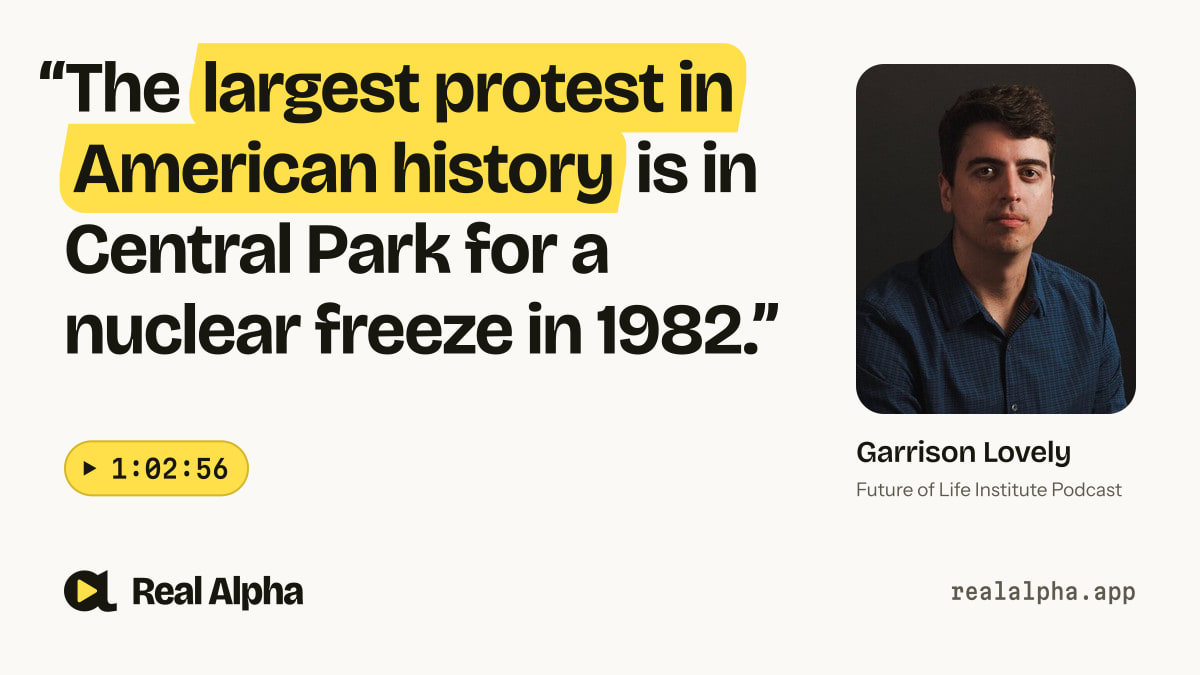
“The largest protest in American history is in Central Park for a nuclear freeze in 1982.”
 Garrison Lovelyat 1:02:56 · Future of Life Institute Podcast
Takeaways
- The nuclear freeze began with a four-page manifesto in 1980.
- Mass mobilization made arms control a major political issue.
- A powerful movement can win results beyond its stated demands.
About this segment
Garrison Lovely recounts how the nuclear freeze movement grew from a short manifesto into a major force that helped shift Reagan’s approach to arms control. He argues that sustained public pressure can make seemingly impossible outcomes possible.

Garrison Lovely is author and journalist.
Wrote Obsolete on AI's race to replace human labor and reported on the political economy of artificial intelligence.
- GD
Gus Docker, Host · Host, Future of Life Institute Podcast
From “The Trillion-Dollar AI Race to Replace Us (with Garrison Lovely)”, Oct 13, 2026. Watch the full episode
Thanks. We'll look at and fix what's off.
Transcript
Transcribed by machine (Whisper) from the episode’s audio, so a word may be off here and there.
- 1:02:36
the final chapter, the nuclear freeze movement, which was born out of a four-page manifesto by an MIT grad student in 1980. Ronald Reagan's elected later that year, running as an arms control skeptic, a hawk who jokes about nuclear war. His administration is saying, we'll be fine if we have enough shovels, like really crazy shit. And then the nuclear freeze does well in some Reagan districts on some like ballot initiatives. And then they build this incredibly powerful movement with millions of people. The largest protest in American history is in Central Park for a nuclear freeze in 1982. In 1983, it becomes the number one issue in the country.
- 1:03:17
And then Reagan is terrified and co-ops the language, pivots 180 on it, doesn't run on a freeze. And so when he wins in 1984 in a 49-state landslide, it's seen as like a defeat for the freeze. But then in 1986 in Reykjavik with Gorbachev, Reagan comes very close to agreeing to eliminate all nuclear weapons. And then this lays the groundwork for a peaceful resolution to the Cold War and an 80% reduction in the stockpile of nuclear weapons, which is so much more than a freeze would have done. And so if you can build a movement that's powerful enough to make presidents think that their fates will hinge on their response to the movement, then you can make things that seem impossible become not just possible, but go beyond what the demands actually require. It's definitely an uplifting sort of history lesson. But I do worry that
- 1:04:19
uh ai so ai is different from nuclear weapons in in in many ways it is enormously um value it's a it's an enormously valuable technology uh a lot of the world economy hinges on ai um working and it is sort of it's a general purpose technology it's not only a destructive weapon and so won't we have economic forces pushing us to develop this technology further nuclear weapons are like this expensive thing that once you have some getting more doesn't really help you very much because there's deterrent effects and like it's rational for countries to limit how many nukes they have if the other ones do it as well but they don't take people's jobs by design and so I think that's your biggest source of potential here and I think while like investors and a lot of the economy broadly could like benefit from artificial general intelligence everybody has
- 1:05:21
something that they will lose by this you know i talked to anthropic people who are sad that they don't program anymore like this thing that they enjoy doing is just now obsolete like like they design software still but they don't code by hand and And... You know, like, woe is them, right? Like, world's smallest file in. It's like you invented yourself out of the job. But I think, like, we all hate slop, although some of us actually love it, but we don't even realize that it's slop.
- 1:05:51
this has begun happening to me by the way i i consider myself quite good at recognizing ai but i have sort of several times over the last couple of months fallen for some videos where where i initially believe that this is this is an actual video and then i find out sort of later that this was actually ai generated and then i begin to wonder like how much of this stuff i you know what have i seen that where it's been ai but i haven't noticed and i will never notice and that it's, yeah, it's, it's quite wild to think about.
- 1:06:22
Yeah, no, the internet is just gaslighting us now all the time. Um, and that sucks. Like, I hate when I see a cool video, I'm like, is this real? Like that's, it's, you know, not like the end of the world, but it, it, it's a shitty thing. And all of these other companies that make SAS products or do whatever, you know, the industry, the obsoleting project is coming for them too. And the people building this stuff are terrified of it. Like not all of them, but I think an increasing share of them you know when i was in san francisco a few months ago the vibe was very much like we gotta stop um i hope your book works and like these are people who are more safety pilled folks as i say but it was still different than it was a year ago when i was last there and i'm i can tell just from you know being online like it's way way more intense now after
- 1:07:12
the hugging face hacks and so you've got these employees who are saying like hey we need to build a pause button. We need to be able to pump the brakes on this. 1,300 employees, including support of OpenAI and Anthropic as companies, signed a letter asking for that. And then you've got the public who's increasingly skeptical of the technology. And then you've got all these businesses and legacy institutions that are threatened by it. And you've got political leaders who don't want to lose control to anything and you know machines that make labor but don't always do what they're told are the kind of thing that you could lose control to and so all the ingredients are there for like this incredibly large and tough collective action problem being solved by the fact that like all of our interests are lined up with stopping them