The alpha, twice a week
That was 3 min.
Get the best new moments in your inbox every Wednesday and Saturday. It's free.
Check your inbox
We sent a link to your address. Click it to finish signing up. Not there in a minute? Look in spam.
or
Future of Life Institute Podcast · 3 min · Oct 13, 2026
Replacing workers can weaken democratic accountability
 Garrison Lovely
 argues that work gives people economic and political leverage, and that replacing workers could weaken a key check on power.
The episode’s best minutes
Full analysis- 8:04Replacing workers can weaken democratic accountability3 min
- 32:17AI training costs matter more than serving customersPro pick 6 min
- 1:02:24A mass movement can push leaders beyond its original demands6 min
- 5 more moments in the full episode
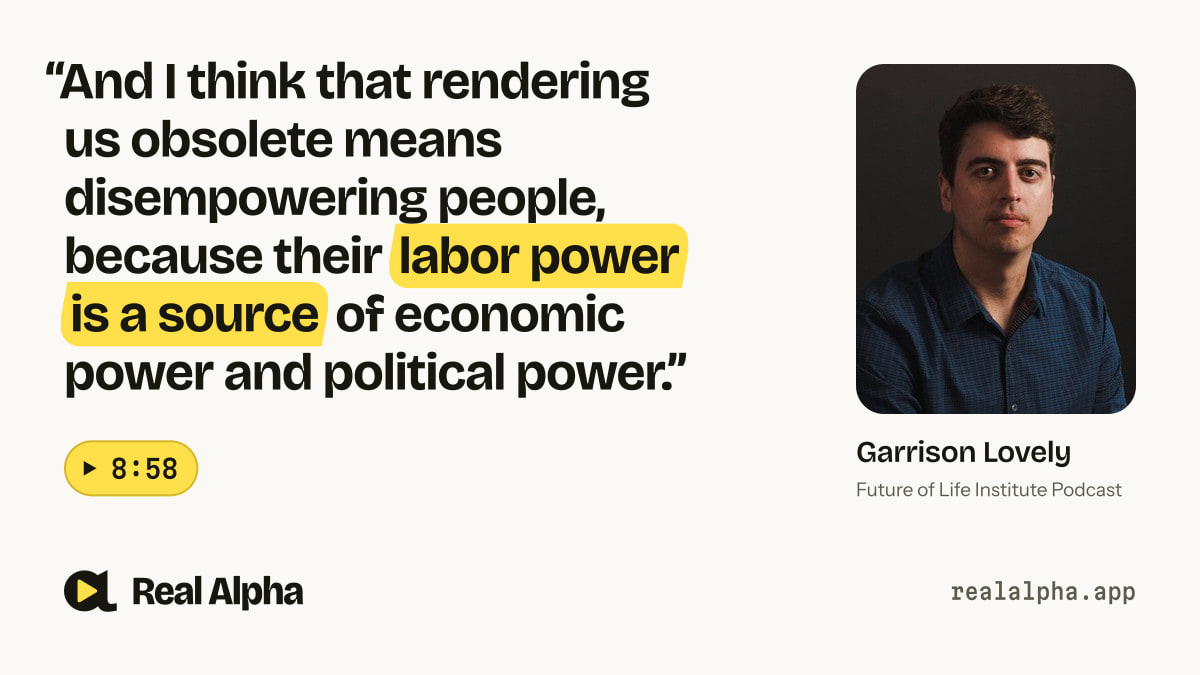
“And I think that rendering us obsolete means disempowering people, because their labor power is a source of economic power and political power.”
 Garrison Lovelyat 8:58 · Future of Life Institute Podcast
Takeaways
- Labor gives workers leverage, including through collective action.
- Replacement could concentrate power among owners of capital.
- Lovely calls for safety and informed public consent before development.
About this segment
Garrison Lovely argues that work gives people economic and political leverage, and that replacing workers could weaken a key check on power. He says development should require public buy-in and a case for how people benefit.

Garrison Lovely is author and journalist.
Wrote Obsolete on AI's race to replace human labor and reported on the political economy of artificial intelligence.
- GD
Gus Docker, Host · Host, Future of Life Institute Podcast
From “The Trillion-Dollar AI Race to Replace Us (with Garrison Lovely)”, Oct 13, 2026. Watch the full episode
Answers “Should AI be regulated?” See all 51 answers
Thanks. We'll look at and fix what's off.
Transcript
Transcribed by machine (Whisper) from the episode’s audio, so a word may be off here and there.
- 8:17
what they say and the way they behave and the amount of money that's going into this and i think it's a pretty clear picture now one could object what's so bad about being obsolete in the economic sense what is so bad about being sort of a child for example or being a pensioner being someone who doesn't work but there are many examples of of people who do not work in our society that are still living great lives and why can't we all end up in that situation maybe eventually if you really trust the people in power um and you trust the democratic processes to take care of everybody you could have some kind of like species-wide retirement um that people are like opting into in this meaningful sense um i don't trust the people running the world right now to do this or our institutions as you mentioned to be to be able to handle it
- 9:10
And I think that rendering us obsolete means disempowering people, because their labor power is a source of economic power and political power. And so if people lose that because they are replaceable, then you lose it. mechanism of democratic accountability. And, you know, there's very scary things within that too, beyond the big picture. It's just like, you know, if soldiers are rendered obsolete, because you have lethal autonomous weapons that can be directed by a single individual to kill protesters, then one of the key ways that dictatorships have historically fallen is taken off the board. And that's also on the table. And the US federal government has expressed strong interest in pursuing those types of technologies. And yeah, so I think about who's in charge right now. But also, this would just be an incredibly difficult thing for any society to
- 10:07
handle. And I think it's kind of like if we play our cards right as a species, we can have some AGI as a treat, where it's like, yeah, we are consciously opting to do this so we can have lives of leisure and abundance and whatever. But I think that's why we should condition development of it on not just having a scientific consensus that it can be done safely, but also by having strong public buy-in that it's what people actually want. And that would force the developers, the proponents of building it to make their case and then explain how people will be better off as a result of being rendered obsolete.