The alpha, twice a week
That was 8 min.
Get the best new moments in your inbox every Wednesday and Saturday. It's free.
Check your inbox
We sent a link to your address. Click it to finish signing up. Not there in a minute? Look in spam.
or
80,000 Hours Podcast · 8 min · Aug 11, 2026
A training pause could leave plenty of room for economic growth
 Geoffrey Irving
 argues governments should prepare to slow frontier AI development, even if a pause is imperfect.
The episode’s best minutes
Full analysis- 12:22Good behavior on one task may not generalize to another3 min
- 21:00Debate can reward arguments that sound true but are falsePro pick 4 min
- 31:27A training pause could leave plenty of room for economic growth8 min
- 5 more moments in the full episode
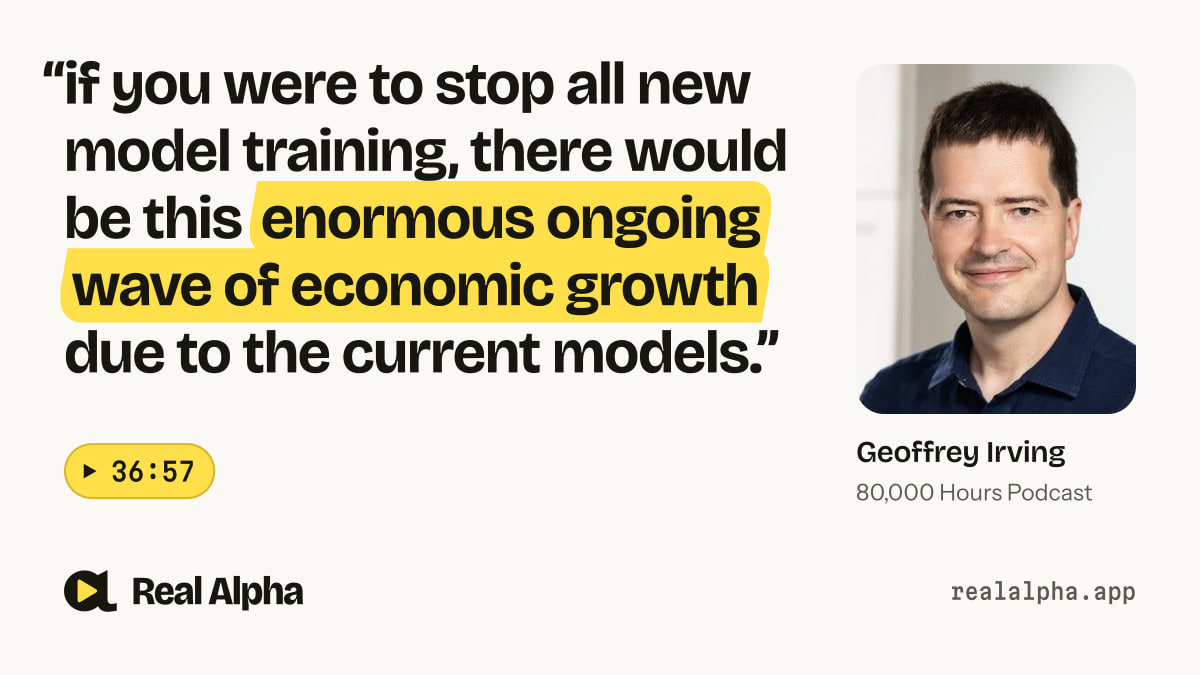
“if you were to stop all new model training, there would be this enormous ongoing wave of economic growth due to the current models.”
 Geoffrey Irvingat 36:57 · 80,000 Hours Podcast
Takeaways
- He thinks governments should pursue both defensive work and slowdowns.
- Current AI models have not yet been fully adopted across the economy.
- A pause could trade faster progress for time to improve safety.
About this segment
Geoffrey Irving argues governments should prepare to slow frontier AI development, even if a pause is imperfect. He says current models are underused and could drive substantial growth while safety work catches up.

Geoffrey Irving is cofounder and chief scientist of Resolution.
Led alignment teams at OpenAI and DeepMind; now co-founded Resolution to research confidence in aligned superintelligence.
- TR
Tom Reed, Host
From “We have 3 years to solve alignment before superintelligence”, Aug 11, 2026. Watch the full episode
Answers “Should AI be regulated?” See all 145 answers
Answers “Will AI boost economic growth?” See all 34 answers
Thanks. We'll look at and fix what's off.
Transcript
Transcribed by machine (Whisper) from the episode’s audio, so a word may be off here and there.
- 31:30
What do you think is the role of governments in this world? Resolution is doing its work. At what point might they need to step in? What might they need to do? So I think there's a couple of different levels of kind of government action you could imagine. Any government can do a bunch of unilateral defensive work. So you can work on defenses for bio or cyber or even persuasion potentially. So that defensive work can be done.
- 32:00
But any government kind of unilaterally, and it's kind of good to do. Then there's kind of last-minute temporary pauses where it's like, oh, we're really close to training this really dangerous model. Let's chill out for just a few months and kind of shift resources towards kind of from capabilities to safety, try to slow down a little bit, try to like just dial up all the knobs that we can to kind of in the direction of safety on the margin.
- 32:24
That also means you could, for example, use algorithms which are a significant but not kind of like a fatal capability, like a cost hit, like something that's like 2 to 10x slower. Maybe you can run that in this kind of temporary pause world. And then the more extreme thing is you have a broader treaty where you try to do a longer coordinated slowdown or pause across kind of multiple countries. I think governments should be trying to do all of these things, and then we'll see how far up the scale we can go.
- 32:54
I think a critical thing there is that I do think we may be in worlds where the algorithms that work are, as I mentioned, like slower and more expensive. The algorithms and the algorithms that don't work. Or you need to dial up. Don't work for alignment, that is. For alignment. Yeah. And you need to dial up either the amount of data or like do an algorithm pivot or something. And that, if you're in pure mad race between the various labs, that's hard to do.
- 33:21
Yeah. And even a little bit of government kind of coordination pressure could make the difference in those worlds. When do you think would be the right time to slow down? Yeah. Right now? Now. So I think like my take is that if we were to carefully analyze this question of like exactly when we should slow down, it would be like a while ago in the past because like we're just too close to this crazy future.
- 33:44
So I think the trying to kind of be super precise about like exactly when in the future. No, no, no, no. like like already is the is the answer i think what whether we can achieve that is is less clear because there's like there's political will on the overton window and so on but like that would be my kind of stock answer is like now to in the past and and can any should you think any one actor should unilaterally slow down like i so i i think that's that's hard it is the case though that like there may be only you could probably find a list of less than 10 people in the world where if you could get them to degree to slow down, you could do it.
- 34:23
So it's not some extremely enormous impersonal sea of people you have to get to coordinate. It's like lab CEOs, potentially people in China, leaders of a couple of countries. You don't get to that many people. And so I think that if a – the question is like if a lab did a unilateral slowdown, how much closer to that less than 10 people did you get and potentially a lot closer because you've kind of made a stand.
- 34:57
That said, like, none of the lab CEOs want to hear that argument. They only want to do the non-unilateral things. And there's some argument in that direction, but it's also a very kind of convenient argument. What do you think we should actually be slowing down? Is it the R&D itself? Is it like inputs to R&D, like chips, chip production? Is it deployments? What are we actually slowing down? So mostly I don't have like a super cast answer to the optimal here.
- 35:23
There's a general thing where we will not, I think, have the ability to kind of like stop progress. So if you try to slow down or you try to like have a pause or the like, you will be slowing progress. But then progress will be continuing. And I am, as mentioned, worried enough that we're close to this kind of ASI future that we get there not too long, even with a slowdown. exactly kind of what the ingredients should be to intervene on.
- 35:50
I think, as you say, probably the answer is all of them would be good. But I don't think I have a Cooper-Cast good answer. Yeah, I mean, I guess one thing I don't quite understand is how— How do you slow down in a way that affects the different actors in any kind of way equivalently? So especially if we're Chinese labs, we're also asking them to slow down. It seems difficult to be sure that they're slowing down in the same way that Anthropic or OpenAI are slowing down.
- 36:12
I think a certain degree of imperfection is required here. So you have to be comfortable with measures that are not going to exactly be fair across all the labs. And so presumably what you need is a combination of tactical measures. So, like, tactical supervision and monitoring, but also, like, if you wanted to do, like, the grand international treaty, then you need kind of human audits as well and inspections and so on.
- 36:38
But it will not have an exactly matched impact on every actor. And I think we just have to be okay with that as, like, slightly disparate results. And do we also just have to be okay with any kind of, like, economic implications? It seems like so much of the global economy is like it's leveraged on there being continued AI progress. Like is that just a hit you're willing to take? I think my take is that if you were to stop all new model training, there would be this enormous ongoing wave of economic growth due to the current models.
- 37:07
That I think if you just take that, it's enormous in terms of like positive benefit, in terms of getting valuable use out of models. You have to do then, you have to learn how to work with the current models. But I think we're in a massive product overhang. We have worked only a little bit on how to kind of cater to the strengths and weaknesses of models. The models of June 2026 are just incredibly good at software engineering in huge numbers of ways, even kind of before the most recent models in the last couple months.
- 37:39
And so I would be fairly unconcerned with that world. It is a tradeoff. Like I think that if you get stronger models, they can do more things better and probably cheaper. So there's a trade-off there. But I think I would much prefer having time to nail down more of the safety story for both alignment and other risks than just massively rolling dice. What is it that gives you so much confidence? We have a high product overhang.
- 38:10
So if it's not already showing up in growth statistics, what are the metrics where you're like, oh, no, but like look at this thing. is already very useful. It will lead to lots of economic growth. I think there's so much use of coding systems in particular. And I think that extends already to huge amounts of other kinds of cognitive labor, like any kind of analytic analysis of business. The things people can already do with models are so impressive that it is extremely unlikely to me that that has seen kind of full adoption across the economy.
- 38:49
Anecdotally, both from myself playing with models and then just reading a lot about what people are doing, there is a massive learning curve to how to best deploy these models into any particular area of activity. So I learn better how to use them across time. So does everyone else. If we just were to stop for even 10 years, It would still keep climbing. Again, I would be totally lying if I said there wasn't a tradeoff here.
- 39:17
Stronger models are, in fact, better at doing lots of things, but I would prefer that tradeoff.