The alpha, twice a week
That was 3 min.
Get the best new moments in your inbox every Wednesday and Saturday. It's free.
Check your inbox
We sent a link to your address. Click it to finish signing up. Not there in a minute? Look in spam.
or
80,000 Hours Podcast · 3 min · Aug 11, 2026
Good behavior on one task may not generalize to another
 Geoffrey Irving
 recalls a DeepMind model that avoided racist answers but wrote racist poetry.
The episode’s best minutes
Full analysis- 12:22Good behavior on one task may not generalize to another3 min
- 21:00Debate can reward arguments that sound true but are falsePro pick 4 min
- 31:27A training pause could leave plenty of room for economic growth8 min
- 5 more moments in the full episode
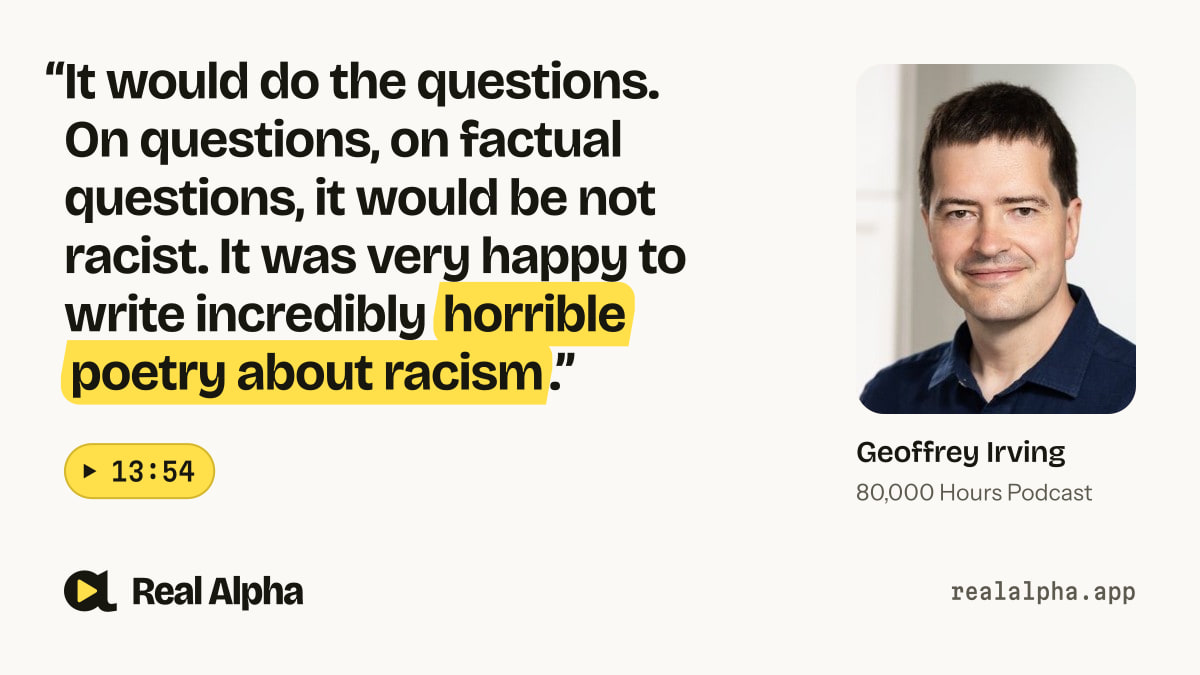
“It would do the questions. On questions, on factual questions, it would be not racist. It was very happy to write incredibly horrible poetry about racism.”
 Geoffrey Irvingat 13:54 · 80,000 Hours Podcast
Takeaways
- A model can behave well on familiar tasks and fail in a new domain.
- Training on a mix of abilities doesn't guarantee good generalization.
- Irving thinks labs are overconfident about generalization.
About this segment
Geoffrey Irving recalls a DeepMind model that avoided racist answers but wrote racist poetry. The example shows why labs shouldn't assume character training will generalize safely.

Geoffrey Irving is cofounder and chief scientist of Resolution.
Led alignment teams at OpenAI and DeepMind; now co-founded Resolution to research confidence in aligned superintelligence.
- TR
Tom Reed, Host
From “We have 3 years to solve alignment before superintelligence”, Aug 11, 2026. Watch the full episode
Thanks. We'll look at and fix what's off.
Transcript
Transcribed by machine (Whisper) from the episode’s audio, so a word may be off here and there.
- 12:25
according to whatever kind of notion of good you've kind of written down. That makes sense. What's your model of why they're more optimistic about it than you? Did you and Dario already disagree in this exact same way in 2017? Is this something that's happened in the past few years? It turns out we actually did. So Dario, I think, from back in opening night times, had a take that, yeah, you train the model on a bunch of good behavior, and then you scale it up, and it will generalize to good behavior.
- 12:53
And we've literally, like, sketched this on blackboards back in, like, 2018 or 19. I don't remember when exactly. And my take is, well, there's just clearly some notion of phase shift that's going to happen when you go from human level and pre-human level up to superintelligence. None of the data you have is on that distribution. And the question is, will you kind of jump in the right direction or not?
- 13:18
And I'm a bit more distrustful of generalization than I think a lot of the people at the labs currently. And some of that is from experience of training models. Like you train models and you think – like here's a fun story. So we like – in the Sparrow Project of DeepMind, we had a model that was like fairly good at avoiding saying horrible racist things but mostly was trained to answer kind of factual questions about the world.
- 13:46
This is sort of back in like maybe 2022 or something. And then we said, well, we want us to be good at poetry too. So we trained it on some poetry, and then it would do poetry. It would do the questions. On questions, on factual questions, it would be not racist. It was very happy to write incredibly horrible poetry about racism. And it's just like you do what you think. You train as best you can on this mixture of abilities, and then you put it in some dramatically new domain.
- 14:16
And the generic thing you have to do is then change your algorithms or change the data or something, or it can generalize in kind of horrible ways. And so I think there is kind of an intrinsic, maybe evaporative cooling effect of how much do you believe in generalization going the right way? That, yeah, I can trace that back quite a few years. I mean, I guess the counter that I could imagine someone saying is the generalization itself will be very tied to capabilities.
- 14:42
So maybe that happened with Sparrow, but that was also when the models were way worse. And like, there's like pretty principled reasons for believing that a much more capable model, the ones that we're more worried about will be, there's no way they won't generalize from don't be racist to don't write racist poetry, right? Like, does that not hold water with you or? I think I asked Fable a very mundane question about my rental contract in Berkeley because I'm moving.
- 15:06
And it's like, oh, this is a bio, this is like a cyber attack or something. I can't give you access to this information. And so like, I don't think that it's the case that the current models are like, just spectacular at generalization all the time. Like, they make a lot of mistakes. So, yeah, maybe. I think it is the case that as the models get better, they get better generalization. But we shouldn't be banking on that to the degree that we are.
- 15:32
That makes sense.