The alpha, twice a week
That was 2 min.
Get the best new moments in your inbox every Wednesday and Saturday. It's free.
Check your inbox
We sent a link to your address. Click it to finish signing up. Not there in a minute? Look in spam.
or
In Good Company with Nicolai Tangen · 2 min · Oct 28, 2026
Ackman sees founder control as useful but prefers one share, one vote
 Bill Ackman
He credits founder control with enabling long-term decisions but flags succession and weaker shareholder checks.
In this episode
Full analysis- 41:04AI could help restore lost brain function3 min
- 13:41AI will commoditize intelligence and expand entrepreneurship3 min
- 32:43Engagement-driven social media can deepen divisionPro pick 5 min
- 8:59Pershing Square pays its investment team on portfolio results3 min
- 16:31Pershing Square’s reputation changed how CEOs receive its activism3 min
- 23:16Ackman sees founder control as useful but prefers one share, one vote2 min
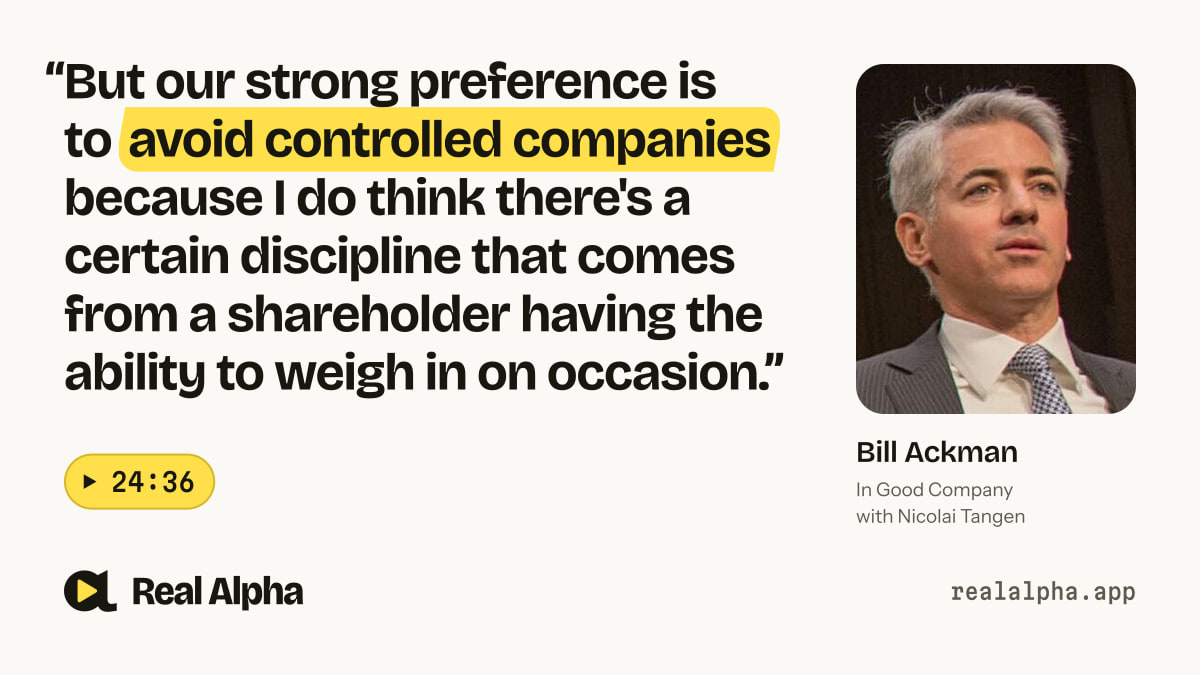
“But our strong preference is to avoid controlled companies because I do think there's a certain discipline that comes from a shareholder having the ability to weigh in on occasion.”
 Bill Ackmanat 24:36 · In Good Company with Nicolai Tangen
Takeaways
- Founder control can protect long-term decisions from short-term pressure.
- He worries about passing control to the next generation.
- Business quality matters more than CEO quality if management can be replaced.
About this segment
He credits founder control with enabling long-term decisions but flags succession and weaker shareholder checks. Pershing Square generally prefers one share, one vote, making exceptions for exceptional CEOs.

Bill Ackman is founder and CEO of Pershing Square.
Founded and runs Pershing Square, an activist investment firm; executive chairman of Howard Hughes Holdings.

Nicolai Tangen, Host · CEO, Norges Bank Investment Management
From “Bill Ackman: Is Permanent Capital an Investor’s Biggest Edge? | Podcast | In Good Company”, Oct 28, 2026. Watch the full episode
Thanks. We'll look at and fix what's off.
Transcript
Transcribed by machine (Whisper) from the episode’s audio, so a word may be off here and there.
- 23:20
just now um you're referring to companies going uh spacex going public for example those kind of things, with fewer rights to the shareholders, voting rights, ability to, you know, appoint boards, these kind of things? I think the, you know, if you look back, I'm a big believer in founder-controlled companies in terms of their ability to make smart long-term decisions. I mean, the problem of a market that's become increasingly short-term, the company is not a controlled business.
- 23:52
You know, CEOs feel pressure to do things to make the numbers, if you will, in the short term that can diminish the long-term value of the business. And what, you know, we've got if Warren Buffett or Sam Walton or I would argue Elon Musk, you know, in control of the company, you know, I view that generally is a very good thing. But I don't know about the next generation. What you don't want to happen is, you know, the next, you know, Elon Musk's, I don't know whether his son or daughter, you wouldn't want that person handed the control that the parent has.
- 24:26
I like one share, one vote. We generally don't like to invest in controlled companies. But if the controlling shareholder is a phenomenal CEO, then I can be comfortable investing in a controlled business. But our strong preference is to avoid controlled companies because I do think there's a certain discipline that comes from a shareholder having the ability to weigh in on occasion. what makes a good ceo i would say uh passion intelligence energy um you know an overall uh and you know good leadership qualities people want to follow that person and uh to the end how do you assess how important part of the equation is it when you invest it's less important to us generally i would say the business quality growth durability are the most important factors. If it's the wrong CEO, we can play a role in recruiting a better
- 25:27
one. So it's less important to us. Of course, we prefer a great business with a phenomenal CEO, but that doesn't happen that often at an attractive price. Usually, it's a great