The alpha, twice a week
That was 3 min.
Get the best new moments in your inbox every Wednesday and Saturday. It's free.
Check your inbox
We sent a link to your address. Click it to finish signing up. Not there in a minute? Look in spam.
or
In Good Company with Nicolai Tangen · 3 min · Oct 28, 2026
Pershing Square’s reputation changed how CEOs receive its activism
 Bill Ackman
 says reputation shifted activism from proxy fights to direct CEO access.
In this episode
Full analysis- 41:04AI could help restore lost brain function3 min
- 13:41AI will commoditize intelligence and expand entrepreneurship3 min
- 32:43Engagement-driven social media can deepen divisionPro pick 5 min
- 8:59Pershing Square pays its investment team on portfolio results3 min
- 16:31Pershing Square’s reputation changed how CEOs receive its activism3 min
- 23:16Ackman sees founder control as useful but prefers one share, one vote2 min
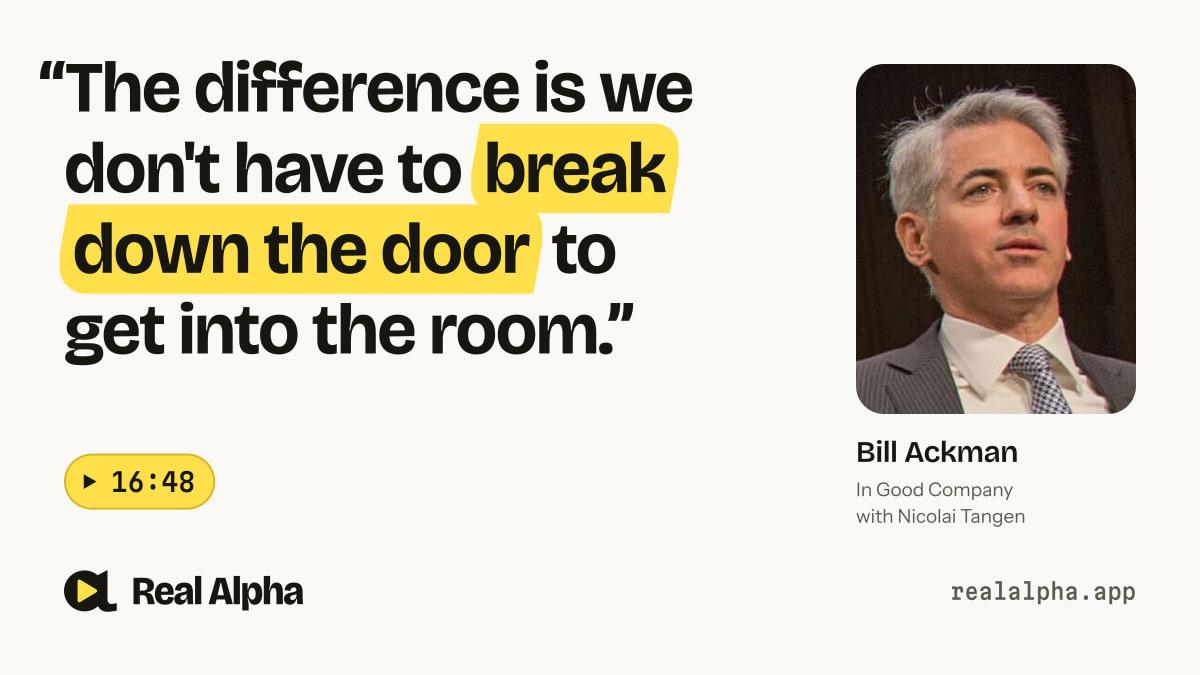
“The difference is we don't have to break down the door to get into the room.”
 Bill Ackmanat 16:48 · In Good Company with Nicolai Tangen
Takeaways
- Pershing Square’s last activist campaign launched in 2016.
- CEOs now often welcome Pershing Square as a shareholder.
- Volatile markets can briefly discount durable businesses.
About this segment
Bill Ackman says reputation shifted activism from proxy fights to direct CEO access. He now sees short-term market dislocations as openings to own durable businesses without demanding much change.

Bill Ackman is founder and CEO of Pershing Square.
Founded and runs Pershing Square, an activist investment firm; executive chairman of Howard Hughes Holdings.

Nicolai Tangen, Host · CEO, Norges Bank Investment Management
From “Bill Ackman: Is Permanent Capital an Investor’s Biggest Edge? | Podcast | In Good Company”, Oct 28, 2026. Watch the full episode
Thanks. We'll look at and fix what's off.
Transcript
Transcribed by machine (Whisper) from the episode’s audio, so a word may be off here and there.
- 16:36
now you are known as an activist investor you know buy stakes and force them to to change but you don't do that all the time i used i used to be known sure so tell me what what well why were you an activist investor then and why are you not so active now I think we're very active now. The difference is we don't have to break down the door to get into the room. Right. Is that because you are older and nicer?
- 17:02
I think a couple of things have happened. One, activism in the early days was not something taken very seriously, and you had to literally break down the door. As activism became more successful as a strategy, as we built our own reputational equity, as I got to know every CEO in America, people realized, you know what, these guys are actually thinking about the long-term interests of the owners of the company.
- 17:20
investors in the business the employees you know what they they behave themselves on boards of directors they can add significant value why don't we just work with them and be open to their ideas as opposed to having to run proxy contests and i think so our last activist investment we launched in 2016 a decade ago that's actually about the 10th anniversary of that of that investment and today we buy a stake in the business and we generally get a thank you note from the CEO for taking a stake, which is a very different message that we got years ago.
- 17:52
We might not even have gotten a return phone call. And that enables us to be a helpful investor. The only thing I think that's happened in terms of market dynamics, it used to be that a really high-quality business that somehow disappointed the stock might drop 3% or 4% to the stock could drop 30% or 40% on a miss. And I think that's driven by the increasing kind of indexation, which is reducing float, and the increasing amount of leveraged short-term capital invested in markets that is creating a lot more volatility.
- 18:22
And what that has done is it's made the occasional amazing high-growth durable company available at a discounted price for a period of time based on a short-term disappointment. So our portfolio today is filled with businesses where we have enormous respect for the people running them. They don't need much in the way of an activist. We're happy to be a quiet owner that occasionally has an idea. Do you think it's something that happened with you as well?
- 18:47
In what sense? Either with age or becoming part of the establishment or just somehow becoming a nicer person or wealthy or I don't know. I've always been a nice person. The media may have portrayed me as otherwise. But look, I'm the generation of people that are running many sort of businesses. I know every CEO in America either directly or one person removed. And so, you know, it's pretty easy to get a read on what we're like as owners, as shareholders.