The alpha, twice a week
That was 4 min.
Get the best new moments in your inbox every Wednesday and Saturday. It's free.
Check your inbox
We sent a link to your address. Click it to finish signing up. Not there in a minute? Look in spam.
or
Bloomberg Surveillance · 4 min · Oct 30, 2026
Affordability needs structural fixes, not quick promises
 Natasha Sarin
 says housing, child care and elder care costs need long-term solutions rather than quick fixes.
The episode’s best minutes
Full analysis- 1:00AI debt is running into limits on market capacity2 min
- 8:36AI spending creates risks for markets and the Fed7 min
- 25:50Affordability needs structural fixes, not quick promisesPro pick 4 min
- One more moment in the full episode
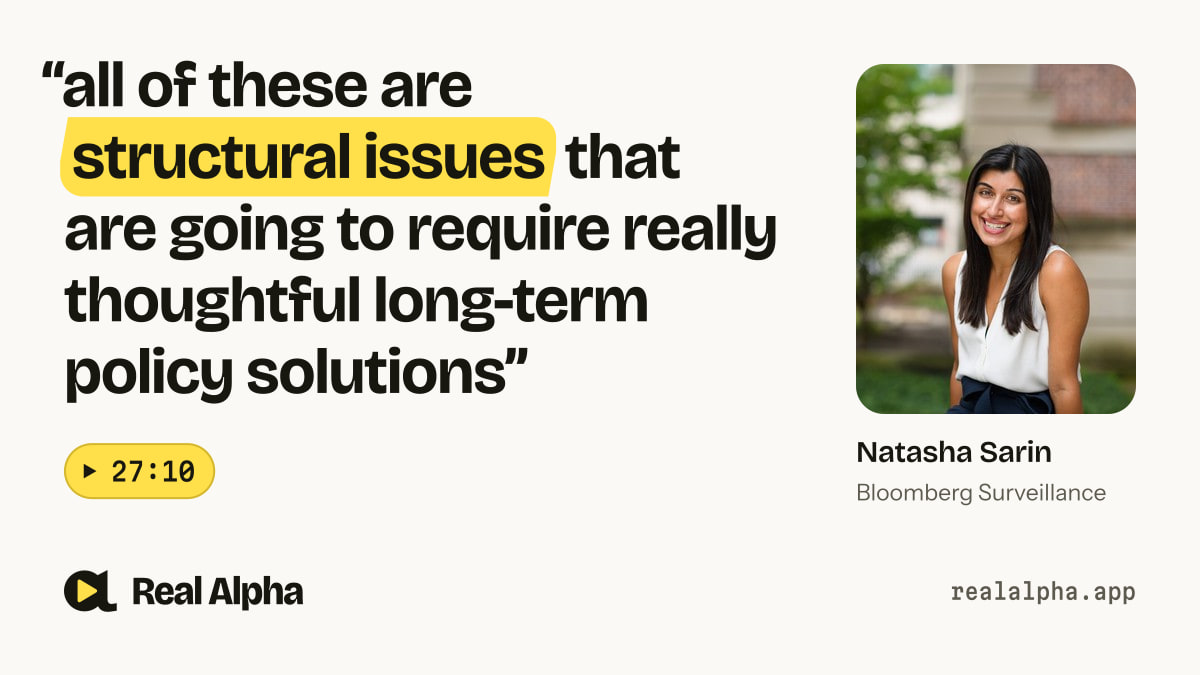
“all of these are structural issues that are going to require really thoughtful long-term policy solutions”
 Natasha Sarinat 27:10 · Bloomberg Surveillance
Takeaways Pro pick
- Cost of living is a central concern across political groups.
- Housing and care costs are structural problems, not quick fixes.
- Taxing the largest profitable companies could raise hundreds of billions.
One of Pro's picks, open to you here. Try Pro free for 7 days
One of Pro's picks. The rest of the summary and the 3 takeaways are in Real Alpha Pro; the video, the quote and the transcript stay free.
Read it with Pro, 7 days freeAbout this segment
Natasha Sarin says housing, child care and elder care costs need long-term solutions rather than quick fixes. She also argues that higher corporate taxes on the largest firms could raise substantial revenue.

Co-founder, Yale Budget Lab
Focused Treasury work on closing the tax gap and co-founded Yale’s nonpartisan Budget Lab.
- TK
Tom Keene, Host
- PS
Paul Sweeney, Host
From “Markets Price in Tech Spending and Midterm Elections | Bloomberg Surveillance”, Oct 30, 2026. Watch the full episode
Thanks. We'll look at and fix what's off.
Transcript
From the transcript Bloomberg Surveillance publishes with the episode.
- 25:53
It kind of goes to the issue, Natasha, as we get ready for midterm elections next week, that once again, it's probably it's the economy, stupid. And I guess this year's format of that or a version of that is just affordability and inflation and all that kind of stuff. How do you think about that for the average household out there?
- 26:12
Yeah, it's so important because if you ask people about how they are thinking about approaching their vote in the election next week, cost of living issues are like so front of mind for every person, essentially, no matter what their political affiliation is. And by the way, 2024 was a cost of living election, which Donald Trump won in large part because people were frustrated by inflation. And he said, I'm going to lower prices on day one. We have another one in these midterms and I speculate we're going to have another one in 2028. I have a piece actually that I wrote for The Times last week where I argued that I'm a little nervous about the idea that you have politicians who are trying to come up with like quick fixes and to affordability, things like cut prices on day one or rent freezes, when the reality
- 27:06
is that things like housing, child care, the cost of elder care in this country, all of these are structural issues that are going to require really thoughtful long-term policy solutions to. Try to address. And so I think we need to think seriously about dealing with this issue of economic precarity, the feeling that You know, I feel like one potential crisis away from being off the brink.
- 27:31
Natasha Sarin, as we look at the fancy people, what they're paying in tax, I would say what's less spoken of because it's not so visceral with our audience, Natasha, is corporate income tax in the 1960s, 4% of GDP tax. craters with Reagan down to 1.5% of GDP. And even today, well under 2% of GDP. Is that a solvable fix? I mean, Exxon today, what? More money than God, $ 20 billion share buyback. Solvable.
- 28:04
This is so solvable and so important. And by the way, if you want to tax the rich, a really good way to do that is by doing a better job of taxing. The companies that they own. And I have this view that essentially you're absolutely right on what's happened to the corporate tax over the course of the last few decades. And even just in the last decade, you saw the corporate tax rate in this country go down from 35 to 21 percent, even though corporations, they were actually asking for 25. So they got more than they had even aspired for as a result of legislation passed in the first Trump administration.
- 28:39
Right. I think there's so much revenue there because these are massive, hugely profitable companies. And by the way, we can leave the rate in place for 98% of companies.
- 28:49
Okay, but I got to get this in before the market opening. Can I ask an Ernie Tedeschi question? Like a nerd question. Can we garner more corporate tax efficiently and fair without messing with a lot of people?
- 29:09
We definitely a thousand percent can. And it's just about the top two percent of the most profitable largest multinationals you can raise on the order of hundreds of billions of dollars over the course of the next decade.