The alpha, twice a week
That was 7 min.
Get the best new moments in your inbox every Wednesday and Saturday. It's free.
Check your inbox
We sent a link to your address. Click it to finish signing up. Not there in a minute? Look in spam.
or
Bloomberg Surveillance · 7 min · Oct 30, 2026
AI spending creates risks for markets and the Fed
 Darius Dale
 says his signals have turned risk-off as investors weigh AI spending, election risks and inflation.
The episode’s best minutes
Full analysis- 1:00AI debt is running into limits on market capacity2 min
- 8:36AI spending creates risks for markets and the Fed7 min
- 25:50Affordability needs structural fixes, not quick promisesPro pick 4 min
- One more moment in the full episode
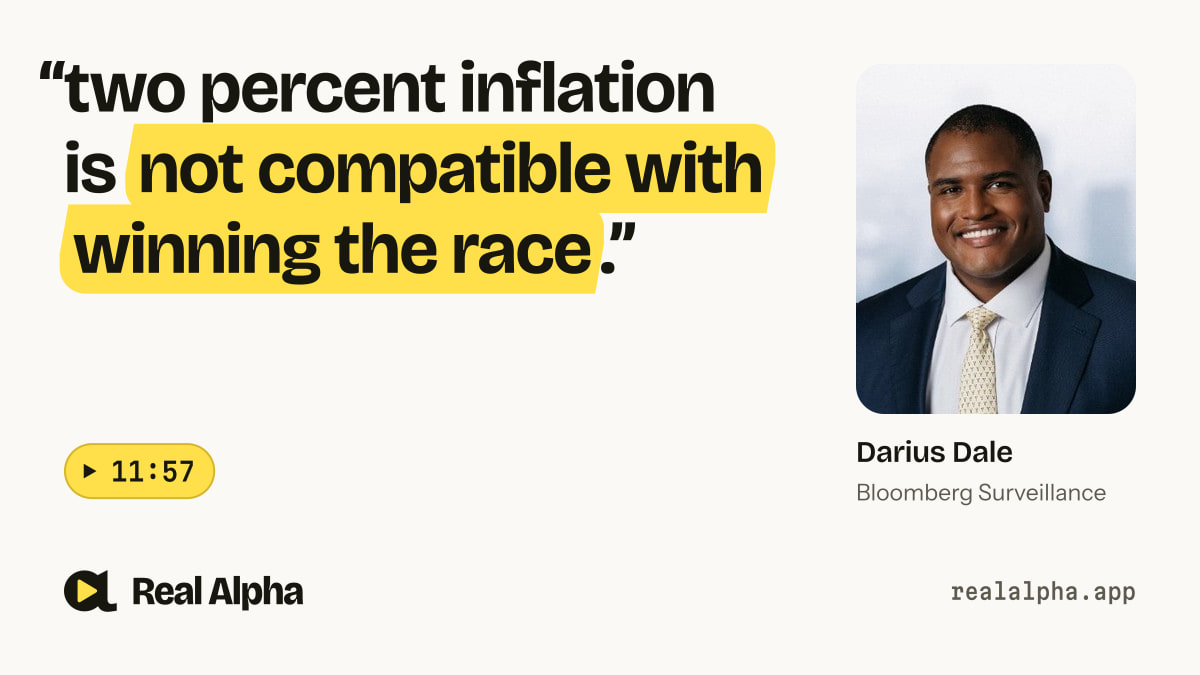
“two percent inflation is not compatible with winning the race.”
 Darius Daleat 11:57 · Bloomberg Surveillance
Takeaways
- His signals turned risk-off and favor quality over high beta.
- Election outcomes could spur political resistance to AI spending.
- He sees a 60/40 portfolio working only in a deflationary regime.
About this segment
Darius Dale says his signals have turned risk-off as investors weigh AI spending, election risks and inflation. He recommends reducing beta and says a 60/40 portfolio needs a deflationary regime to work.

Founder & CEO, 42 Macro
Built 42 Macro, an independent research boutique delivering systematic macro risk-management insights to investors.
- TK
Tom Keene, Host
- PS
Paul Sweeney, Host
From “Markets Price in Tech Spending and Midterm Elections | Bloomberg Surveillance”, Oct 30, 2026. Watch the full episode
Thanks. We'll look at and fix what's off.
Transcript
From the transcript Bloomberg Surveillance publishes with the episode.
- 8:39
With this market? We've got a huge week of earnings. We heard from the Federal Reserve. The market's at or near all-time highs within 2% or 3%. It feels like there's some angst out there, particularly as it relates to the AI story. What are the conversations you're having with your clients these days?
- 8:57
Thank you for that pivot. We've been having a conversation with our clients for the last month or so. Our quant systems pivot us to a risk-off-market regime, which is a signal to our clients across the global buy side to take down their gross and tighten their net exposure. go up in quality, up in size, lower in beta. And that's what they've been doing for the last month. And we're starting to see this kind of cascading sequence of one pod takes it down, the other pod takes it down. And so we're really concerned about that spiraling out of control with such a salient catalyst as next week.
- 9:25
We don't have any ability to predict what's going to happen in the elections. All we can do is read and react to our signals. And Our signals are suggesting that the risk of a blue wave triggering a response in the Republican Party to get on board with anti-AI is actually rising.
- 9:41
I look at this, and this morning I'm looking at Amazon tanking. Two days in a row, folks, NASDAQ futures now down a whopping 2.5%. NASDAQ on futures down 8% plus over the last number of days. Joe Feldman over at Telsey says Amazon is a robust, solid, strong future. How do you as an investment guy get beyond the panic to some sell side report that says climb on board now? How do you do that exercise?
- 10:11
Well, as a business owner, we obviously forecast our revenue, cash flows, et cetera. And I have no ability to forecast my cash flows in 2029. So when I see reports like Oracle saying they're going to be free cash flow positive in 2029, not understanding the amount of demand for compute that we're going to have in the economy from companies like mine that need to purchase it, to me, it raises an eyebrow. One thing that also raises an eyebrow as it relates to this broader AI thing in the political cycle is next week, we have not just the actual midterm elections in the 36th gubernatorial elections, which could be a really negative catalyst in terms of slowing growth rate of all the AI CapEx. There's another catalyst that I don't think enough people are talking about, but hopefully they will start to talk about, is there are
- 10:50
three wealth taxes on the ballot, California, Colorado, Washington. If those wealth tax. Votes go in a way that's obviously not favorable for Wall Street, you're going to have two catalysts that are negative. One catalyst is you're going to force billionaires to actually, you know, sell assets and raise cash that's negative for the But from a longer-term basis, in our opinion, we think that will be a signal for 2028. And you're going to get a signal that candidates will start to campaign on significant redistributive policies, which will challenge the free cash flow assumptions that hockey staked back to positive in 2028, 2029, and 2030.
- 11:23
What did you make of our Federal Reserve yesterday, Tom? It was all over it with his Fed watch on the Fed day. I was medicated. Yes, exactly. You were being kind. What did you take away from that?
- 11:38
So let's set the chairs condescending delivery aside because I think we're all getting tired of it.
- 11:43
The Federal Reserve. So said the gentleman. There was some massive shaking. Good morning, Robert Schiller.
- 11:55
So setting that aside, the Fed has an impossible dilemma right now because two percent inflation is not compatible with winning the race. if in fact the administration is being honest with us, that this is truly a national security imperative and not just a race to more corporate profits.
- 12:12
That's the single smartest thing I've heard on this conundrum, Paul, in months and months. There's a bigger picture here than Fed parlor game, if you will.
- 12:22
And this is why we think, you know, we do believe this market regime gets worse. And so ultimately you're going to see more credit spread. You're going to see multiples come down, but you have to buy this dip because we ultimately believe that Fed Treasury Scott Besant, Fed Chair Kevin Worshen, David Zervers from Jeffries, Spooze and Chartreuse. They're down there working on something. And in our opinion, we think it'll be a liquidity backstop next year.
- 12:43
Let's go back to the heritage of Yale economics here. I think of Edward Yardeni, the Cowles Commission, the giant James Tobin and all. Of course. Yale 101 is you inflate your way out of a debt crisis. You inflate your way out of an industrial. Policy, which is AI. Exactly. That's the only solution, right? 100%.
- 13:03
And so that, in our opinion, that's where we're headed. We think the markets aren't ready to price that risk in. We think the next trade, the current trade, is downshifting the growth expectations. We're at cycle highs for 2027 revenue and earnings growth. Right now, cycle highs heading into one of the most salient negative catalysts any of us has seen in our careers.
- 13:23
Our macro weather model currently views the positioning cycle as a meaningful headwind for asset markets. Am I selling here? What am I doing here?
- 13:33
Well, respectfully, we would have said to sell in September when our system's triggered risk off. But in our opinion, if you're fully invested here, you need to, at the bare minimum, downshift your beta, rotate into things that are less high beta, less cyclical, up in quality. In our opinion, we think there's going to be more spread, widening, more multiple compression before we get to a happy place.
- 13:53
How does. Anybody hedge AI, do you think, these days? Because it just feels like it's everywhere. I can't buy a utility stock for the safe dividend because they've run up on the AI trade here.
- 14:06
What do I do? My clients are going to kill me for saying this, but the long end of the treasury curve. You're talking about a risk-off deflation market regime, a Q4 2018-style scenario where the market, where the street goes, buy that. In our opinion, we think that risk is severely underpriced right now.
- 14:24
Does the 60-40 model work here? Based on the conversations we have in the studio, I'm not so sure it does because I don't hear a lot of people, Paul, saying price up, yield down on bonds. I don't know. I can get a 5% coupon on a 10-year. I'm sleeping soundly over that.
- 14:43
In our opinion, the 60-40 model does not work unless you get a risk-off. You need to have a risk-off sentiment in financial markets. You need to go into a deflation market regime. And right now we're in an inflation market regime. The only thing that'll get us into a deflation market regime is a slowdown in data center.
- 14:57
Get halfway there. If we have a disinflationary vector of some form. We don't. Some people, some people are predicting we will. That's a seismic shift if we get it right.
- 15:07
It's pretty good forecasting. We don't see any disinflation in the system right now. I heard a guest say we're going back to two percent inflation next year in Q2 because of the comps. But in order to get 2% inflation, you need to at least see some 2% prints on a three-month annualized, six-month annualized before you get there on a year-over-year basis. And we're still not seeing that when you look at CPI or PCE.
- 15:27
Derek Still, thank you so much. Particularly, thank you there. Stay with us. More from Bloomberg Surveillance coming up after this.